
Short Answer
21 Facts About Luna Moths
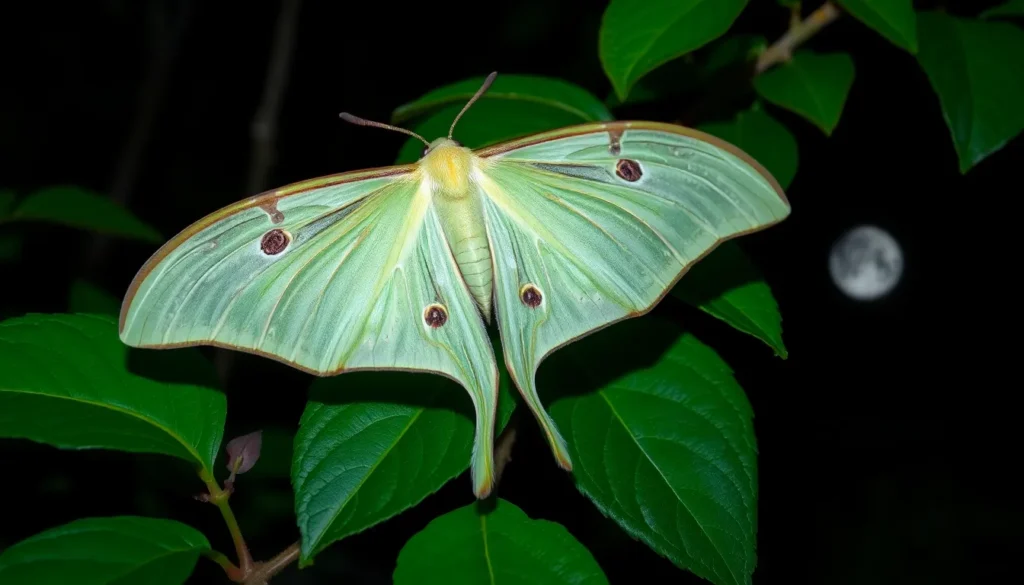
- Luna moths (Actias luna) are part of the Saturniidae family. This family is known as the giant silk moths, characterized by large wings and often striking colors.
- They have a wingspan ranging from 3 to 4.5 inches. This makes them one of the larger moth species in North America.
- Their wings are pale green with long, tapering tails. These tails are thought to help deflect echolocation from bats, a natural predator.
- Luna moths lack functional mouthparts as adults. As a result, they do not eat and survive only for about one week to reproduce.
- The adult luna moth’s primary purpose is reproduction. After emerging from the cocoon, they focus on mating and laying eggs.
- The caterpillars are large and green, feeding on several types of trees. Common host plants include hickory, walnut, sweetgum, and birch.
- The life cycle includes four stages: egg, larva (caterpillar), pupa (cocoon), and adult. The pupal stage occurs inside a silken cocoon spun among leaf litter.
- Luna moths are mostly nocturnal. They are active at night and attracted to light sources.
- The moths are native to North America. Their range extends from Canada to parts of the eastern United States.
- Luna moths use pheromones for mating communication. Females release specific scent signals to attract males over long distances.
- They have two eyespots on each hindwing. These spots may help deter predators by mimicking the eyes of larger animals.
- The moth’s lifespan as an adult is very short, typically about seven days. This brief period emphasizes their focus on reproduction rather than feeding or growth.
- Their green coloration provides camouflage among leaves. This helps protect them from predation during the day when they rest.
- Luna moths do not build nests or have social structures. They are solitary insects throughout their life stages.
- The species was first described scientifically by Carl Linnaeus in 1758. It remains a popular species for entomological study and observation.
- Predators include bats, birds, and small mammals. The moth’s unique wing shape and coloration help reduce predation risk.
- Climate and habitat changes can affect luna moth populations. Loss of host trees and pesticide use are concerns for their survival.
- They are not considered endangered but can be locally rare. Conservation efforts focus on habitat preservation.
- Luna moths have inspired cultural symbolism related to transformation and beauty. Their striking appearance often features in art and folklore.
- The moths are sometimes kept in captivity for educational purposes. Their life cycle is used to teach about metamorphosis and insect biology.
- Despite their beauty, luna moths play an important role in ecosystems as herbivores and prey. Their caterpillars help regulate plant growth, and adults provide food for nocturnal predators.
Habitat and Behavior
Luna moths inhabit deciduous woodlands and forests across much of eastern North America, from Canada down through the United States. They prefer areas where host trees such as hickory, walnut, sweetgum, and birch are abundant, as these provide food for their caterpillars. These moths are nocturnal and are usually active during the night, when they engage in mating and egg-laying behaviors. During the day, adult luna moths rest on tree trunks or foliage, relying on their green coloration for camouflage. Their lifecycle involves a complete metamorphosis, with the pupal stage occurring inside a cocoon crafted from silken threads and leaf debris on the forest floor. Luna moths do not feed as adults, living only a short time to reproduce before dying.
Why This Animal Matters
Luna moths serve several ecological functions. As caterpillars, they contribute to the control of foliage growth on their host trees, which can influence forest health and plant community dynamics. They are also an integral part of the food web, serving as prey for nocturnal predators such as bats and owls. Their presence indicates healthy woodland ecosystems, making them useful as bioindicators. Culturally, luna moths have been admired for their beauty and symbolic representation of transformation, often appearing in art and folklore. Although not endangered, their populations can be affected by habitat loss and environmental change, highlighting the importance of forest conservation for maintaining biodiversity.
Common Misconceptions
Misconception: Luna moths are harmless and do not have any predators.
Correction: Luna moths have natural predators including bats, birds, and small mammals. Their wing shape and coloration are adaptations to help evade predation.
Misconception: Luna moths live for several months as adults.
Correction: Adult luna moths live only about one week because they do not eat and focus solely on reproduction.
Misconception: Luna moths can bite or sting.
Correction: Luna moths do not have biting or stinging capabilities and are completely harmless to humans.
Misconception: The long tails on luna moth wings serve no purpose.
Correction: The tails help confuse bat echolocation signals, increasing the moth’s chances of escaping predation.
FAQ
Why do luna moths have long tails on their wings?
The long tails on luna moth wings help deflect echolocation signals from bats, confusing predators and increasing the moth's chance of escape.
Do luna moths eat as adults?
No, adult luna moths lack functional mouthparts and do not feed. They live only about a week, focusing on reproduction.
Where can luna moths be found?
Luna moths are native to eastern North America, inhabiting deciduous forests from Canada down through the United States.

Leave a Reply