
Short Answer
21 Facts About Flatworms
- Flatworms belong to the phylum Platyhelminthes. This phylum includes a variety of simple, soft-bodied invertebrates characterized by their flattened body shape.
- They lack a specialized respiratory and circulatory system. Flatworms rely on diffusion through their body surface to exchange gases and distribute nutrients.
- Flatworms have bilateral symmetry. Their body plan is symmetrical along one plane, allowing for a defined head and tail region.
- Many flatworms are hermaphroditic. They possess both male and female reproductive organs, enabling them to reproduce sexually in versatile ways.
- Some flatworms reproduce asexually through regeneration. They can regrow lost body parts, and in some cases, an entire new organism can develop from a fragment.
- The nervous system is simple but organized. Flatworms have a pair of cerebral ganglia (clusters of nerve cells) and paired nerve cords.
- Flatworms exhibit cephalization. They have a concentration of sensory organs and nerve cells in the head region, which aids in environmental sensing.
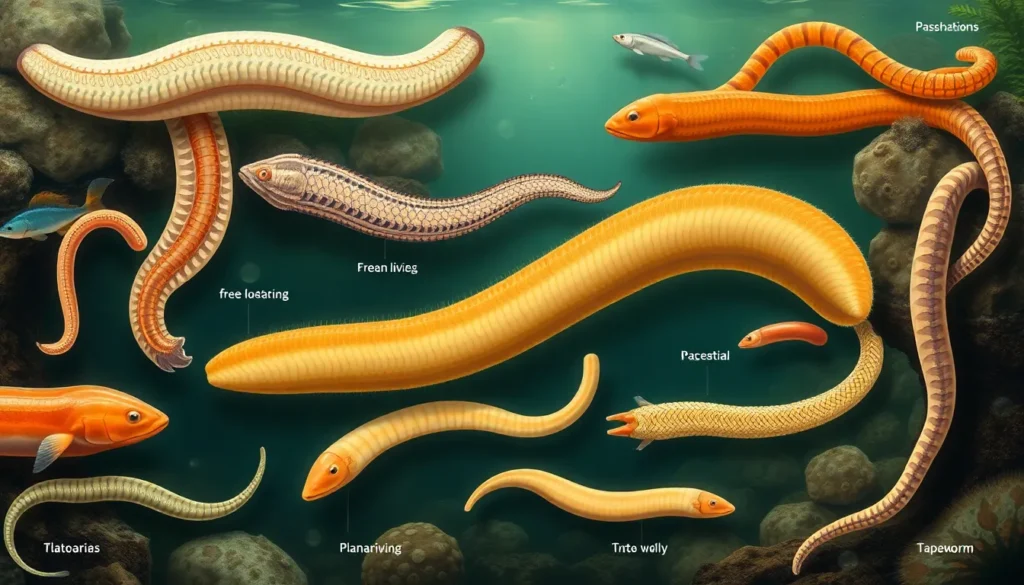
- Flatworms can be free-living or parasitic. Free-living species often inhabit freshwater or marine environments, while parasitic species live inside host organisms.
- Planarians are a well-known group of free-living flatworms. They are often studied for their regenerative abilities and simple nervous system.
- Tape worms are parasitic flatworms. They live in the digestive tracts of vertebrates and can grow to considerable lengths.
- Flatworms have a gastrovascular cavity with only one opening. This serves as both mouth and anus, limiting their digestive efficiency.
- They move using cilia or muscle contractions. Smaller flatworms glide over surfaces using tiny hair-like structures called cilia.
- Flatworms lack a body cavity (acoelomate). Their internal organs are embedded directly in solid tissue.
- Some flatworms exhibit remarkable camouflage abilities. They can blend with their environment to avoid predators.
- Flatworms are among the simplest animals with three embryonic germ layers. This triploblastic structure allows for more complex tissues and organs compared to simpler animals.
- They possess flame cells for excretion. These specialized cells help regulate water balance and remove waste products.
- Flatworms can detect light and chemical signals. Simple eyespots and chemoreceptors help them navigate their environment.
- The size of flatworms varies widely. Some microscopic species exist, while others, like certain tapeworms, can reach several meters in length.
- Flatworms are used in scientific research. Their regenerative capacity and simple body plan make them valuable models for developmental biology studies.
- Flatworms have existed for hundreds of millions of years. Fossil evidence suggests they appeared during the Cambrian period.
- Flatworms play important roles in ecosystems. Free-living species help control populations of smaller organisms, while parasitic species impact host health and population dynamics.
Habitat and Behavior
Flatworms inhabit a wide range of environments, including freshwater, marine, and terrestrial habitats. Free-living flatworms tend to favor moist environments such as pond bottoms, streams, and ocean floors, where they scavenge or prey on small invertebrates. Parasitic flatworms live inside host organisms, often in the digestive system, blood, or tissues. Their behavior varies by species; some glide smoothly using cilia, while others employ muscular contractions to move. Many are nocturnal or avoid light to reduce predation risk. Flatworms survive by absorbing nutrients either from prey or their hosts, and their simple body structure allows efficient diffusion of gases and wastes. Their reproductive strategies include both sexual reproduction and remarkable regenerative capabilities that enable survival and population maintenance.
Why This Animal Matters
Flatworms hold ecological significance as both predators and parasites, influencing the balance of aquatic and terrestrial ecosystems. By preying on smaller organisms, free-living flatworms help control populations and contribute to nutrient cycling. Parasitic flatworms impact the health and survival of various animal hosts, including humans and livestock, sometimes causing diseases that affect agriculture and public health. Scientifically, flatworms serve as important model organisms for studying regeneration, developmental biology, and evolutionary biology. Their simple anatomy and remarkable regenerative abilities provide insights into tissue repair and stem cell research. Understanding flatworms also aids in managing parasitic infections, which has practical implications for medicine and veterinary science.
Common Misconceptions
Misconception: Flatworms are just simple worms without any complex features.
Correction: Although flatworms have a simple body plan, they possess organized nervous systems, reproductive organs, and specialized cells like flame cells, reflecting complexity beyond simple worms.
Misconception: All flatworms are harmful parasites.
Correction: Many flatworm species are free-living and play beneficial roles in ecosystems, while only certain groups, such as tapeworms and flukes, are parasitic.
Misconception: Flatworms have a circulatory system like larger animals.
Correction: Flatworms lack a circulatory system and rely entirely on diffusion through their flattened bodies to transport gases and nutrients.
FAQ
What are flatworms?
Flatworms are invertebrates belonging to the phylum Platyhelminthes, characterized by their soft, flattened bodies and simple organ systems.
Do flatworms have a circulatory system?
No, flatworms lack a circulatory system and rely on diffusion through their thin bodies to transport oxygen and nutrients.
Can flatworms regenerate lost body parts?
Yes, many flatworms can regenerate lost parts of their bodies, and some can even grow into a complete new organism from a fragment.



Leave a Reply