
Short Answer
21 Facts About Woodpeckers
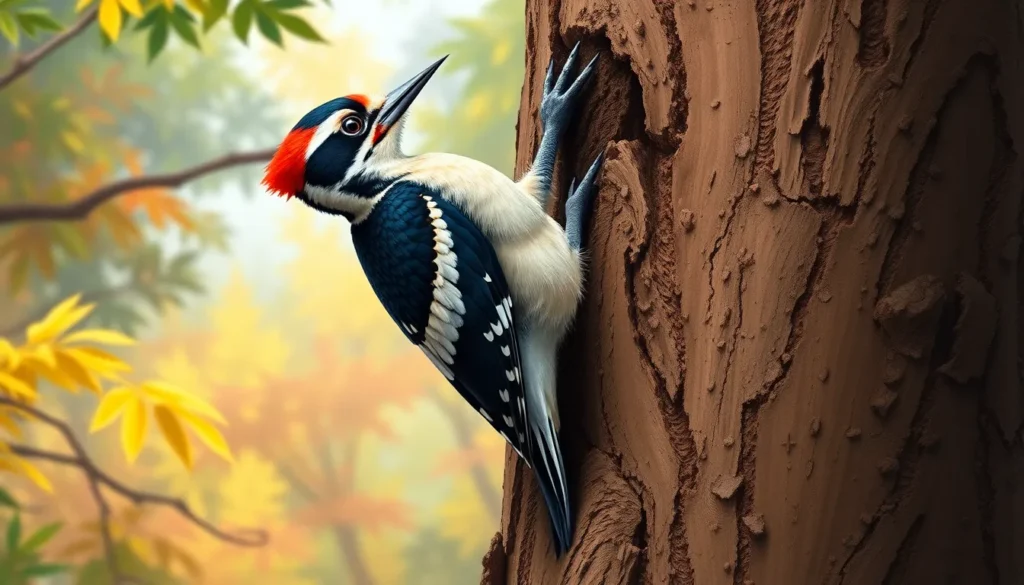
- Woodpeckers use their beaks to drill into wood. They peck at tree trunks and branches to find insects, create nesting sites, or communicate with other woodpeckers.
- Woodpeckers have specialized skulls. Their skulls contain spongy bone that helps absorb the shock from repeated pecking, protecting their brains.
- They possess long, barbed tongues. These tongues can extend far beyond their beaks to extract insects from holes and crevices.
- Woodpeckers produce drumming sounds. Instead of singing, many species drum on resonant surfaces to establish territory or attract mates.
- They have zygodactyl feet. This means two toes point forward and two backward, aiding in gripping tree bark securely.
- Woodpeckers inhabit all continents except Australia and Antarctica. They are found in a wide range of forested environments worldwide.
- Many species excavate cavities for nesting. These holes also provide shelter for other animals once abandoned.
- Woodpeckers play an important role in forest ecosystems. By controlling insect populations and creating nesting sites, they contribute to biodiversity.
- The largest woodpecker species is the Great Slaty Woodpecker. Native to Southeast Asia, it can reach lengths of up to 50 cm (20 inches).
- Some woodpeckers migrate seasonally. While many are resident birds, others move to different areas depending on food availability.
- Woodpeckers have stiff tail feathers. These provide support and balance when climbing vertical surfaces.
- They exhibit a variety of plumage patterns. Many species show striking black, white, and red coloration, often with sexual dimorphism.
- Woodpecker drumming speed varies by species. Some can drum up to 20 times per second during communication or territory defense.
- They have a unique hyoid bone structure. This bone supports and protects the tongue during rapid pecking movements.
- Woodpeckers can peck thousands of times per day. This high activity level is necessary for feeding, nesting, and signaling.
- They primarily feed on insects but may also consume fruits and nuts. Their diet varies according to species and habitat.
- Woodpeckers can detect insect larvae beneath bark. Their keen hearing and tactile sense help locate hidden prey.
- Some species are threatened by habitat loss. Deforestation and urbanization reduce available nesting and feeding sites.
- Woodpeckers have inspired human technology. The study of their impact-resistant skulls has influenced helmet design and shock absorption research.
- They belong to the family Picidae. This family includes over 200 species worldwide, classified into several genera.
Habitat and Behavior
Woodpeckers primarily inhabit forested regions, ranging from tropical rainforests to temperate woodlands and even savannas. They are adapted to live on or near trees, where they forage for insects, larvae, and sometimes sap. Their characteristic behavior involves climbing tree trunks vertically using strong feet and stiff tail feathers for support. Woodpeckers use their beaks to peck and drill into wood, either to find food or excavate nesting cavities. Many species are territorial and communicate through drumming sounds rather than song. Depending on the species, woodpeckers may be resident year-round or migrate short distances in response to seasonal changes in food availability.
Why This Animal Matters
Woodpeckers are important contributors to the health of forest ecosystems. By controlling insect populations, they help prevent outbreaks of pests that can damage trees. Their nesting cavities provide essential shelter not only for themselves but also for other birds, mammals, and insects, promoting biodiversity. Additionally, woodpeckers are indicators of forest health; their presence often reflects a well-structured ecosystem. Culturally, woodpeckers have featured in various mythologies and folklore, symbolizing persistence and communication. From a scientific perspective, their unique anatomical adaptations have offered insights into biomechanics and inspired technological innovations in impact resistance.
Common Misconceptions
Misconception: Woodpeckers can damage houses by drilling into wooden siding.
Correction: While woodpeckers may occasionally peck at wooden structures, this behavior is usually related to searching for insects or creating resonant surfaces to drum on. Persistent damage is uncommon and often related to specific environmental factors or food scarcity.
Misconception: Woodpeckers’ brains are at risk of injury from repeated pecking.
Correction: Woodpeckers have evolved specialized skull structures and shock-absorbing adaptations that protect their brains from damage despite high-impact pecking.
Misconception: All woodpeckers drum only on trees.
Correction: Woodpeckers also drum on other resonant surfaces such as metal poles, wooden fences, and even house gutters to produce sounds for communication.
FAQ
Why do woodpeckers peck on trees?
Woodpeckers peck on trees primarily to find insects living beneath the bark, create nesting cavities, and communicate with other woodpeckers through drumming sounds.
How do woodpeckers avoid brain injury from pecking?
They have evolved specialized skull structures with spongy bone and a unique hyoid bone arrangement that absorbs shock and protects the brain during rapid pecking.
Do woodpeckers eat only insects?
While insects and larvae make up the majority of their diet, many woodpecker species also consume fruits, nuts, and sap depending on availability and species-specific preferences.



Leave a Reply