
Short Answer
21 Facts About Thorny Devils (Lizards)
- Scientific Name
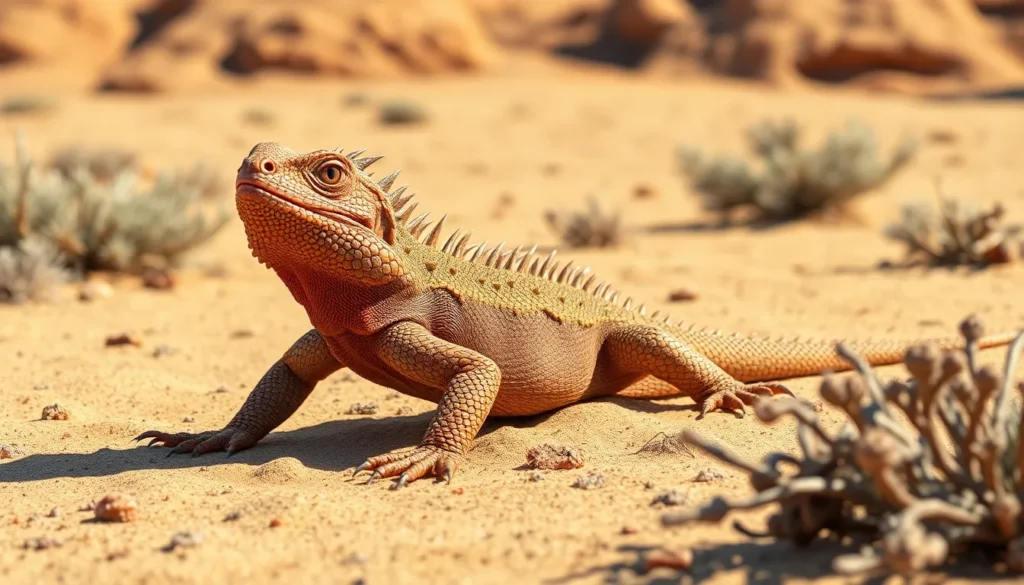
The thorny devil’s scientific name is Moloch horridus, reflecting its distinctive, intimidating appearance. - Native Range
Thorny devils are endemic to Australia, primarily found in arid and semi-arid regions. - Spiky Appearance
They have a body covered with sharp, conical spines which serve as a deterrent against predators. - Camouflage
Their coloration, ranging from reddish to yellowish-brown, helps them blend into desert environments. - Size
An adult thorny devil typically measures about 20 centimeters (8 inches) in length. - Defense Mechanism
When threatened, the thorny devil can puff up its body to appear larger and more threatening. - False Head
They possess a false head on the back of their neck, which they present to predators while hiding their real head. - Diet
Thorny devils primarily feed on ants, consuming thousands in a single day. - Specialized Tongue
They have a sticky tongue adapted to efficiently capture ants. - Water Collection
The lizard’s skin channels moisture from dew and rain towards its mouth, aiding hydration in arid climates. - Slow Movement
Thorny devils move slowly, which conserves energy and helps avoid detection by predators. - Seasonal Color Change
They may change color with the seasons, becoming darker in winter to absorb more heat. - Temperature Regulation
Behavioral adaptations such as basking and shade-seeking help regulate their body temperature. - Reproduction
Females lay eggs in burrows, with incubation periods varying depending on environmental conditions. - Longevity
In the wild, thorny devils can live up to 20 years under favorable conditions. - Predators
Natural predators include birds of prey and larger reptiles, though spines provide effective protection. - Territorial Behavior
They are generally solitary and may exhibit territoriality during breeding seasons. - Unique Gait
The thorny devil has a distinctive slow and deliberate walking style that minimizes sand disturbance. - Conservation Status
Currently, thorny devils are not considered threatened and have stable populations in their native habitat. - Scientific Research
They have been studied for their unique water-harvesting skin and adaptations to desert life. - Cultural Significance
Thorny devils are iconic symbols of Australia’s desert wildlife and appear in local folklore and art.
Habitat and Behavior
Thorny devils inhabit arid and semi-arid regions of Australia, including deserts and scrublands with sandy soils. Their habitat consists of sparse vegetation and loose sand, which facilitates their burrowing and camouflage strategies. They are primarily terrestrial and exhibit slow, deliberate movements to avoid detection by predators. Their spiny bodies not only provide defense but also aid in collecting water from dew and rainfall, channeled via grooves in their skin to their mouths. Thorny devils are insectivorous, feeding almost exclusively on ants, which they consume in large quantities. They forage mostly during daylight hours but avoid extreme heat by seeking shade or burrowing. During colder months, they may change coloration to absorb more warmth from the sun. Reproduction involves laying eggs in sandy burrows, where the young develop and hatch after several months. Overall, their behavioral and physiological adaptations enable them to survive in some of the harshest terrestrial environments.
Why This Animal Matters
Thorny devils play an important ecological role as specialized ant predators, helping regulate ant populations in their ecosystems. Their unique adaptations to desert life provide valuable insights into evolutionary biology and physiological mechanisms of water conservation. Additionally, the thorny devil serves as a flagship species for arid Australian habitats, drawing attention to the importance of desert conservation. Their striking appearance and unusual behaviors have also inspired scientific studies in biomimicry and materials science. Culturally, they hold significance for Indigenous Australian communities and contribute to Australia’s natural heritage and biodiversity. Monitoring their populations can serve as an indicator of environmental health in desert ecosystems.
Common Misconceptions
Misconception: Thorny devils are venomous.
Correction: Thorny devils are not venomous; their defense relies solely on their spiny armor and camouflage.
Misconception: Thorny devils can shoot their spines at predators.
Correction: The spines are fixed and cannot be shot or detached; they serve as physical protection only.
Misconception: Thorny devils drink water like most lizards.
Correction: They do not drink water traditionally but absorb moisture through their skin from dew and rainfall.
Misconception: Thorny devils are aggressive animals.
Correction: They are generally shy and rely on camouflage and defense rather than aggression.
FAQ
What do thorny devils eat?
Thorny devils primarily feed on ants, consuming thousands daily using their sticky tongues to capture them efficiently.
How do thorny devils stay hydrated in the desert?
They absorb moisture through specialized grooves in their skin from dew and rain, channeling water to their mouths without drinking in the traditional sense.
Are thorny devils dangerous to humans?
No, thorny devils are not dangerous or venomous to humans; their spines serve as a defense against predators, not as weapons against humans.



Leave a Reply