
Short Answer
21 Facts About Camels
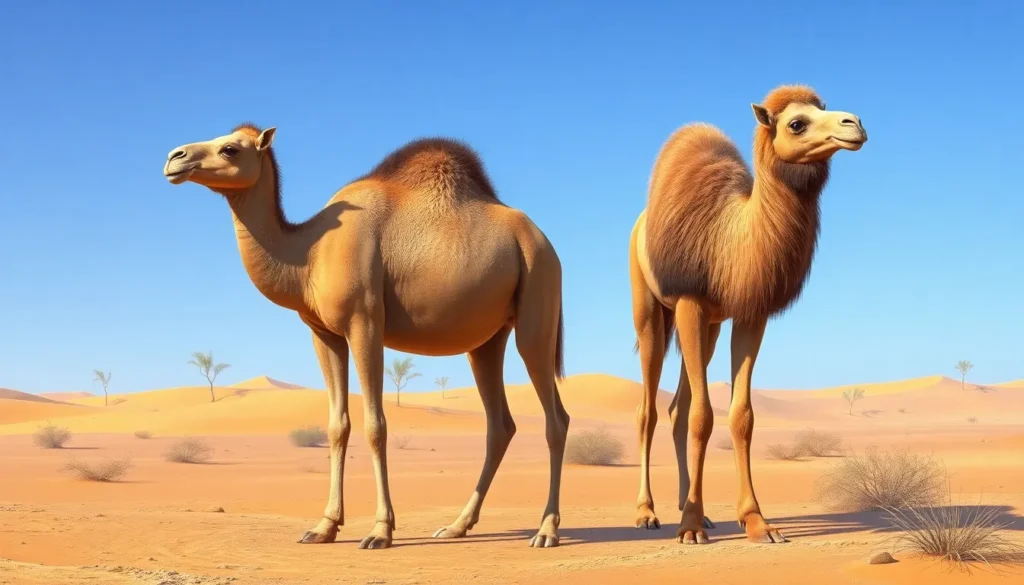
- Camels have two main species. The dromedary camel has one hump and is found mostly in the Middle East and North Africa, while the Bactrian camel has two humps and is native to Central Asia.
- Humps store fat, not water. Contrary to popular belief, camel humps store fat which can be converted to energy when food is scarce.
- Camels can drink large amounts of water quickly. They can drink up to 40 gallons (150 liters) of water in one session after dehydration.
- They are well adapted to extreme temperatures. Camels tolerate desert heat by regulating their body temperature and minimizing sweating.
- Camels have specialized feet. Their wide, padded feet prevent sinking in sand and provide stability on rocky terrain.
- They have long eyelashes and sealable nostrils. These features protect their eyes and respiratory system from sand and dust storms.
- Camels can survive without water for long periods. They can endure several days to weeks without water depending on conditions.
- They have a unique blood cell shape. Their oval-shaped red blood cells allow better flow during dehydration and rehydration.
- Camels are herbivores. They feed on dry grasses, grains, and thorny plants that other animals avoid.
- They have a three-chambered stomach. This allows efficient digestion of tough desert vegetation.
- Camels can run at speeds up to 40 mph (65 km/h). Despite their size, they can sprint quickly when necessary.
- They have been domesticated for thousands of years. Camels have been used for transportation, milk, meat, and wool by desert cultures.
- Camels have excellent endurance. They can travel up to 25 miles (40 km) a day in harsh desert conditions.
- Camel milk is nutritionally rich. It is high in vitamins and minerals and is consumed widely in desert regions.
- Camels can close their nostrils during sandstorms. This prevents inhalation of sand particles.
- They have thick fur that insulates against both heat and cold. The fur reflects sunlight and retains warmth at night.
- Camels communicate through various sounds. They grunt, roar, and make moaning noises to communicate moods and warnings.
- The gestation period for camels is approximately 13 months. Females typically give birth to one calf at a time.
- Camels have strong social structures. They live in groups led by a dominant male.
- They are important to the economies of many desert regions. Camels contribute to transport, agriculture, and tourism.
- Wild populations of Bactrian camels are critically endangered. Conservation efforts are ongoing to protect them in their native habitats.
Habitat and Behavior
Camels are primarily found in arid and semi-arid regions such as deserts and steppes. The dromedary camel inhabits the hot deserts of the Middle East and North Africa, while the Bactrian camel lives in the cold deserts and mountainous regions of Central Asia. Their behavior is highly adapted to survive harsh environmental conditions. Camels are mostly crepuscular, being active during early morning and evening to avoid midday heat. They are herbivorous browsers and grazers, feeding on sparse desert vegetation. Socially, camels live in herds led by a dominant male. They demonstrate remarkable endurance and can travel long distances in search of food and water. Their physiological adaptations, such as water conservation, temperature regulation, and specialized feet, enable them to thrive in challenging desert landscapes.
Why This Animal Matters
Camels hold significant ecological, cultural, and economic importance. Ecologically, they play a role in desert ecosystems by grazing on vegetation that few other animals can consume, helping to maintain plant community balance. Culturally, camels have been central to the livelihoods and traditions of many desert-dwelling peoples for thousands of years, symbolizing resilience and survival. Economically, they serve as transportation, sources of milk, meat, wool, and leather, and contribute to tourism in desert regions. Conservation of wild Bactrian camels is vital as they are one of the few remaining wild large mammals adapted to extreme desert environments, highlighting the need to preserve biodiversity in these fragile ecosystems.
Common Misconceptions
Misconception: Camels store water in their humps.
Correction: Camels’ humps store fat, which serves as an energy reserve. Water is stored in their bloodstream and tissues, not in the humps.
Misconception: Camels can survive without water indefinitely.
Correction: Camels can survive longer without water than many animals but still need to drink periodically to survive.
Misconception: All camels have two humps.
Correction: Only Bactrian camels have two humps; dromedary camels have one.
Misconception: Camels are slow and clumsy.
Correction: Camels can run at speeds up to 40 mph (65 km/h) and are well adapted to navigating desert terrain.
Misconception: Camels only live in hot deserts.
Correction: While dromedaries live in hot deserts, Bactrian camels inhabit cold desert and mountainous areas.
FAQ
Do camels store water in their humps?
No, camels store fat in their humps, which can be metabolized for energy. Water is stored in their bloodstream and body tissues.
How long can camels survive without water?
Camels can survive several days to weeks without water, depending on environmental conditions and their activity levels.
What is the difference between a dromedary and a Bactrian camel?
Dromedary camels have one hump and are native to hot deserts in the Middle East and North Africa, whereas Bactrian camels have two humps and live in colder desert and mountainous areas of Central Asia.





Leave a Reply