
Short Answer
21 Facts About the Internet
- The Internet began as ARPANET: The Internet’s origins date back to ARPANET, a network created by the U.S. Department of Defense in the late 1960s to enable communication between research institutions.
- World Wide Web is not the Internet: The Web is a system of interlinked hypertext documents accessed via the Internet, but the Internet includes many other services like email and file transfer.
- Over 5 billion users worldwide: As of recent estimates, more than 5 billion people use the Internet globally, representing more than half the world’s population.
- Internet Protocol (IP) addresses: Every device connected to the Internet has a unique IP address that identifies it for communication purposes.
- Data travels in packets: Information sent over the Internet is broken into small units called packets that travel independently and are reassembled at the destination.
- Domain Name System (DNS): DNS translates human-readable website names (like example.com) into IP addresses, making navigation easier.
- Internet speeds vary widely: Internet connection speeds depend on technology used, ranging from dial-up modems to modern fiber-optic connections offering gigabit speeds.
- Email predates the Web: Email was developed in the early 1970s and remains one of the most widely used Internet services.
- Search engines index billions of pages: Tools like Google crawl and index an enormous number of web pages to help users find relevant information quickly.
- Internet traffic is mostly video: Video streaming constitutes a significant majority of global Internet traffic, driven by platforms like YouTube and Netflix.
- Cybersecurity is a major concern: The Internet faces threats such as hacking, malware, and data breaches, prompting ongoing efforts in security and privacy.
- Internet of Things (IoT): IoT connects everyday devices like appliances and cars to the Internet, enabling automated and remote control.
- IPv6 introduced due to address exhaustion: The original IPv4 protocol was limited to about 4.3 billion addresses, leading to the development of IPv6 with a vastly larger address space.
- Social media shapes communication: Platforms like Facebook and Twitter have transformed how people interact, share information, and participate in public discourse.
- Internet censorship varies by country: Some governments restrict or control access to certain websites or online content for political or cultural reasons.
- Open-source software powers much of the Internet: Many fundamental Internet technologies and web servers use open-source software like Linux and Apache.
- Net neutrality debates influence Internet access: Discussions about whether Internet service providers should treat all data equally impact how users experience online content.
- Internet has reshaped commerce: E-commerce platforms enable buying and selling goods worldwide, changing the retail landscape.
- Online education expanded via the Internet: The Internet supports remote learning through platforms offering courses, lectures, and educational resources globally.
- The Internet uses undersea cables: Vast networks of underwater fiber-optic cables carry most international Internet traffic across continents.
- The first website is still online: The first-ever website, created by Tim Berners-Lee in 1991, remains accessible as a historical artifact.
How It Works
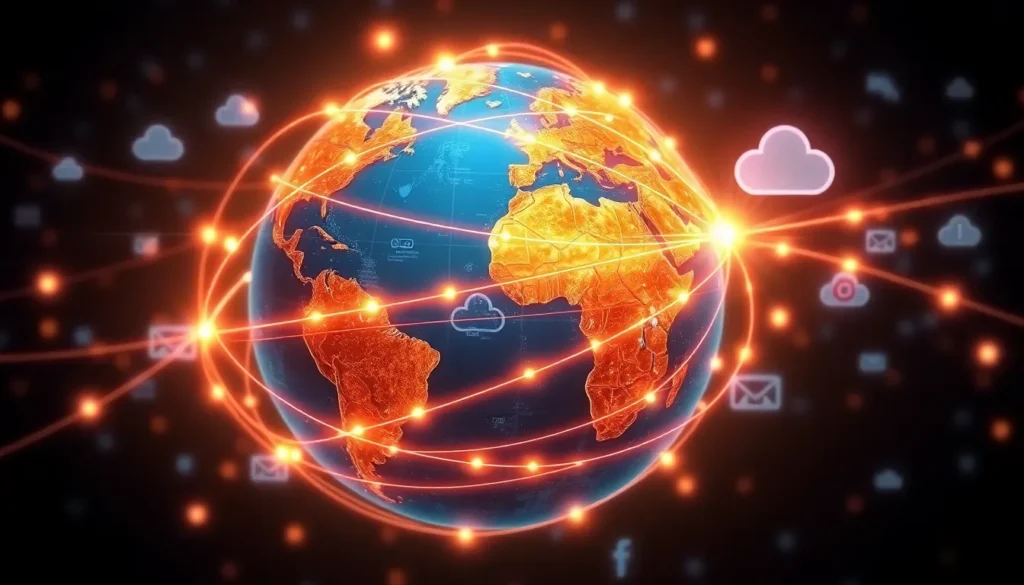
The Internet functions as a global network of interconnected computer networks that communicate using standard protocols, primarily the Internet Protocol Suite (TCP/IP). Devices connected to the Internet send and receive data in small packets that are routed through various nodes and servers based on IP addresses. Naming systems like DNS translate user-friendly domain names into these IP addresses, allowing users to access websites and services easily. The infrastructure includes physical components such as fiber-optic cables, routers, and data centers, as well as software layers that enable applications like web browsers, email clients, and streaming services.
Why It Matters
The Internet has revolutionized nearly every aspect of modern life by facilitating instant communication, access to vast amounts of information, and new forms of social interaction. It underpins global commerce, education, entertainment, and government services, making many activities more efficient and accessible. The Internet also fosters innovation by enabling collaboration across borders and providing platforms for new technologies. Its democratizing potential allows marginalized voices to be heard but also presents challenges such as misinformation and digital divides. Overall, the Internet is a critical infrastructure that shapes economies, cultures, and societies worldwide.
Common Misconceptions
Misconception: The Internet and the World Wide Web are the same.
Correction: The Internet is the global network of connected computers, while the World Wide Web is a system of interlinked web pages accessed via the Internet.
Misconception: The Internet was invented by a single person or organization.
Correction: The Internet developed over decades through the contributions of many researchers, engineers, and organizations.
Misconception: The Internet is completely anonymous and unregulated.
Correction: While users can maintain some privacy, Internet activity can be tracked, and many countries regulate or monitor online content and behavior.
Misconception: Faster Internet speed always means better quality.
Correction: Speed is important, but factors like latency, reliability, and network congestion also affect the user experience.
Misconception: The Internet is inherently secure.
Correction: Security depends on measures taken by users and providers; vulnerabilities exist and require constant attention.
FAQ
What is the difference between the Internet and the World Wide Web?
The Internet is the global network of computers and devices that communicate with each other, while the World Wide Web is a collection of information accessed through the Internet using web browsers.
How does the Internet send data between computers?
Data is broken into small packets, each containing part of the information and destination address. These packets travel independently through the network and are reassembled at the destination.
Why do we need IPv6?
IPv4 addresses have become insufficient due to the large number of devices connected to the Internet. IPv6 provides a much larger pool of addresses to accommodate growth.



Leave a Reply