
Short Answer
21 Facts About the Moon
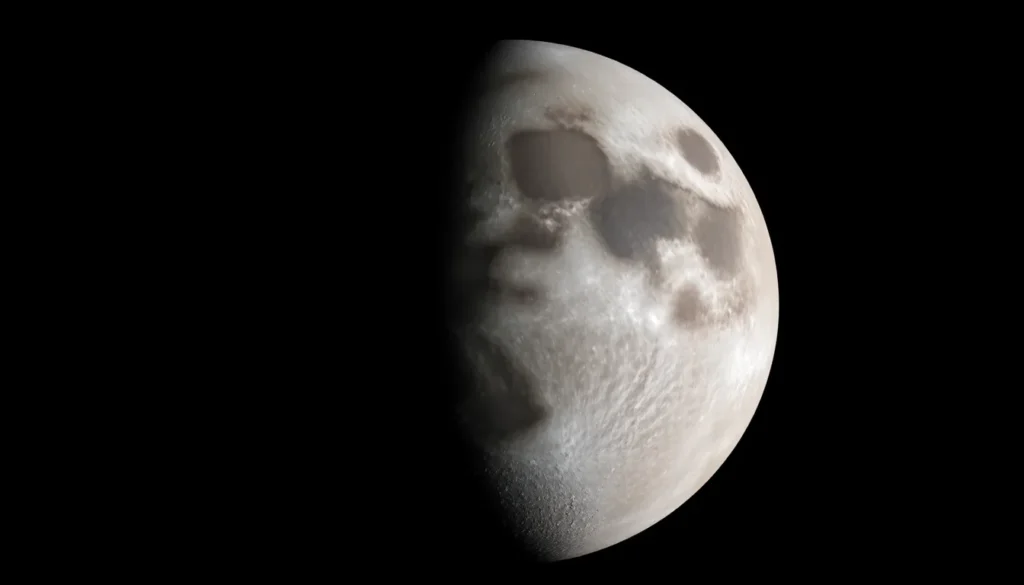
- The Moon is Earth’s only natural satellite. It orbits Earth at an average distance of about 384,400 kilometers (238,855 miles).
- The Moon’s diameter is about 3,474 kilometers. This is roughly one-quarter the diameter of Earth.
- The Moon has no atmosphere. This means it does not have weather or sound and experiences extreme temperature variations.
- The Moon’s surface is covered in regolith. This is a layer of loose dust and broken rock created by impacts from meteoroids.
- The Moon is tidally locked to Earth. It always shows the same face, known as the near side, to our planet.
- The far side of the Moon was first photographed in 1959. It remained unseen by humans until spacecraft imagery was obtained.
- The Moon’s gravity is about one-sixth of Earth’s gravity. This affects how astronauts move and how objects fall on its surface.
- The Moon influences Earth’s tides. Its gravitational pull causes the regular rise and fall of ocean levels.
- The Moon formed approximately 4.5 billion years ago. It is believed to have originated from debris after a Mars-sized body collided with the early Earth.
- The Moon has no liquid water on its surface. However, ice has been detected in permanently shadowed craters near its poles.
- The first human-made object to reach the Moon was the Soviet Luna 2 spacecraft in 1959.
- The first humans landed on the Moon in 1969. NASA’s Apollo 11 mission was the first to safely land astronauts on the lunar surface.
- The Moon’s surface features include large dark plains called maria. These were formed by ancient volcanic activity and appear as dark patches visible from Earth.
- The Moon has many impact craters. These are the result of collisions with asteroids and comets over billions of years.
- The Moon’s exosphere is extremely thin. Unlike Earth’s atmosphere, it consists of sparse atoms and molecules that rarely collide.
- Solar eclipses occur when the Moon passes between Earth and the Sun. The apparent sizes of the Moon and Sun are similar, allowing the Moon to block the Sun’s light.
- The Moon’s surface temperature ranges from extremely hot to extremely cold. Temperatures can reach about 127°C (260°F) during the day and drop to -173°C (-280°F) at night.
- Several countries have sent robotic missions to the Moon. These missions have helped map its surface and study its geology.
- Moon rocks brought back to Earth have helped scientists understand the solar system’s history.
- The Moon has been a cultural and scientific symbol throughout human history. It has influenced calendars, mythology, and scientific exploration.
- Future missions are planned to establish a human presence on the Moon. These aim to explore the Moon further and use it as a base for deeper space exploration.
How It Works
The Moon’s orbit around Earth is governed by gravitational forces between the two bodies. Its synchronous rotation, or tidal locking, means one hemisphere constantly faces Earth while the other remains hidden. The lack of atmosphere results in a surface exposed to direct solar radiation and meteor impacts, creating its characteristic craters and maria. The Moon’s gravity affects Earth’s oceans, causing tides by pulling on the water. Its formation is thought to stem from a giant impact event early in the solar system’s history, which caused debris to coalesce into the Moon.
Why It Matters
The Moon plays a critical role in Earth’s natural systems, particularly in regulating tides that affect marine ecosystems and coastal environments. Its presence stabilizes Earth’s axial tilt, contributing to a stable climate. Scientifically, the Moon serves as a record of the early solar system, preserving geological history that Earth’s dynamic surface has erased. Human exploration of the Moon has advanced technology and inspired scientific inquiry. The Moon is also considered a stepping stone for future space missions, potentially serving as a base for exploration of Mars and beyond.
Common Misconceptions
Misconception: The Moon produces its own light.
Correction: The Moon does not generate light but reflects sunlight.
Misconception: The same side of the Moon is never visible from Earth.
Correction: The same side, called the near side, is always visible due to tidal locking.
Misconception: The Moon is completely lifeless and unchanging.
Correction: While the Moon lacks life, it experiences geological changes such as moonquakes and surface alteration by meteor impacts.
FAQ
Why does the Moon have phases?
The Moon’s phases occur because of its orbit around Earth and the changing angles of sunlight it reflects toward Earth, causing it to appear to grow and shrink in shape.
Is the Moon shrinking?
Yes, recent studies suggest the Moon is slowly shrinking due to cooling and contraction of its interior, causing moonquakes and surface features like cliffs.
Can humans live on the Moon?
Currently, the Moon lacks a breathable atmosphere and water, so humans cannot live there without life support systems. Future missions aim to develop habitats for longer stays.



Leave a Reply