
Short Answer
21 Facts About Dugongs
- Dugongs are marine mammals. They belong to the order Sirenia, which also includes manatees and the extinct Steller’s sea cow.
- They are the only strictly marine herbivorous mammals. Unlike manatees, which can inhabit freshwater, dugongs live exclusively in saltwater environments.
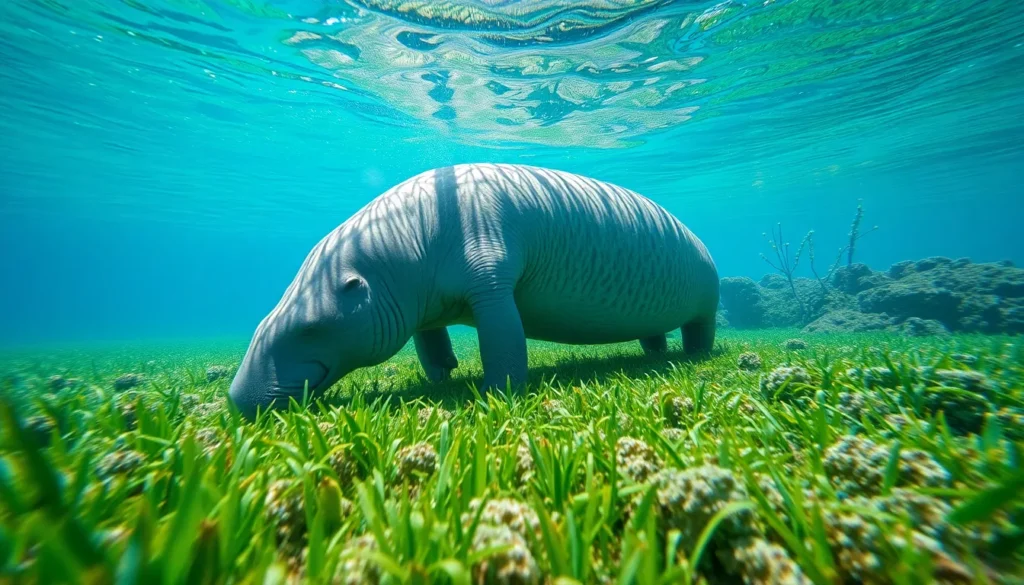
- Dugongs primarily feed on seagrass. Their diet consists almost entirely of seagrass species found in shallow coastal waters.
- They have a slow metabolism. This adaptation suits their low-energy diet and aquatic lifestyle.
- Dugongs can grow up to 4 meters in length. Adult dugongs typically weigh between 230 and 400 kilograms.
- Their name comes from the Malay word “duyung,” meaning “lady of the sea.” This reflects their gentle nature and mythological associations.
- Dugongs have a unique tail fluke. It is broadly fluked and resembles that of a whale, distinct from the paddle-shaped tails of manatees.
- They use their sensitive bristle-like hairs to locate food. These hairs are mainly found on their upper lip and help detect seagrass.
- Dugongs are slow swimmers. They typically move at speeds of 4 to 10 kilometers per hour but can swim faster when disturbed.
- They surface to breathe every few minutes. Dugongs have lungs adapted for slow, deep breathing, allowing dives lasting several minutes.
- Dugongs are social but generally seen in small groups. Groups range from solitary individuals to aggregations of a few animals.
- Their reproductive rate is low. Females have a long gestation period of about 13 to 15 months and usually give birth to a single calf.
- Dugongs can live up to 70 years in the wild. Longevity depends on environmental conditions and threats.
- They play a critical ecological role. By grazing on seagrass, dugongs help maintain healthy seagrass beds, which support diverse marine life.
- Dugongs are found in warm coastal waters from East Africa to Australia and the Red Sea to the western Pacific. Their range includes parts of the Indian Ocean and the western Pacific Ocean.
- They are considered vulnerable to extinction. Threats include habitat loss, hunting, entanglement in fishing gear, and boat collisions.
- Conservation efforts include protected areas and reducing human impacts. Several countries have enacted legislation to safeguard dugong populations.
- Dugongs communicate using a variety of sounds. These vocalizations help maintain contact between individuals, especially mothers and calves.
- Their thick skin provides protection. Dugongs have dense, tough skin that reduces injury from rough seagrass beds and predators.
- Dugongs have cultural significance in many coastal communities. They appear in myths and traditional stories across their range.
- Research on dugongs helps inform marine conservation strategies. Understanding their biology and ecology supports efforts to preserve marine ecosystems.
Habitat and Behavior
Dugongs inhabit warm, shallow coastal waters typically less than 10 meters deep, where seagrass beds are abundant. They prefer sheltered bays, lagoons, and estuaries but can also be found near coral reefs. Dugongs are slow-moving and spend much of their time grazing on seagrass meadows. They use their bristled snouts to uproot and consume plants efficiently. Dugongs surface regularly to breathe but can hold their breath for up to six minutes during dives. Socially, they are somewhat solitary or form small groups, with loose aggregations around rich feeding sites. Mothers and calves maintain close contact, with calves nursing for up to two years. Dugongs are mostly nocturnal feeders but can be active during the day. Their slow reproductive rate and long lifespan reflect their adaptation to stable but vulnerable coastal habitats.
Why This Animal Matters
Dugongs play a key ecological role by maintaining the health and productivity of seagrass ecosystems. Their grazing prevents overgrowth and promotes nutrient cycling, supporting diverse marine species such as fish and invertebrates. As a flagship species for marine conservation, dugongs help raise awareness about coastal habitat protection. Their declining populations serve as indicators of environmental degradation, including water pollution and habitat destruction. Culturally, dugongs hold significance for indigenous and coastal communities, featuring in folklore and traditional practices. Protecting dugongs promotes biodiversity conservation, sustainable fisheries, and healthy coastal environments, which benefit human livelihoods.
Common Misconceptions
Misconception: Dugongs are whales.
Correction: Although dugongs share some characteristics with whales, they belong to the order Sirenia, distinct from cetaceans. Dugongs are more closely related to elephants than to whales.
Misconception: Dugongs are aggressive animals.
Correction: Dugongs are gentle herbivores and generally avoid confrontation. They pose no threat to humans and are known for their calm behavior.
Misconception: Dugongs can live in freshwater.
Correction: Unlike manatees, dugongs are strictly marine animals and do not inhabit freshwater environments.
FAQ
What do dugongs eat?
Dugongs are herbivores that primarily feed on various species of seagrass found in shallow coastal waters. Their diet is essential for maintaining healthy seagrass ecosystems.
Where do dugongs live?
Dugongs inhabit warm, shallow marine waters of the Indian Ocean and western Pacific Ocean, including coastal regions of East Africa, the Red Sea, Australia, and several island nations.
Are dugongs endangered?
Dugongs are classified as vulnerable to extinction, facing threats such as habitat loss, hunting, entanglement in fishing gear, and boat collisions. Conservation efforts aim to protect their populations and habitats.


Leave a Reply