
Short Answer
21 Facts About Gypsy Moths
- Scientific Classification: The gypsy moth is scientifically known as Lymantria dispar and belongs to the family Erebidae.
- Origin: Originally native to Europe and Asia, gypsy moths were introduced to North America in the late 19th century.
- Invasive Species: In North America, gypsy moths are considered an invasive species due to their defoliation of native forests.
- Sexual Dimorphism: Male and female gypsy moths differ notably; males have brown, furry wings and are strong fliers, while females are white with black markings and typically do not fly.
- Life Cycle: The gypsy moth undergoes complete metamorphosis with four stages: egg, larva (caterpillar), pupa, and adult moth.
- Egg Masses: Females lay egg masses containing 100 to 1,000 eggs, often on tree trunks, rocks, or man-made structures.
- Larval Feeding: The caterpillars are voracious feeders and consume the leaves of over 500 species of trees and shrubs.
- Preferred Hosts: Oak trees are among their preferred hosts, but they also feed on maples, birches, and other hardwood species.
- Defoliation Impact: Large outbreaks can cause significant defoliation, weakening trees and making them susceptible to disease and other pests.
- Natural Predators: Birds, small mammals, and certain parasitic insects help control gypsy moth populations naturally.
- Population Cycles: Gypsy moth populations tend to have outbreak cycles every 7 to 10 years, with population crashes often caused by disease and predation.
- Overwintering Eggs: Eggs overwinter and hatch in the spring, timing larval emergence with leaf bud burst for optimal feeding.
- Dispersal Mechanism: Young larvae can disperse by ‘ballooning’ using silk threads, allowing them to travel by wind to new locations.
- Role of Pheromones: Female gypsy moths release pheromones to attract males for mating over long distances.
- Control Measures: Various control methods include biological pesticides such as Bacillus thuringiensis (Bt), chemical insecticides, and introduction of natural predators.
- Impact on Forestry: Gypsy moth outbreaks can have substantial economic impacts on forestry and urban landscapes due to tree damage.
- Research Importance: Gypsy moths serve as a model organism for studying invasive species dynamics and pest management techniques.
- Flight Capability: Only male gypsy moths are strong fliers; females typically remain near their hatching site.
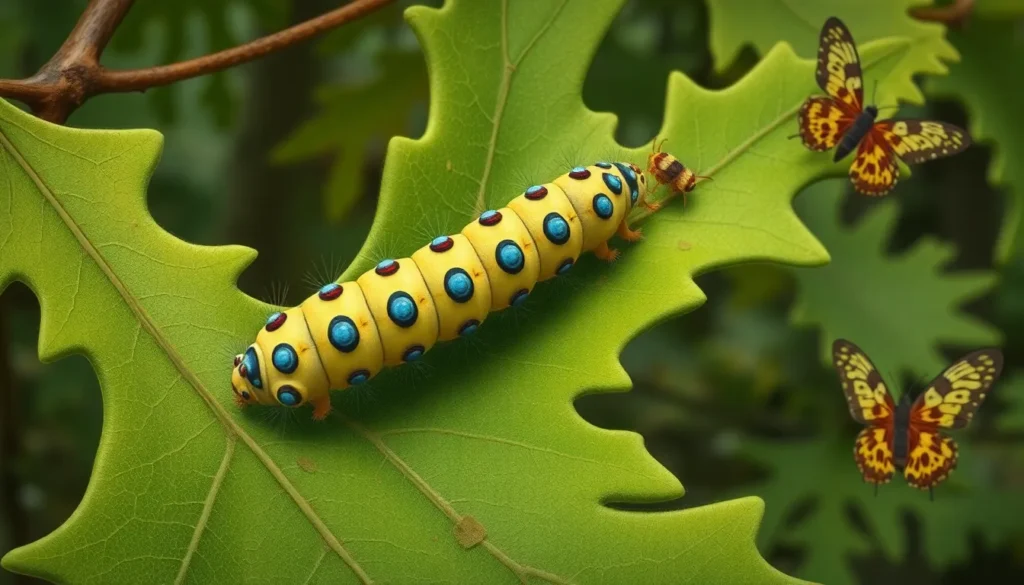
- Identification: Gypsy moth caterpillars have a distinctive pattern of five pairs of blue dots followed by six pairs of red dots along their backs.
- Regulatory Status: Due to their pest status, gypsy moths are subject to quarantine regulations in some areas to prevent spread.
- Historical Introduction: The species was accidentally introduced in 1869 near Boston by Étienne Léopold Trouvelot, who intended to breed them for silk production.
Habitat and Behavior
Gypsy moths inhabit temperate deciduous and mixed forests primarily across Europe, Asia, and North America. They thrive in environments where host trees are abundant, particularly oak-dominated woodlands. The larvae feed on leaves during spring and early summer, often causing extensive defoliation. Adult males are capable of flying and seek out females using pheromone cues, while females typically remain near the egg mass site. The species overwinters in the egg stage, with eggs laid in protective masses on various surfaces. Larvae disperse by ballooning on silken threads to colonize new areas, contributing to their spread. Gypsy moth populations undergo cyclical outbreaks influenced by natural enemies, climatic factors, and food availability.
Why This Animal Matters
Gypsy moths play a significant ecological role as herbivores influencing forest composition and health through defoliation. Their feeding can stress trees, making them more vulnerable to secondary pests and diseases. Economically, they impact forestry and urban environments due to tree damage and the cost of control measures. The species is also important in scientific research as a model for invasive species biology and pest management. Despite their negative effects, gypsy moths are part of the food web, providing prey for various predators and contributing to biodiversity. Understanding gypsy moth dynamics aids in forest conservation and sustainable management practices.
Common Misconceptions
Misconception: Gypsy moths are native to North America.
Correction: Gypsy moths were introduced to North America from Europe and Asia in the late 1800s and are considered invasive in this region.
Misconception: Both male and female gypsy moths can fly well.
Correction: Only male gypsy moths are capable of sustained flight; females are generally flightless.
Misconception: Gypsy moth caterpillars are harmless to trees.
Correction: The caterpillars are defoliators and can cause significant damage during population outbreaks.
Misconception: Gypsy moths only feed on oak trees.
Correction: While oaks are preferred, gypsy moth caterpillars feed on a wide variety of trees and shrubs.
Misconception: Gypsy moth outbreaks are permanent and uncontrollable.
Correction: Outbreaks are cyclical and often controlled naturally by predators, diseases, and environmental factors.
FAQ
What damage do gypsy moths cause to trees?
Gypsy moth caterpillars feed on the leaves of many tree species, primarily hardwoods like oak. During outbreaks, they can cause extensive defoliation, which stresses trees and may lead to reduced growth, vulnerability to diseases, or even death if defoliation is repeated over consecutive years.
How do gypsy moths spread to new areas?
Young gypsy moth larvae disperse by ballooning, releasing silk threads that catch the wind and carry them to new locations. Additionally, human activities such as transporting firewood or outdoor equipment can inadvertently spread egg masses to new areas.
Are gypsy moths harmful to humans?
Gypsy moths are not directly harmful to humans. However, their caterpillars have hairs that can cause mild skin irritation or allergic reactions in sensitive individuals. They do not bite or sting, and the moths themselves do not transmit diseases.


Leave a Reply