
Short Answer
21 Facts About Black Holes
1. Black Holes Have an Event Horizon
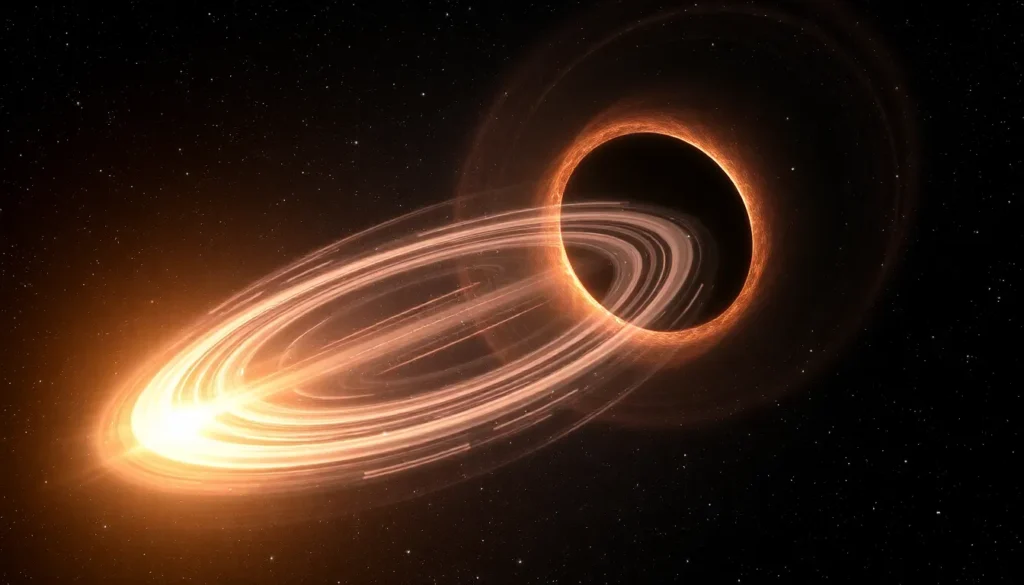
The event horizon is the boundary around a black hole beyond which nothing can escape. It acts like a point of no return for matter and light.
2. They Can Form from Collapsing Stars
Black holes often form when massive stars exhaust their fuel and collapse under their own gravity, resulting in a dense singularity.
3. Black Holes Vary in Size
They range from small, stellar-mass black holes a few times the mass of the Sun, to supermassive black holes millions or billions of times heavier, found in galactic centers.
4. Nothing Can Escape a Black Hole
The gravitational pull of a black hole is so intense that even light cannot escape once it crosses the event horizon.
5. Black Holes Can Spin
Many black holes rotate, dragging spacetime around them in a phenomenon called frame-dragging.
6. They Are Detected Indirectly
Because black holes emit no light, scientists detect them by observing the effects on nearby stars or gas, such as X-ray emissions from accretion disks.
7. Hawking Radiation Suggests Black Holes Can Evaporate
Physicist Stephen Hawking proposed that black holes emit radiation due to quantum effects, potentially leading to their gradual evaporation.
8. Black Holes Can Merge
When two black holes orbit closely, they can merge into a larger black hole, releasing gravitational waves detectable by instruments like LIGO.
9. They Influence Galaxy Formation
Supermassive black holes at galactic centers are believed to affect the growth and evolution of their host galaxies.
10. The First Image of a Black Hole Was Released in 2019
The Event Horizon Telescope captured the first direct image of a black hole’s shadow in the galaxy M87.
11. Black Holes Can Have Magnetic Fields
They can produce strong magnetic fields that influence surrounding plasma and jets of particles.
12. Inside a Black Hole Lies a Singularity
The singularity is a point of infinite density where current physical theories break down.
13. Time Near a Black Hole Slows Down
According to general relativity, time dilates in strong gravitational fields, so time passes slower near a black hole compared to far away.
14. Black Holes Can Evade the No-Hair Theorem
The theorem states black holes can be described only by mass, charge, and spin, but new research explores more complex characteristics.
15. Primordial Black Holes May Exist
Some theories suggest black holes formed shortly after the Big Bang, though none have been confirmed.
16. They Can Produce Powerful Jets
Some black holes emit jets of high-energy particles that travel vast distances through space.
17. Black Holes Affect Time and Space
They warp spacetime so severely that paths of objects and light bend significantly near them.
18. They Are Predicted by Einstein’s General Relativity
The concept of black holes arises naturally from equations of general relativity proposed by Albert Einstein in 1915.
19. Black Holes Can Be Part of Binary Systems
Black holes often exist in binary pairs with stars, facilitating mass transfer and observable phenomena.
20. They Are Not Cosmic Vacuum Cleaners
Black holes do not indiscriminately suck in matter but have gravitational effects similar to other massive objects at a distance.
21. Studying Black Holes Advances Physics
Research into black holes pushes the boundaries of quantum mechanics and gravity, helping scientists seek a unified theory.
History / Background
The concept of black holes emerged from the equations of general relativity developed by Albert Einstein in 1915. Shortly after, physicists such as Karl Schwarzschild found solutions indicating regions where gravity would be so strong that nothing could escape. The term “black hole” was popularized in the 1960s, although earlier descriptions referred to these objects as “dark stars” or “frozen stars.” Over decades, theoretical work combined with astronomical observations has confirmed their existence and expanded understanding of their properties and roles in the universe.
Importance and Impact
Black holes are fundamental to astrophysics and cosmology. They provide natural laboratories for testing the laws of physics under extreme conditions, especially gravity and quantum mechanics. Supermassive black holes influence galaxy formation and evolution, while merging black holes produce gravitational waves, a new observational window into the cosmos. Understanding black holes helps clarify the life cycles of stars and the universe’s structure.
Why It Matters
Studying black holes enhances knowledge of fundamental physics, potentially leading to breakthroughs in unifying gravity with quantum theory. Black holes also serve as critical tools for understanding the universe’s past and future. For the general public, black holes inspire curiosity and foster interest in science, technology, engineering, and mathematics (STEM) fields.
Common Misconceptions
Black holes suck everything in like vacuum cleaners.
Black holes only exert gravitational pull like any massive object; objects must cross the event horizon to be pulled in irreversibly.
Black holes are visible objects.
Black holes cannot be seen directly because no light escapes; they are detected by effects on nearby matter and radiation.
Black holes instantly destroy everything that falls in.
While the gravitational forces near a black hole are extreme, the process depends on size and type; tidal forces can stretch objects gradually.
All black holes are the same size.
Black holes vary widely, from stellar-mass to supermassive, with vastly different scales and properties.
FAQ
What is a black hole?
A black hole is a region in space where gravity is so intense that nothing, including light, can escape from it.
How are black holes detected?
Black holes are detected indirectly by observing their gravitational effects on nearby stars, gas, and by detecting gravitational waves from mergers.
Can anything escape a black hole?
Once an object crosses the event horizon, it cannot escape the black hole’s gravitational pull.






Leave a Reply