
Short Answer
21 Facts About Animal Mimicry
- Mimicry is an evolutionary adaptation. It involves one species evolving to resemble another species or natural object to gain survival advantages such as avoiding predators.
- Batesian mimicry involves a harmless species mimicking a harmful one. This form of mimicry was first described by Henry Walter Bates in the 19th century through studies of butterflies in the Amazon.
- Müllerian mimicry occurs between two or more harmful species. These species share similar warning signals, reinforcing predator avoidance behavior.
- Warning coloration is a key feature in many mimicry systems. Bright colors such as yellow, red, and black often signal toxicity or danger to predators.
- Some mimics copy not only appearance but also behavior. For example, certain harmless snakes imitate the movements of venomous snakes to deter threats.
- Mimicry can extend beyond visual cues. Certain species mimic sounds or chemical signals to deceive predators or prey.
- Batesian mimics depend on the abundance of the model species. If mimics become too common, predators may learn that the warning signals are unreliable.
- Müllerian mimicry benefits all involved species. By sharing the cost of educating predators, harmful species increase the effectiveness of their warning signals.
- Some species use aggressive mimicry. Instead of avoiding predators, these species deceive prey by resembling harmless or attractive organisms.
- Mimicry has evolved independently multiple times. Different animal groups such as insects, reptiles, and birds exhibit diverse mimicry strategies.
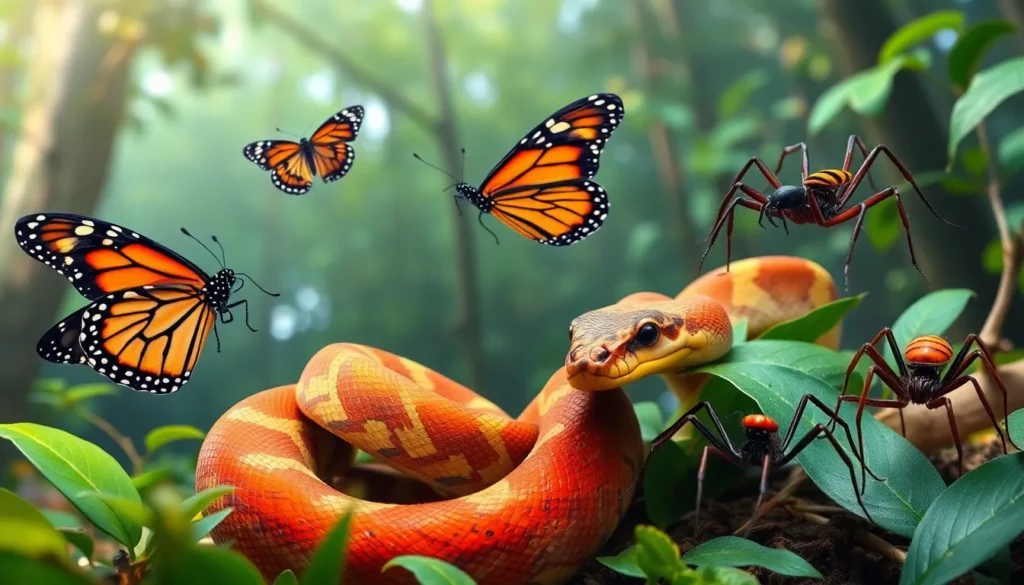
- One famous example of Batesian mimicry is the viceroy butterfly mimicking the monarch butterfly. Monarchs are toxic to predators, so viceroys gain protection by resembling them.
- Coral snake mimicry is a classic case of Batesian mimicry. Non-venomous snakes like the milk snake display similar color patterns to venomous coral snakes to avoid predation.
- Müllerian mimicry rings can involve multiple species. For example, several species of toxic butterflies share similar wing patterns to mutually reinforce predator avoidance.
- Some spiders mimic ants to avoid predators or hunt ants. This is an example of morphological and behavioral mimicry.
- Plants can also mimic animals or other plants. Some orchids mimic female insects to attract pollinators without offering nectar.
- Mimicry influences ecological interactions. It affects predator-prey dynamics and can shape community composition.
- Human activity can impact mimicry systems. Changes in species abundance or habitat can disrupt mimic-model relationships.
- Research into mimicry has informed evolutionary biology. It provides evidence for natural selection and coevolutionary processes.
- Understanding mimicry has practical applications. It aids in biodiversity conservation and pest management strategies.
- Mimicry can sometimes be imperfect but still effective. Some mimics only resemble models under specific conditions or from certain viewpoints.
- Studying mimicry requires interdisciplinary approaches. It combines ecology, genetics, behavior, and evolutionary theory to understand complex adaptations.
Habitat and Behavior
Animal mimicry occurs across diverse habitats worldwide, from tropical rainforests to deserts and freshwater ecosystems. The specific environment influences the types of mimicry and the species involved. Many mimics occupy niches close to their models to maximize the protective advantage. Behaviorally, mimics may adopt the movements, postures, or even sounds of the species they imitate. For example, some harmless snakes not only resemble venomous species in coloration but also in their defensive behaviors, such as coiling or rattling. Mimicry often plays a crucial role in survival strategies, helping species avoid predation or enhance hunting success. In some cases, mimicry involves complex interactions with multiple species, forming mimicry rings or networks that reinforce warning signals within the community.
Why This Animal Matters
Animal mimicry is significant for its ecological and evolutionary implications. It contributes to biodiversity by promoting species interactions and adaptations. Mimicry influences predator-prey relationships and can stabilize ecosystems by reducing predation pressure on certain species. Culturally, mimicry has fascinated scientists and the public alike, illustrating natural selection and adaptation vividly. From a conservation perspective, understanding mimicry helps in protecting species that rely on these relationships for survival. Disruptions to mimicry systems through habitat loss or species decline can have cascading effects on ecosystem health. Furthermore, mimicry research has provided insights into evolutionary biology and continues to inspire biomimicry in technology and design.
Common Misconceptions
Misconception: All mimicry involves harmless species copying harmful ones.
Correction: While Batesian mimicry fits this description, Müllerian mimicry involves multiple harmful species sharing warning signals to collectively deter predators.
Misconception: Mimicry always involves perfect resemblance.
Correction: Many mimics are imperfect but still gain protective benefits due to predator perception limits or context-specific cues.
FAQ
What is the difference between Batesian and Müllerian mimicry?
Batesian mimicry involves a harmless species mimicking a harmful one to avoid predators, while Müllerian mimicry involves two or more harmful species sharing similar warning signals to collectively reinforce predator avoidance.
Can mimicry occur in animals other than insects?
Yes, mimicry occurs in various animal groups including reptiles, birds, spiders, and even some mammals, using visual, behavioral, and chemical cues.
Why is mimicry important in nature?
Mimicry enhances survival by deterring predators, influencing ecological interactions, and providing evidence for evolutionary processes like natural selection and coevolution.

Leave a Reply