
Short Answer
21 Facts About Cassowaries
- They are large, flightless birds. Cassowaries belong to the ratite group, which also includes emus and ostriches. They are incapable of flight due to their small wings and heavy bodies.
- There are three recognized species of cassowaries. These are the Southern Cassowary (Casuarius casuarius), the Dwarf Cassowary (Casuarius bennetti), and the Northern Cassowary (Casuarius unappendiculatus).
- They are native to New Guinea, nearby islands, and northeastern Australia. Their habitat primarily includes tropical rainforests where they find shelter and food.
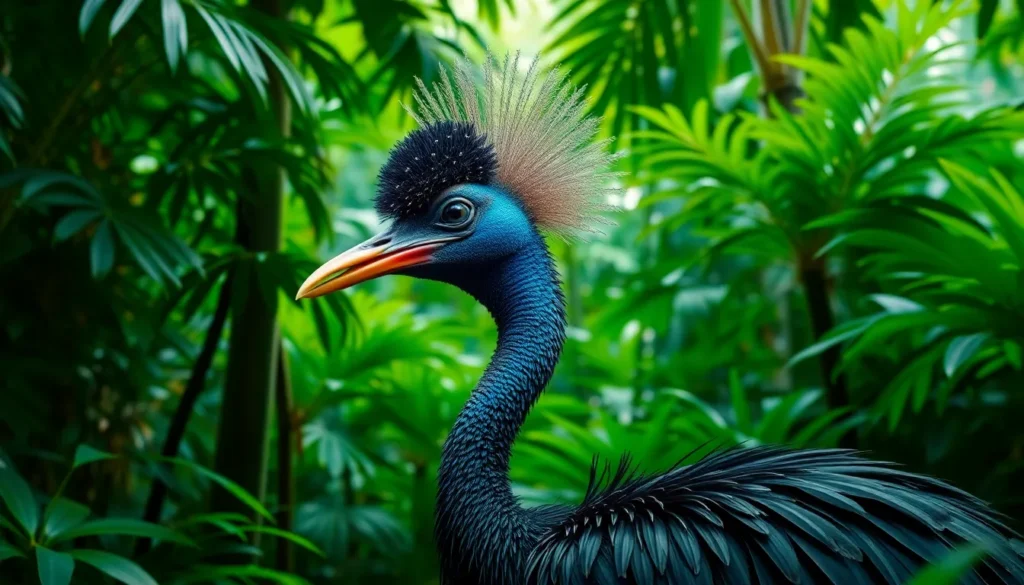
- Cassowaries have a distinctive casque on their heads. This helmet-like structure varies in size and shape and is made of keratin; its exact function is still debated but may assist in protection or sound resonance.
- The birds have vivid blue and black plumage. Their necks and heads are often brightly colored, displaying shades of blue, red, and purple.
- They are solitary animals. Cassowaries typically live alone except during mating season and when females are raising chicks.
- They are primarily frugivores. Their diet consists mostly of fruit, although they occasionally consume fungi, insects, and small animals.
- Cassowaries are important seed dispersers. By consuming fruit and passing seeds through their digestive tract, they help maintain forest diversity and regeneration.
- They can run up to 50 km/h (31 mph). Despite their size, cassowaries are fast runners and can navigate dense forest terrain efficiently.
- Cassowaries are strong swimmers. They can cross rivers and swim between islands if necessary.
- They have powerful legs with sharp claws. The inner claw on each foot can be up to 12 cm (4.7 inches) long and is used for defense.
- Cassowaries can be dangerous to humans. When threatened, they may attack using their claws, and injuries have been reported, although attacks are rare.
- They play a critical role in their ecosystems. Their seed dispersal supports forest health and biodiversity, making them a keystone species.
- Breeding involves male parental care. After females lay eggs, males incubate them and care for the chicks until they are independent.
- Cassowary eggs are large and bright green. The eggs can measure around 9 cm by 14 cm and are incubated for about 50 days.
- The birds have a low-frequency booming call. This call can travel long distances through dense forest, facilitating communication.
- They are listed as vulnerable or near threatened. Habitat loss, vehicle strikes, and human interaction contribute to population decline.
- Cassowaries have been part of indigenous culture for thousands of years. They feature in local myths and traditional hunting practices.
- They have a lifespan of up to 40-50 years in the wild. Longevity varies with environmental conditions and threats.
- Cassowaries can detect low-frequency sounds. This ability helps them communicate and sense their environment effectively.
- They have unique, scratchy skin on their necks. This skin is tough and helps protect them from scratches and bites in dense forest underbrush.
Habitat and Behavior
Cassowaries inhabit tropical rainforests, primarily in New Guinea, nearby islands, and the wet tropical regions of northeastern Australia. They prefer dense forested environments where fruit is abundant year-round. These birds are solitary and territorial, typically moving quietly through the forest floor. They are most active during the day but can also be crepuscular. Cassowaries use their powerful legs for swift running to escape danger or chase prey. Their diet is largely composed of fallen fruit, but they supplement it with small animals, fungi, and plants. Males take on the role of incubating eggs and raising chicks alone after the female lays the eggs. Cassowaries communicate using low-frequency calls that can travel through dense vegetation, helping maintain contact in vast forest habitats.
Why This Animal Matters
Cassowaries are crucial to the ecosystems they inhabit due to their role as seed dispersers. They consume large fruits that many other animals cannot, passing the seeds through their digestive system intact and depositing them far from the parent tree. This seed dispersal supports forest regeneration and biodiversity. Their presence is an indicator of healthy rainforest ecosystems. Culturally, cassowaries hold significance for indigenous communities, appearing in folklore and traditional practices. Conservation efforts are important as their populations are threatened by habitat destruction, road mortality, and human encroachment. Protecting cassowaries also safeguards the broader rainforest environment and its biodiversity.
Common Misconceptions
Misconception: Cassowaries are aggressive man-eaters.
Correction: While cassowaries can be dangerous if provoked or cornered, attacks on humans are rare. They generally avoid people unless threatened or habituated to human presence.
Misconception: The casque is used as a weapon.
Correction: The casque’s function is not fully understood, but it is unlikely used as a weapon. It may aid in moving through dense vegetation, sound resonance, or display.
FAQ
Are cassowaries dangerous to humans?
Cassowaries can be dangerous if they feel threatened, using their strong legs and sharp claws for defense. However, attacks on humans are rare and usually occur only when the birds are provoked or habituated to people.
What is the purpose of the cassowary's casque?
The exact function of the casque is uncertain, but theories include its use for protection while moving through dense forest, sound resonance to amplify calls, or as a display feature to attract mates or deter rivals.
How do cassowaries contribute to their ecosystem?
Cassowaries are important seed dispersers. They eat fruit whole and deposit seeds far from the parent plants in their droppings, aiding forest regeneration and maintaining biodiversity.


Leave a Reply