
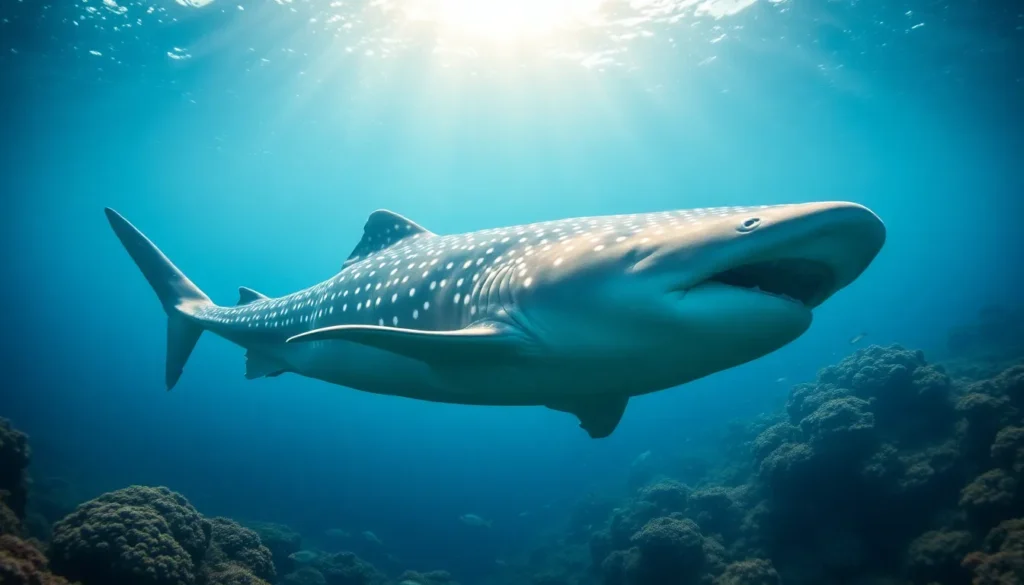
Short Answer
21 Facts About Whale Sharks
- Largest Fish Species: Whale sharks (Rhincodon typus) are the largest known fish, reaching lengths of up to 18 meters (59 feet) or more.
- Filter Feeders: Despite their size, whale sharks are filter feeders, consuming plankton, small fish, and squid by filtering water through their gills.
- Spot Patterns: Each whale shark has a unique pattern of white spots and stripes, which researchers use to identify individuals.
- Slow Growth Rate: Whale sharks grow slowly and may live for 70 to 100 years or more, although precise lifespan data remain uncertain.
- Wide Distribution: They inhabit tropical and warm-temperate oceans worldwide, often found in coastal and open waters.
- Gentle Giants: Whale sharks are known for their docile nature and pose no threat to humans, often allowing divers to approach closely.
- Migration Patterns: These sharks undertake long migrations between feeding grounds, though tracking studies are ongoing to fully understand their routes.
- Reproductive Biology: Whale sharks are ovoviviparous, meaning eggs develop and hatch inside the female before live birth; however, details about their breeding habits are limited.
- Gill Rakers: Their gill rakers are specialized to trap plankton efficiently during filter feeding.
- Slow Swimmers: Whale sharks typically swim at speeds of around 3 miles per hour (5 km/h).
- Social Behavior: Generally solitary, whale sharks sometimes aggregate in groups at abundant feeding sites.
- Endangered Status: Classified as endangered by the IUCN due to threats like fishing, habitat loss, and ship strikes.
- Scientific Discovery: The species was first described in 1828, but much about their biology remains under study.
- Size Variability: While some individuals exceed 18 meters, most average around 12 meters in length.
- Feeding Mechanisms: They can feed both by actively swimming with open mouths or by gulping water at the surface.
- Impact on Ecosystem: By consuming vast amounts of plankton, whale sharks help regulate oceanic food chains.
- Threats from Humans: Bycatch, targeted hunting, and vessel collisions are significant threats to their populations.
- Protected Areas: Several countries have established marine protected areas to safeguard whale shark habitats.
- Cultural Significance: In some coastal communities, whale sharks are revered and play roles in local folklore and tourism.
- Scientific Research: Modern tagging and photographic identification techniques have advanced the understanding of their life cycle and movements.
- Unique Senses: Whale sharks possess electroreceptors called ampullae of Lorenzini, aiding in detecting prey in murky waters.
Habitat and Behavior
Whale sharks inhabit tropical and warm-temperate oceans worldwide, primarily in open waters but occasionally near coastal regions. They prefer surface and mid-water zones where plankton is abundant, often coinciding with areas of high productivity such as upwellings and coral reefs. Their behavior is generally solitary, though they sometimes form aggregations in locations with plentiful food. Whale sharks are slow swimmers, cruising at speeds of about 3 miles per hour, which facilitates their filter-feeding lifestyle. They feed mainly on plankton, small fish, and squid by filtering enormous volumes of water through their gill rakers. Migration patterns are complex and not fully understood, but satellite tracking has revealed seasonal movements tied to feeding opportunities and possibly breeding sites. Their reproductive biology remains somewhat mysterious, with few observations of mating or birthing in the wild.
Why This Animal Matters
Whale sharks play a crucial role in marine ecosystems by regulating plankton populations, which helps maintain the balance of oceanic food webs. As a large filter feeder, they contribute to nutrient cycling and influence the dynamics of marine biodiversity. Their gentle nature and impressive size have made them a flagship species for marine conservation, raising awareness about the protection of ocean habitats. Whale sharks also have cultural significance in several coastal communities, where they are featured in folklore and attract eco-tourism, providing economic incentives for conservation. However, their endangered status highlights the need for continued efforts to mitigate threats such as fishing pressure, habitat degradation, and vessel collisions.
Common Misconceptions
Misconception: Whale sharks are whales.
Correction: Despite their name, whale sharks are fish, not mammals. They belong to the shark family and breathe through gills, unlike whales which are mammals and breathe air.
Misconception: Whale sharks are dangerous to humans.
Correction: Whale sharks are generally docile and pose no threat to humans. They are often approachable by divers and snorkelers without aggressive behavior.
Misconception: Whale sharks actively hunt large prey.
Correction: Whale sharks are filter feeders that consume tiny plankton and small fish, not large prey. Their feeding mechanism involves filtering small organisms from the water.
Misconception: Whale sharks are fast swimmers.
Correction: Whale sharks swim relatively slowly compared to many other sharks, moving at about 3 miles per hour, which suits their filter-feeding lifestyle.
Misconception: Whale sharks live only near the coast.
Correction: While whale sharks can be found near coastal areas, they primarily inhabit open ocean waters and undertake long migrations across vast distances.
FAQ
How big can whale sharks get?
Whale sharks can grow up to 18 meters (59 feet) in length, with some unconfirmed reports suggesting even larger sizes. Most individuals encountered are around 12 meters long.
Are whale sharks dangerous to humans?
No, whale sharks are generally gentle and pose no threat to humans. They are filter feeders and do not have aggressive behavior towards divers or swimmers.
Where do whale sharks live?
Whale sharks are found in tropical and warm-temperate oceans worldwide, often near coastal areas and open seas where plankton is abundant.





Leave a Reply