
Short Answer
21 Facts About Weaver Ants
- Weaver ants belong to the genus Oecophylla. They are part of the Formicidae family and are primarily found in tropical Asia and Australia.
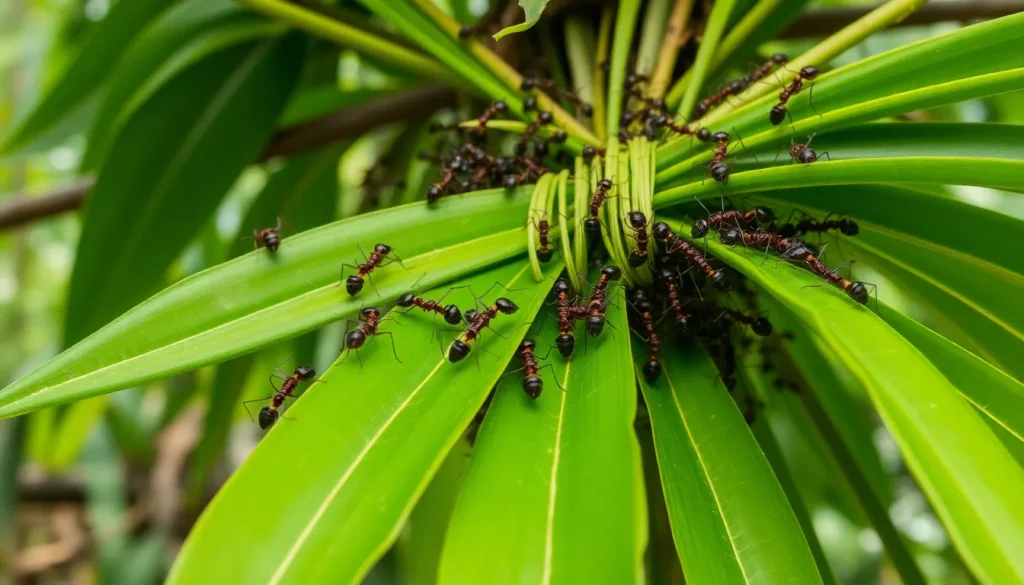
- They are famous for building nests by weaving leaves together. Weaver ants use larval silk to bind leaves, creating large, durable nests in trees.
- Weaver ants exhibit eusocial behavior. Their colonies have a well-defined caste system including workers, soldiers, and reproductive individuals.
- Workers are responsible for nest construction and defense. They also forage for food and care for the queen’s offspring.
- Soldier ants have larger heads and mandibles. They protect the colony from predators and rival ants.
- Weaver ants have excellent cooperative behavior. Multiple workers coordinate to pull leaves together while other workers apply silk to stitch them.
- Larvae produce silk used in nest construction. Unlike most ants, weaver ants use their own larvae as living silk-spinners.
- The nests can house thousands of ants. A single colony may consist of several interconnected nests.
- Weaver ants are aggressive predators. They hunt a variety of arthropods and can overpower prey larger than themselves.
- They have a mutualistic relationship with some tree species. The ants protect the host tree from herbivores and in return receive shelter and food resources.
- Weaver ants communicate through pheromones and tactile signals. This complex communication helps coordinate their activities effectively.
- Their bites are painful but not dangerous to humans. Weaver ants can bite and spray formic acid as a defense mechanism.
- Weaver ants are used in biological pest control. Due to their predation on pest insects, they benefit agricultural practices in some regions.
- They have a distinctive reddish or orange coloration. This coloration helps in species identification among ants.
- Weaver ants have strong mandibles adapted for gripping and cutting leaves. These mandibles are key to their nest-building abilities.
- Colonies can span multiple trees. Weaver ants maintain territories that cover extensive canopy areas.
- Reproduction occurs through nuptial flights. Winged males and queens leave the nest to mate and start new colonies.
- Weaver ants have a significant impact on local ecosystems. By controlling herbivore populations, they help maintain plant health.
- They are studied for their complex social structures and cooperative behavior. Weaver ants serve as a model organism in social insect research.
- Some cultures use weaver ants as food. In parts of Southeast Asia, the ants and their larvae are consumed as a protein source.
- Climate and habitat loss can affect weaver ant populations. Changes in tropical forests may threaten their natural habitats and survival.
Habitat and Behavior
Weaver ants predominantly inhabit tropical and subtropical forests, especially in Asia and Australia. They prefer living in trees where they can construct their distinctive nests by weaving together leaves using silk produced by their larvae. These ants are diurnal and highly territorial, aggressively defending their nests and foraging areas. Their behavior includes cooperative nest construction, coordinated foraging, and complex communication through chemical and tactile signals. Weaver ants prey on a broad range of insects and arthropods, which they overpower using teamwork. Their nests can consist of thousands of individuals, often spanning multiple trees to form large colonies. The ants’ social structure is divided into castes with specific roles, enabling efficient colony functioning and survival.
Why This Animal Matters
Weaver ants play a vital ecological role as natural pest controllers by preying on herbivorous insects that damage plants. This predation helps maintain the health of tropical forests and agricultural crops, making them beneficial in integrated pest management strategies. Their mutualistic relationships with certain tree species illustrate important ecological interactions that support biodiversity. Furthermore, their complex social systems and nest-building techniques provide valuable insights for entomologists and biologists studying social insects and cooperative behavior. In some cultures, weaver ants also have cultural significance as a food source. Conservation of their natural habitats is important as environmental changes threaten their populations and the ecological balance they help maintain.
Common Misconceptions
Misconception: Weaver ants are harmful pests to humans.
Correction: While their bites can be painful, weaver ants are not dangerous to humans and generally avoid conflict unless provoked.
Misconception: Weaver ants build nests using plant materials alone.
Correction: Weaver ants uniquely use silk produced by their larvae to weave leaves together, a behavior uncommon among ants.
Misconception: Weaver ants only live in one nest.
Correction: Weaver ant colonies often consist of multiple nests spread over several trees, interconnected and functioning as a single colony.
FAQ
How do weaver ants build their nests?
Weaver ants build their nests by pulling together leaves and stitching them using silk produced by their larvae. Worker ants hold the leaves in place while larvae secrete silk to bind the leaves, creating a woven structure.
Are weaver ants dangerous to humans?
Weaver ants can deliver painful bites and spray formic acid as a defense mechanism, but they are not dangerous to humans and generally avoid attacking unless threatened.
What role do weaver ants play in ecosystems?
Weaver ants help control populations of herbivorous insects by preying on them, thus protecting plants and maintaining ecological balance. They also engage in mutualistic relationships with certain tree species.

Leave a Reply