
Short Answer
21 Facts About Velvet Ants
- Velvet ants are actually wasps. Despite their name, velvet ants belong to the family Mutillidae and are a type of solitary wasp rather than true ants.
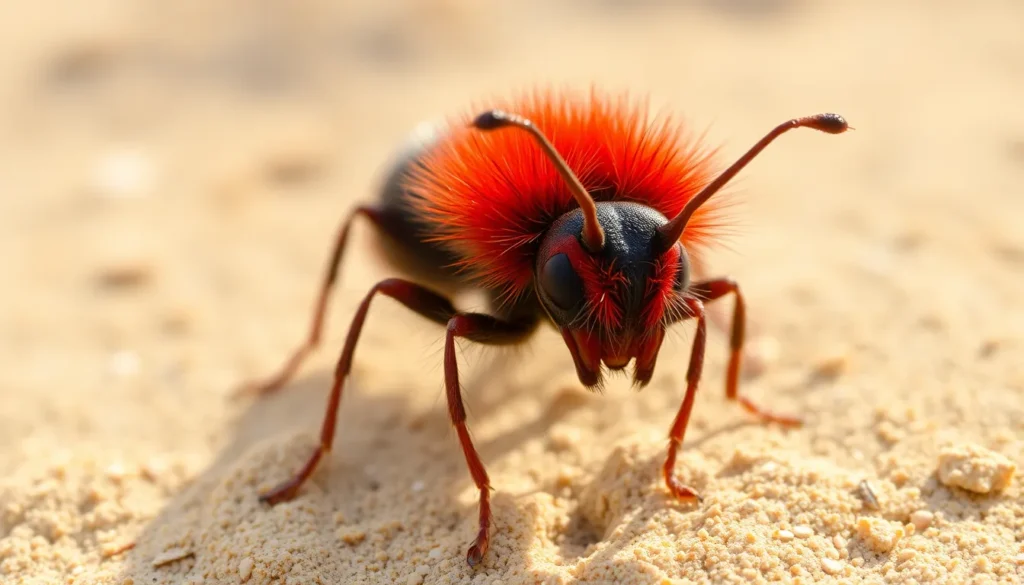
- Females are wingless, resembling ants. Female velvet ants lack wings and have a dense coat of hair, which is why they are often confused with ants.
- Males have wings and can fly. Unlike females, male velvet ants have wings and are capable of flight, which helps in finding mates.
- They are known for their bright, warning coloration. Many species display bright red, orange, or yellow hair that serves as aposematic signaling to predators.
- Velvet ants possess one of the most painful stings of any insect. Their sting is notoriously painful and has earned some species the nickname “cow killer.”
- They are solitary insects. Velvet ants do not form colonies like social wasps or ants but live independently.
- Velvet ants are parasitoids. Females lay their eggs inside the nests of ground-nesting bees or wasps, where their larvae consume the host larvae.
- Their exoskeleton is extremely tough. This provides protection against stings and bites from hosts and predators.
- They are found predominantly in dry, sandy habitats. Many species inhabit deserts and other arid environments where their hosts are common.
- Velvet ants are active during the day. They are diurnal and often seen searching for host nests in daylight.
- They have a strong chemical defense. Some species can secrete noxious chemicals to deter predators.
- Their hairs can produce a squeaking sound. When threatened, velvet ants can stridulate (rub body parts) to create warning noises.
- Velvet ants show sexual dimorphism. Apart from wing presence, males and females differ in size, coloration, and body shape.
- They have a worldwide distribution but are most diverse in North and South America. The greatest number of species is found in the Americas, especially in the southwestern United States.
- Velvet ants play a role in controlling bee and wasp populations. By parasitizing these insects, they help regulate their numbers in ecosystems.
- Their sting is used for defense rather than hunting. Since females capture hosts by infiltration, the sting primarily serves to fend off threats.
- Velvet ants have inspired folklore and myths. Due to their painful sting and bright colors, they have various local nicknames and superstitions.
- They do not pose a significant threat to humans. While their sting is painful, velvet ants are not aggressive and sting only when handled or threatened.
- Velvet ants can be used as bioindicators. Because they rely on host species, their presence can indicate the health of local bee and wasp populations.
- They are sometimes studied for their unique adaptations. Their tough exoskeleton and chemical defenses make them subjects of entomological research.
- The diversity of velvet ants includes over 3,000 species worldwide. The family Mutillidae contains thousands of species with varying colors, sizes, and behaviors.
Habitat and Behavior
Velvet ants are most commonly found in warm, dry environments such as deserts, grasslands, and sandy areas. These habitats provide suitable nesting sites for their hosts, which are typically ground-nesting bees or wasps. Females actively search for host nests by walking on the ground, using their antennae and sensory organs to locate larvae or pupae of their prey. They then insert their ovipositor to lay eggs inside the host’s nest. The emerging larvae feed on the host larvae, eventually killing them. Males, in contrast, are winged and primarily focus on finding mates during their brief adult life.
Velvet ants are solitary and do not form colonies. Their bright coloration warns potential predators of their painful sting and chemical defenses. When threatened, they may stridulate to produce a warning sound. Their thick exoskeleton provides additional protection against attacks. Velvet ants are primarily diurnal and most active during warm daylight hours.
Why This Animal Matters
Velvet ants play an important ecological role as natural regulators of bee and wasp populations. By parasitizing these insects, they contribute to maintaining the balance within their ecosystems. Their presence can serve as an indicator of ecosystem health, especially regarding pollinator species. Additionally, the study of velvet ants offers insights into insect adaptations such as chemical defenses, mimicry, and parasitoid behavior.
Although their sting is painful, velvet ants are not aggressive and do not pose significant risks to humans, making them an important but often overlooked component of biodiversity. Their unique life cycle and behaviors add to the complexity of insect ecology and contribute to scientific understanding of parasitism and predator-prey relationships.
Common Misconceptions
Misconception: Velvet ants are true ants.
Correction: Velvet ants are actually wingless female wasps belonging to the family Mutillidae, not ants.
Misconception: Velvet ants are aggressive and attack humans unprovoked.
Correction: Velvet ants are solitary and non-aggressive, stinging humans only when handled or threatened.
Misconception: All velvet ants have wings.
Correction: Only males have wings; females are wingless and resemble ants.
Misconception: Velvet ants kill cows with their sting.
Correction: The nickname “cow killer” refers to the intense pain of their sting, but velvet ants do not harm large animals like cows.
FAQ
Are velvet ants dangerous to humans?
Velvet ants are not aggressive and usually sting only when handled or threatened. While their sting is very painful, it poses no serious medical threat to healthy adults.
Why are velvet ants called 'cow killers'?
The nickname 'cow killer' refers to the extremely painful sting of some velvet ant species, but they do not harm cows or other large animals.
How can you distinguish a velvet ant from a true ant?
Female velvet ants are wingless and hairy but belong to the wasp family Mutillidae. True ants have different body structures and behaviors, and males of velvet ants have wings, unlike ants.



Leave a Reply