
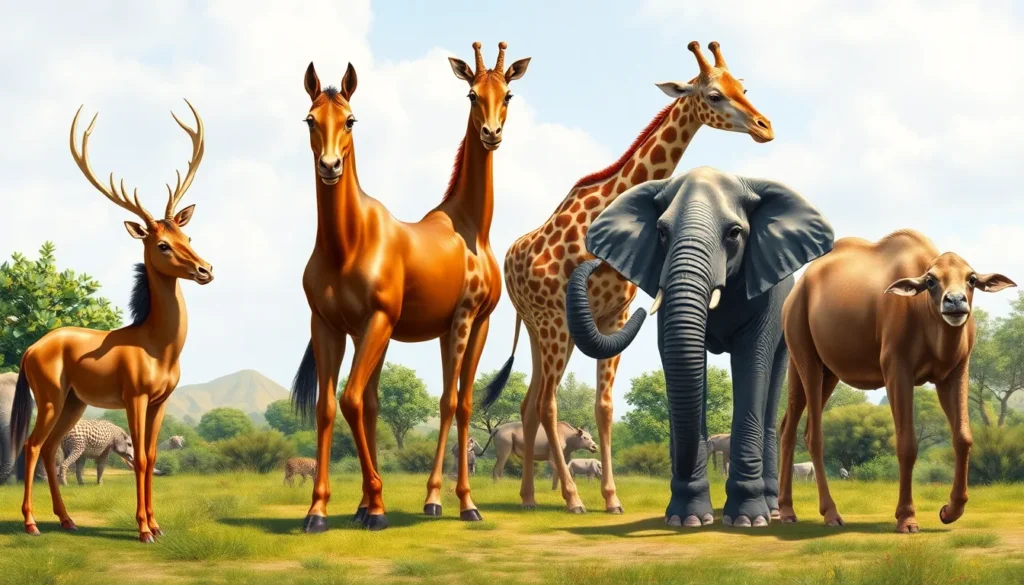
Short Answer
21 Facts About Ungulates
- Ungulates include both odd-toed and even-toed groups. The two main orders are Perissodactyla (odd-toed) and Artiodactyla (even-toed), differentiated by the number of weight-bearing toes.
- They possess hooves which are modified toenails. These hooves provide protection and support for walking on various terrains.
- Ungulates are primarily herbivorous. Their diets mainly consist of grasses, leaves, and other plant materials, adapted through specialized teeth and digestive systems.
- Many ungulates have complex stomachs. Ruminants, a subgroup of even-toed ungulates, have multi-chambered stomachs to efficiently digest tough plant fibers.
- Ungulates vary greatly in size. They range from small species like duikers to the large African elephant, the largest extant land mammal.
- Sexual dimorphism is common. Many species exhibit differences in size or ornamentation between males and females, such as antlers or horns.
- They play key roles as prey animals. Ungulates are a primary food source for many large carnivores and thus integral to food webs.
- Some ungulates are adapted for speed and endurance. Species like pronghorns and gazelles have evolved to escape predators through rapid and sustained running.
- Ungulates exhibit a variety of social structures. They may live solitarily, in pairs, or in large herds depending on species and environmental conditions.
- Many ungulates undertake seasonal migrations. These movements help them access resources and avoid harsh climates.
- Antlers and horns differ fundamentally. Antlers, found mainly in deer, are shed annually, while horns, seen in bovids, are permanent structures.
- Ungulates have diverse reproductive strategies. Gestation periods, offspring numbers, and parental care vary widely among species.
- The evolutionary history of ungulates dates back to the Paleocene. Fossil records show their ancestors emerged shortly after the extinction of dinosaurs.
- Elephants, despite lacking typical hooves, are closely related to some ungulates. They belong to the order Proboscidea, which is evolutionarily linked to sea cows and hyraxes.
- Ungulates have influenced human culture and economy. They have been domesticated for food, labor, and companionship.
- Many ungulates face conservation challenges. Habitat loss, hunting, and climate change threaten several species.
- Ungulate hooves grow continuously and require regular wear. Natural behaviors like walking on abrasive surfaces help maintain hoof health.
- Some ungulates have specialized adaptations for harsh environments. Camels, for example, have padded feet and water conservation mechanisms suited for deserts.
- Ungulates communicate through visual, auditory, and olfactory signals. These methods facilitate mating, territory defense, and social bonding.
- Ungulates contribute to ecosystem engineering. Their grazing and trampling affect plant communities and soil properties.
- Ungulates exhibit a wide range of lifespans. Smaller species may live just a few years, while larger ones like elephants can live over 60 years in the wild.
Habitat and Behavior
Ungulates inhabit a broad range of ecosystems, from dense forests and savannas to mountains, deserts, and wetlands. Their distribution spans all continents except Antarctica, with species adapted to local climatic and ecological conditions. Behaviorally, ungulates display diverse social systems, including solitary lifestyles, monogamous pairs, and large herds. Many rely on keen senses and speed to avoid predators, while others use camouflage or defensive structures like horns. Seasonal migrations and territoriality are common behavioral traits that help ungulates optimize resource use and reproductive success. Their feeding strategies are closely linked to their digestive adaptations, with ruminants fermenting plant material in specialized stomach chambers and non-ruminants relying on hindgut fermentation or other mechanisms.
Why This Animal Matters
Ungulates are essential components of terrestrial ecosystems, serving as primary consumers that convert plant biomass into energy available to carnivores. Their grazing shapes vegetation dynamics, influencing biodiversity and habitat structure. Ungulates also play important cultural and economic roles in human societies through domestication, hunting, and symbolism in art and mythology. Conservation of wild ungulate populations is critical for maintaining ecological balance, supporting predator species, and preserving natural heritage. Additionally, studying ungulates provides insight into evolutionary biology, animal behavior, and environmental adaptation.
Common Misconceptions
Misconception: All hoofed animals are ruminants.
Correction: While many ungulates are ruminants with multi-chambered stomachs, some, such as horses and rhinoceroses, are non-ruminant herbivores with different digestive systems.
Misconception: Hooves are the same as claws or nails.
Correction: Hooves are specialized, thickened structures derived from toenails but are distinct in their composition and function, adapted for weight-bearing and protection.
FAQ
What distinguishes odd-toed from even-toed ungulates?
Odd-toed ungulates (Perissodactyla) bear weight primarily on one or three toes, such as horses and rhinos, while even-toed ungulates (Artiodactyla) bear weight on two toes, like deer and cattle.
Are all ungulates herbivores?
Most ungulates are herbivores, adapted to eating plant material, though the specific diets and digestive adaptations vary among species.
Why are ungulates important to ecosystems?
Ungulates act as primary consumers, shaping vegetation patterns and serving as prey for predators, thereby maintaining ecological balance.



Leave a Reply