
Short Answer
21 Facts About Snowshoe Hare Cycles
- Cyclic Population Fluctuations: Snowshoe hare populations typically fluctuate in a roughly 10-year cycle, with periods of rapid growth followed by sharp declines.
- Predator-Prey Dynamics: These cycles are closely linked to predator populations, especially lynx, whose numbers rise and fall in response to hare abundance.
- Classic Ecological Example: Snowshoe hare cycles are often cited as a textbook example of predator-prey population dynamics in ecology.
- Vegetation Impact: High hare populations can lead to overbrowsing of vegetation, reducing food availability and contributing to population crashes.
- Role of Food Quality: Changes in plant nutritional quality during peak hare densities can influence their survival and reproduction rates.
- Stress and Immunity: High population densities increase stress in hares, weakening immune systems and increasing susceptibility to disease.
- Climate Influence: Snow conditions and climate variations can affect survival rates during winter, influencing cycle amplitude and timing.
- Reproductive Rates: Hares have high reproductive potential, which supports rapid population growth during favorable conditions.
- Mortality Factors: Predation is the primary cause of mortality, but starvation and disease also play significant roles during declines.
- Spatial Variation: Cycle amplitude and phase can vary geographically, with some regions exhibiting more pronounced or delayed cycles.
- Genetic Adaptations: Some research suggests hares may undergo genetic changes in response to cyclic pressures, although this is still being studied.
- Role of Alternative Predators: Besides lynx, other predators like coyotes, foxes, and raptors also influence hare populations.
- Historical Data: Fur trapping records from the 19th century first revealed these cyclical population patterns.
- Impact on Ecosystem: Hare population cycles influence the abundance and behavior of many other species in boreal ecosystems.
- Behavioral Changes: During peak densities, hares may exhibit increased aggression and altered foraging behaviors.
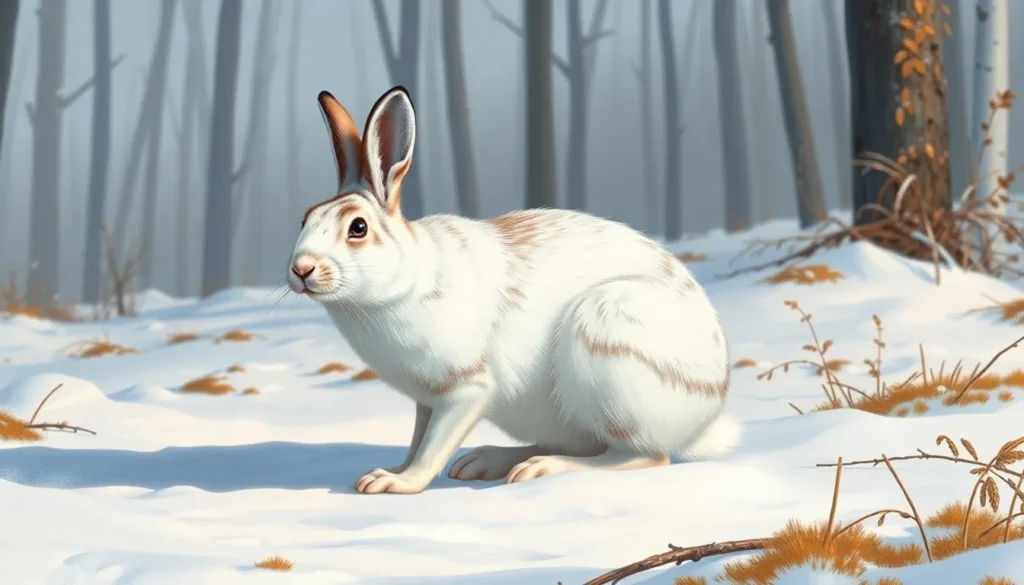
- Seasonal Coat Color Change: Snowshoe hares change coat color seasonally for camouflage, which also affects their vulnerability during population lows and highs.
- Human Influence: Habitat fragmentation and climate change may alter traditional cycle patterns.
- Population Monitoring: Long-term studies and monitoring programs have provided valuable data on these cycles.
- Modeling Efforts: Ecologists use mathematical models to better understand and predict hare cycle dynamics.
- Conservation Status: Snowshoe hares are not currently endangered, but their cycles are important for maintaining ecosystem balance.
- Educational Value: Studies of snowshoe hare cycles have contributed significantly to the development of ecological theory.
Habitat and Behavior
Snowshoe hares (Lepus americanus) inhabit boreal and montane forests across North America, ranging from Alaska through Canada and into parts of the northern United States. They prefer dense coniferous or mixed woodlands that provide ample cover from predators and abundant food sources such as shrubs, grasses, and twigs. Their large hind feet, adapted for moving on snow, give them their common name. Behaviorally, snowshoe hares are primarily crepuscular and nocturnal, feeding mostly at dawn and dusk. They rely heavily on camouflage, changing their fur color from brown in summer to white in winter to blend with the snowy environment. During population peaks, hares may become more visible and active, increasing predation risk. To evade predators, they use rapid zigzag movements and seek cover in dense vegetation or snow burrows.
Why This Animal Matters
Snowshoe hares play a crucial ecological role as both herbivores and prey species. Their population cycles significantly affect the dynamics of boreal forest ecosystems. High hare densities can influence plant community composition through intense browsing, while their population declines can lead to predator scarcity or shifts to alternative prey. The cyclical relationship with predators like the Canada lynx has been a foundational case study in ecology, helping scientists understand population regulation and predator-prey interactions. Additionally, snowshoe hares contribute to cultural traditions and subsistence hunting among Indigenous peoples. Understanding hare cycles also aids in wildlife management and conservation strategies, especially considering potential impacts of climate change on these sensitive population patterns.
Common Misconceptions
Misconception: Snowshoe hare populations crash solely due to predation.
Correction: While predation is a significant factor, food availability, disease, stress, and environmental conditions also contribute to population declines.
Misconception: The 10-year cycle is identical everywhere the snowshoe hare lives.
Correction: Cycle length and amplitude can vary geographically, with some areas showing less pronounced or irregular cycles due to local ecological factors.
FAQ
What causes the population cycles of snowshoe hares?
The population cycles are caused by a combination of factors including predation pressure, food availability, disease, and environmental conditions, with predators such as the Canada lynx playing a key role.
How long do snowshoe hare population cycles last?
These cycles typically last about 10 years, though the exact length and intensity can vary by region.
Do snowshoe hares change color seasonally?
Yes, snowshoe hares change their fur color from brown in the summer to white in the winter, providing camouflage against snow.

Leave a Reply