
Short Answer
21 Facts About Sea Squirts (Tunicates)
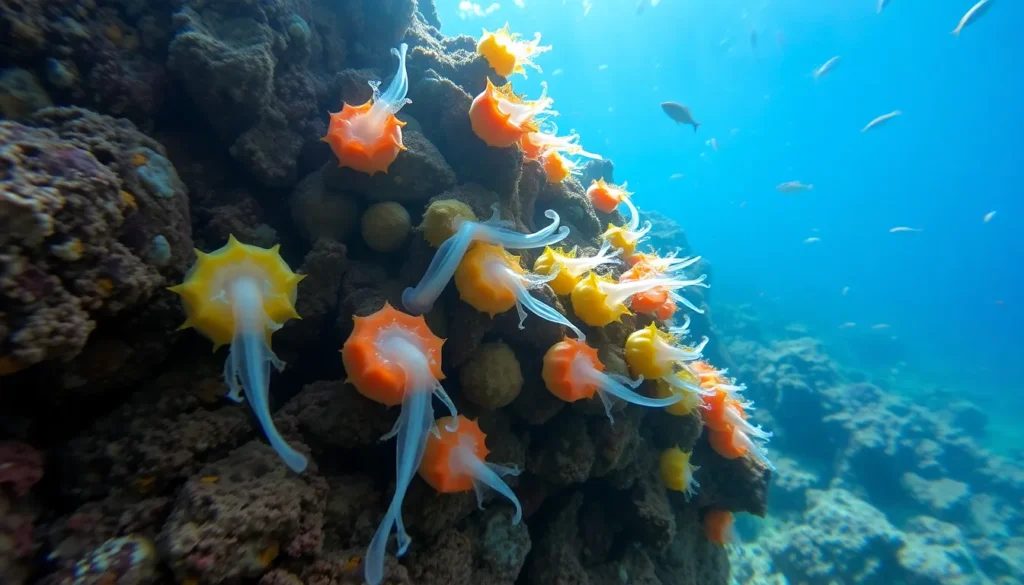
- Sea squirts are marine filter feeders. They draw water into their bodies through an incurrent siphon, filter out plankton and organic particles, and expel the filtered water through an excurrent siphon.
- They belong to the subphylum Tunicata. Tunicates are part of the phylum Chordata, making them more closely related to vertebrates than many other invertebrates.
- Sea squirts have a tough outer covering called a tunic. This tunic is composed of a cellulose-like carbohydrate called tunicin, which is unusual for animals.
- Adult sea squirts are sessile. Most species attach themselves permanently to rocks, docks, or ship hulls.
- Their larvae possess a notochord. Unlike adults, tunicate larvae have a tail with a notochord and a dorsal nerve cord, features shared with vertebrates.
- Sea squirts undergo metamorphosis. The free-swimming larval stage transforms into a sessile adult, losing most chordate characteristics in the process.
- They reproduce both sexually and asexually. Many species release eggs and sperm into the water for external fertilization, while some can reproduce by budding.
- Some species form colonies. Colonial tunicates consist of many genetically identical individuals connected by a shared tunic.
- Sea squirts can regenerate. Certain species can regrow lost body parts, an ability useful for survival and research.
- They are found in oceans worldwide. Sea squirts inhabit a range of marine environments from shallow intertidal zones to deep sea floors.
- Sea squirts play a role in biofouling. Their tendency to settle on man-made structures can cause maintenance challenges for ships and offshore installations.
- They have a simple heart that can reverse pumping direction. This unique circulatory feature helps circulate blood efficiently without a complex cardiovascular system.
- Sea squirts filter large volumes of water. Some species can filter several liters of seawater per hour, contributing to water clarity and nutrient cycling.
- They are used in scientific research. Due to their chordate features and simple genomes, tunicates are studied for developmental biology and evolutionary research.
- Sea squirts produce bioactive compounds. Some species synthesize chemicals with potential pharmaceutical applications, such as anti-cancer agents.
- They have few predators. Their tough tunic and chemical defenses deter many potential predators.
- Sea squirts can impact local ecosystems. By filtering plankton, they influence nutrient availability and food webs in their habitats.
- They are indicators of environmental health. Changes in sea squirt populations can reflect water quality and pollution levels.
- Sea squirts vary greatly in size and shape. Species range from a few millimeters to several centimeters, with diverse forms including solitary, encrusting, and branching colonies.
- They have a simple nervous system. Adult sea squirts possess a rudimentary neural ganglion but lack complex brains.
- Some species exhibit bioluminescence. A few tunicates produce light, possibly for defense or communication, although this phenomenon is not widespread.
Habitat and Behavior
Sea squirts inhabit marine environments globally, from shallow coastal waters to deep ocean floors. Typically, adults are sessile, attaching themselves to hard substrates such as rocks, shells, docks, and ship hulls. Their sedentary lifestyle involves filtering seawater for food, primarily plankton and organic particles, using their siphons. Larvae are free-swimming and use their notochord and tail for locomotion before settling down and undergoing metamorphosis into adults. Sea squirts can be solitary or colonial, with colonies connected by a common tunic. Their ability to filter large volumes of water influences local water quality and nutrient cycling. While mostly sedentary, some species can move slightly by contracting their bodies or detaching to relocate. Their reproductive strategies include both sexual reproduction via external fertilization and asexual reproduction through budding in colonial species.
Why This Animal Matters
Sea squirts are ecologically significant as filter feeders that help maintain water quality and nutrient balance in marine ecosystems. They serve as a food source for some predators despite their chemical defenses and tough tunics. Scientifically, tunicates are valuable for research into chordate evolution, developmental biology, and regenerative medicine due to their simple body plans and genetic makeup. Additionally, some species produce bioactive compounds with potential medicinal applications, including anti-cancer properties. Their role in biofouling impacts maritime industries, prompting research into antifouling technologies. Sea squirts also act as bioindicators, with their population health reflecting changes in marine environmental conditions such as pollution and habitat alteration.
Common Misconceptions
Misconception: Sea squirts are simple sponges.
Correction: Although both are filter feeders and sessile, sea squirts belong to the phylum Chordata and possess chordate features during their larval stage, distinguishing them from sponges which are in the phylum Porifera.
Misconception: Sea squirts are plants because they are immobile and attach to surfaces.
Correction: Sea squirts are animals with complex biological systems; their immobility is a lifestyle adaptation rather than a characteristic of plants.
Misconception: All sea squirts are solitary organisms.
Correction: Many sea squirt species form colonies made up of connected individuals sharing a common tunic.
Misconception: Sea squirts have no evolutionary relationship to vertebrates.
Correction: Tunicates are chordates and share a common ancestor with vertebrates, making them important in understanding vertebrate evolution.
Misconception: Sea squirts are harmless and have no impact on human activities.
Correction: While generally harmless, sea squirts can cause biofouling on ships and underwater structures, leading to economic and maintenance challenges.
FAQ
What are sea squirts?
Sea squirts are marine invertebrates belonging to the subphylum Tunicata within the phylum Chordata. They are sessile filter feeders found worldwide in marine environments.
How do sea squirts feed?
Sea squirts feed by drawing water into their bodies through an incurrent siphon, filtering out plankton and organic particles using a mucous net, and expelling filtered water through an excurrent siphon.
Are sea squirts related to vertebrates?
Yes, sea squirts are chordates and share a common evolutionary ancestor with vertebrates. Their larvae have chordate features such as a notochord and dorsal nerve cord, linking them to vertebrate lineage.




Leave a Reply