
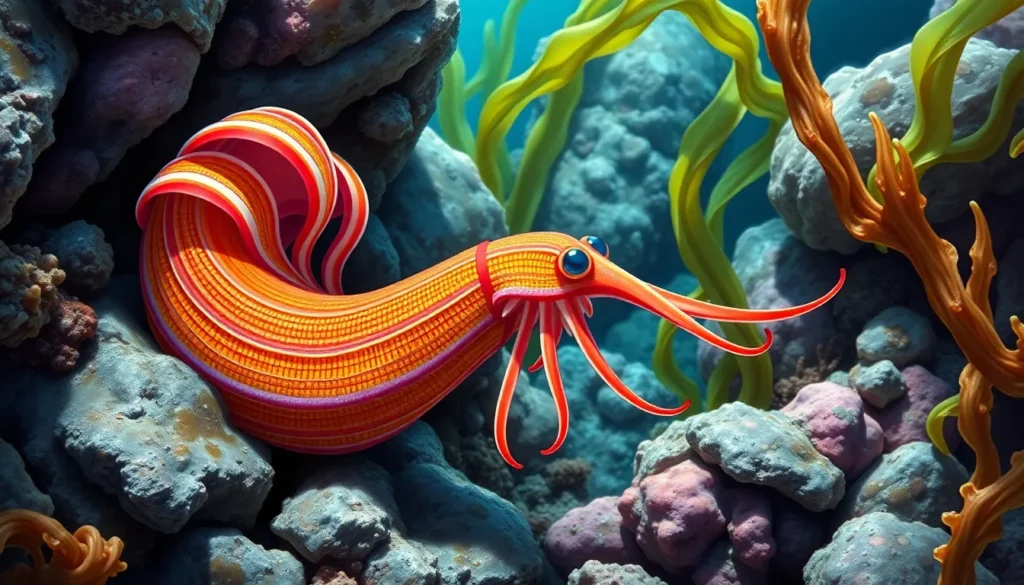
Short Answer
21 Facts About Ribbon Worms (Nemertea)
- Ribbon Worms Are Part of the Phylum Nemertea.
Ribbon worms belong to a distinct phylum called Nemertea, which includes about 1,300 known species of mostly marine worms. - They Have a Unique Proboscis.
Ribbon worms possess an eversible proboscis housed in a fluid-filled cavity called the rhynchocoel, used to capture prey. - Their Bodies Are Long and Ribbon-Like.
They typically have flattened, elongated bodies, often brightly colored, which can range from a few millimeters to several meters in length. - Some Species Are Among the Longest Invertebrates.
Lineus longissimus, a species of ribbon worm, can reach lengths exceeding 30 meters, making it one of the longest invertebrates known. - They Are Mostly Marine but Can Be Found in Freshwater and Terrestrial Habitats.
While most ribbon worms live in marine environments, some species inhabit freshwater or moist terrestrial ecosystems. - Ribbon Worms Are Predators.
They primarily feed on small invertebrates, using their proboscis to immobilize or entangle prey with toxins or sticky secretions. - Their Proboscis Is Not a Stinging Tentacle.
Unlike cnidarians, their proboscis lacks stinging cells but often delivers toxins through mucus to subdue prey. - Ribbon Worms Have a Closed Circulatory System.
They possess a closed circulatory system that is unusual among invertebrates, aiding efficient oxygen transport. - They Exhibit Regenerative Abilities.
Many ribbon worms can regenerate lost body parts, including their proboscis and sections of their trunk. - Ribbon Worms Lack a True Coelom.
They are considered acoelomates or pseudocoelomates, as their body cavity is not fully lined with mesodermal tissue. - They Have a Simple Nervous System.
Their nervous system consists of paired cerebral ganglia and nerve cords, enabling basic sensory and motor functions. - Reproduction Can Be Sexual or Asexual.
Ribbon worms reproduce sexually with separate sexes or hermaphroditically and can also reproduce asexually by fragmentation. - Some Species Lay Eggs that Develop into Larvae.
Their developmental stages often include a free-swimming larval form called a pilidium in marine species. - Their Mucus Can Be Toxic.
Many ribbon worms produce mucus containing toxins that serve as defense against predators and aid in prey capture. - They Can Move by Muscular Contractions or Ciliary Action.
Ribbon worms use their muscles to crawl or swim, and some also employ cilia on their ventral surface for movement. - Some Species Exhibit Bright and Varied Coloration.
Colors range from bright reds and oranges to greens and browns, possibly serving as camouflage or warning signals. - Ribbon Worms Play Important Ecological Roles.
As predators, they help regulate populations of smaller invertebrates in marine and freshwater ecosystems. - They Are Found Worldwide.
Ribbon worms inhabit diverse regions across global oceans and some freshwater systems, from shallow waters to deep-sea environments. - Their Fossil Record Is Sparse.
Due to their soft bodies, ribbon worms have left few fossils, making their evolutionary history challenging to reconstruct. - Scientific Interest in Ribbon Worms Has Grown Recently.
Research focuses on their unique anatomy, regenerative ability, and potential biomedical applications of their toxins. - Ribbon Worms Are Not Harmful to Humans.
Despite their toxins, ribbon worms pose no known danger to humans and do not sting or bite people.
Habitat and Behavior
Ribbon worms primarily inhabit marine environments, often residing in intertidal zones, under rocks, within sediments, or among seaweed. Some species have adapted to freshwater habitats such as streams and ponds, and a few occupy moist terrestrial environments like forest floors. Their behavior is generally predatory; they use their eversible proboscis to capture small invertebrates such as annelids, mollusks, and crustaceans. Their movement varies by species, including crawling via muscular contractions or using cilia to glide over surfaces. Ribbon worms tend to be solitary and are more active during the night or in low light conditions, which reduces predation risk. Regeneration allows them to recover from injury, and some species can reproduce by fragmentation or budding, contributing to their resilience in diverse habitats.
Why This Animal Matters
Ribbon worms play an important ecological role as predators of smaller invertebrates, helping to maintain balanced populations in their ecosystems. Their presence influences the community structure of benthic environments, contributing to nutrient cycling and energy flow. Additionally, their unique biology, including the specialized proboscis and regenerative capacity, makes them subjects of scientific study, especially in evolutionary biology and regenerative medicine. The toxins produced by some species are under investigation for potential pharmaceutical applications. Although not of direct economic importance, ribbon worms are indicators of environmental health and biodiversity, reflecting ecosystem changes in marine and freshwater environments.
Common Misconceptions
Misconception: Ribbon worms are dangerous and can sting humans.
Correction: Ribbon worms do not sting or bite humans and are not harmful despite producing toxins used for prey capture and defense.
Misconception: Ribbon worms are a type of flatworm.
Correction: Although they may appear similar, ribbon worms belong to the separate phylum Nemertea and differ anatomically and biologically from flatworms (Platyhelminthes).
Misconception: All ribbon worms live in the ocean.
Correction: While most are marine, some ribbon worm species inhabit freshwater and moist terrestrial environments.
Misconception: Their proboscis is used for stinging like jellyfish tentacles.
Correction: Ribbon worm proboscises do not sting but use toxins in mucus and mechanical entanglement to capture prey.
FAQ
What makes ribbon worms unique compared to other worms?
Ribbon worms are unique due to their eversible proboscis housed in a rhynchocoel, a closed circulatory system, and their ability to regenerate large portions of their body.
Are ribbon worms dangerous to humans?
No, ribbon worms are not harmful to humans. Although they produce toxins to capture prey and defend themselves, they do not sting or bite people.
Where are ribbon worms typically found?
Ribbon worms are mostly found in marine environments worldwide, but some species inhabit freshwater and moist terrestrial habitats.




Leave a Reply