
Short Answer
21 Facts About Narwhals
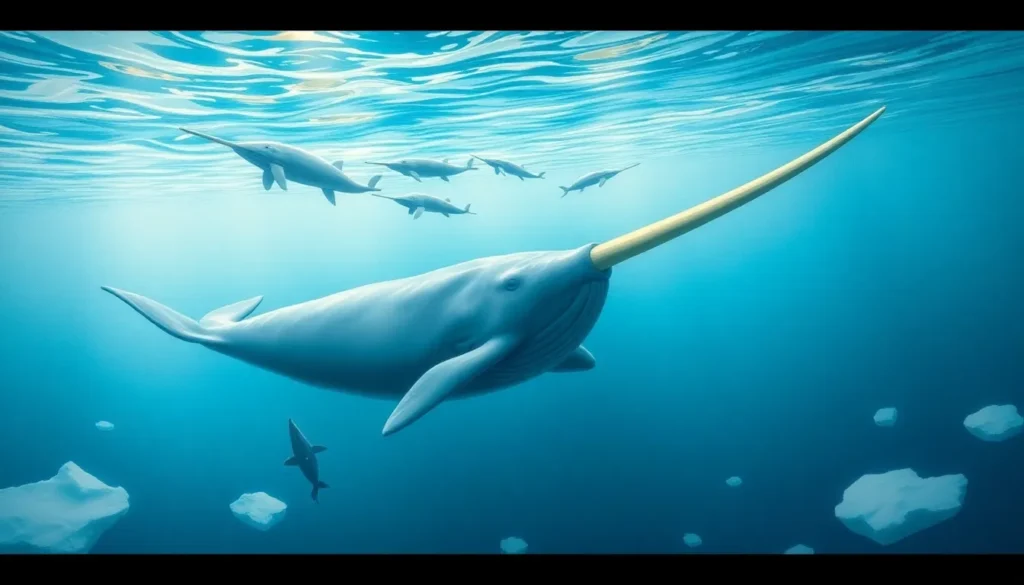
- Unique Tusk: Male narwhals are known for their long, spiral tusk, which is actually an elongated upper left canine tooth that can grow up to 10 feet long.
- Tusk Purpose: The tusk is believed to have sensory capabilities, detecting changes in the environment such as water temperature and pressure.
- Both Sexes Have Tusks Rarely: Although primarily males have tusks, some females also develop smaller tusks.
- Scientific Name: The narwhal’s scientific name is Monodon monoceros, meaning “one-tooth, one-horn.”
- Arctic Habitat: Narwhals inhabit Arctic waters around Greenland, Canada, and Russia.
- Size: Adult narwhals typically measure 13 to 18 feet long and weigh between 1,800 and 3,500 pounds.
- Diet: Narwhals primarily feed on fish, squid, and shrimp found in deep Arctic waters.
- Diving Ability: They can dive to depths of 1,500 meters (nearly 5,000 feet) to forage for food.
- Social Animals: Narwhals travel in groups called pods, which usually consist of 10 to 20 individuals.
- Communication: They use clicks, whistles, and knocks to communicate and navigate underwater.
- Migration: Narwhals migrate seasonally, moving offshore in summer and returning to coastal areas in winter.
- Predators: Their main predators are orcas and polar bears.
- Blubber Layer: Narwhals have a thick blubber layer that insulates them from cold Arctic temperatures.
- Reproduction: Females give birth to a single calf after a 15-month gestation period.
- Longevity: Narwhals can live up to 50 years in the wild.
- Conservation Status: The International Union for Conservation of Nature (IUCN) lists narwhals as Near Threatened due to climate change and hunting pressures.
- Traditional Hunting: Indigenous Arctic communities have hunted narwhals sustainably for centuries, using their meat and tusks.
- Scientific Study: Narwhals are difficult to study due to their remote habitat and elusive behavior.
- Mythological Associations: Historically, narwhal tusks were sold as unicorn horns in medieval Europe.
- Adaptations: Narwhals lack a dorsal fin, which may help them swim under ice.
- Climate Change Impact: Melting sea ice and changing ocean conditions are affecting narwhal distribution and food availability.
Habitat and Behavior
Narwhals primarily inhabit the cold, icy waters of the Arctic Ocean, especially around Greenland, Canada’s Nunavut region, and parts of Russia. They are highly adapted to this environment, with a thick layer of blubber to insulate against freezing temperatures. These whales are known for their deep-diving abilities, reaching depths up to 1,500 meters to find prey such as fish, squid, and shrimp. Narwhals are social animals that travel in groups called pods, which provide protection and assist in navigating the challenging Arctic seascape. Their seasonal migrations involve moving closer to shore during the winter and venturing offshore in summer. Their lack of a dorsal fin helps them maneuver beneath ice sheets, and their specialized tusk may serve sensory roles in their environment.
Why This Animal Matters
Narwhals play an important ecological role as mid-level predators in the Arctic marine food web, helping to regulate populations of fish and invertebrates. Culturally, they hold significance for Indigenous Arctic peoples, who have traditionally hunted narwhals for sustenance and materials. The narwhal’s tusk has also inspired myths and legends, contributing to human cultural history by being mistaken for the horn of the mythical unicorn. Conservation-wise, narwhals are indicators of Arctic ecosystem health, and their sensitivity to climate change makes them important subjects for scientific study. Protecting narwhals helps preserve biodiversity and traditional ways of life in the Arctic region.
Common Misconceptions
Misconception: Narwhal tusks are magical or have healing powers.
Correction: The tusks are specialized teeth with sensory functions but have no magical properties. Historical beliefs about their powers are myths.
Misconception: Only male narwhals have tusks.
Correction: While most tusks are found in males, some females also develop smaller tusks, although this is less common.
Misconception: Narwhals are mythical creatures.
Correction: Narwhals are real marine mammals scientifically studied and documented in Arctic regions.
FAQ
Why do narwhals have tusks?
Narwhal tusks are elongated teeth that are believed to serve multiple purposes, including sensory perception, dominance displays, and possibly mating rituals. The tusks contain millions of nerve endings that may help narwhals detect changes in their environment.
Are narwhals endangered?
Narwhals are classified as Near Threatened by the IUCN. While not currently endangered, they face threats from climate change, habitat loss, and hunting, which could impact their populations in the future.
Can female narwhals have tusks?
Yes, although tusks are much more common in males, some female narwhals also develop smaller tusks. This is less frequent and not as pronounced as in males.




Leave a Reply