
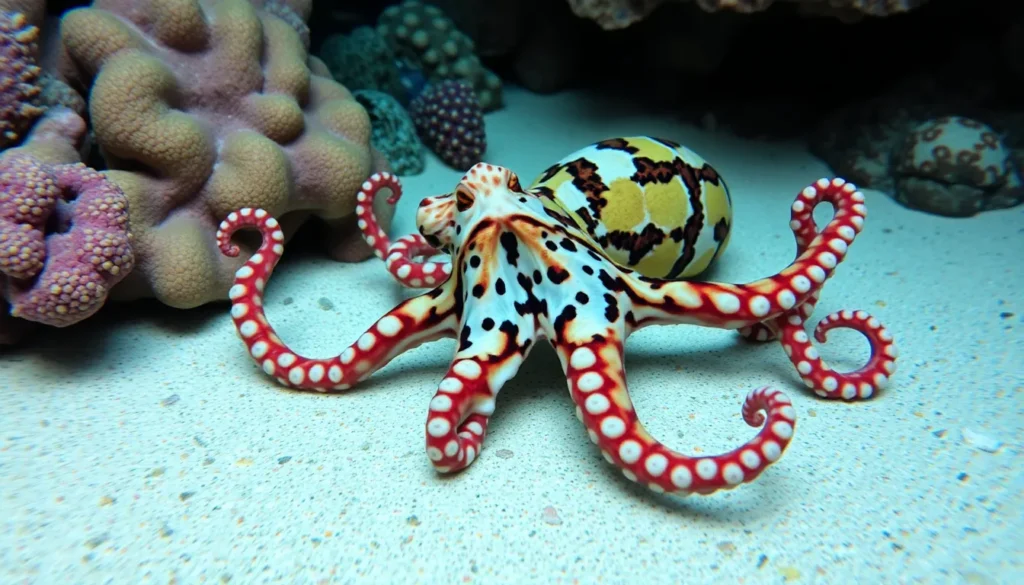
Short Answer
21 Facts About Mimic Octopus
- Exceptional Mimicry
The mimic octopus is renowned for its ability to imitate the appearance and behaviors of various marine animals such as lionfish, flatfish, and sea snakes to avoid predators. - Scientific Name
Its scientific name is Thaumoctopus mimicus, derived from Greek words meaning “wonderful octopus”. - Discovery
It was first described scientifically in 1998, making it a relatively recent discovery in marine biology. - Size
The mimic octopus typically grows to about 60 cm (24 inches) in length, including its arms. - Habitat
It is commonly found in shallow, muddy or sandy coastal waters of Southeast Asia, particularly Indonesia. - Behavioral Flexibility
Unlike many octopuses, it actively changes its behavior and posture to mimic various animals, demonstrating complex behavioral adaptability. - Predator Avoidance
Its mimicry serves as an effective defense mechanism, deterring predators by resembling venomous or dangerous species. - Camouflage Skills
Besides mimicry, it can also camouflage by changing its skin color and texture to blend into its surroundings. - Diet
The mimic octopus feeds on small fish, crabs, and worms, using its arms to probe into crevices and sediment. - Locomotion
It can swim by jet propulsion but often crawls along the sea floor using its arms. - Intelligence
Like other octopuses, it exhibits high intelligence, including problem-solving skills and learning abilities. - Reproduction
Females lay eggs and guard them until they hatch, after which the young are independent. - Short Lifespan
The mimic octopus has a lifespan of about 1 to 2 years in the wild. - Venomous Mimicry
It sometimes mimics highly venomous creatures, such as the sea snake, to further discourage predators. - Unique Arm Postures
It uses specific arm positions to imitate different animals, for example, spreading two arms to mimic flatfish. - Non-Venomous
Despite mimicking venomous animals, the mimic octopus itself is not venomous. - Solitary Nature
It is primarily solitary, coming together only for mating purposes. - Daytime Activity
Unlike many octopus species that are nocturnal, the mimic octopus is often active during the day. - Scientific Interest
Its mimicry behavior has attracted significant scientific interest for studying animal behavior and evolution. - Environmental Sensitivity
Being a coastal species, it is sensitive to habitat disturbance such as pollution and coastal development. - Conservation Status
There is limited data on its population status, but habitat threats may impact its numbers.
Habitat and Behavior
The mimic octopus inhabits shallow tropical and subtropical waters of the Indo-Pacific region, particularly in muddy or sandy substrates near river mouths and coastal areas. It prefers environments where it can easily hide and forage for small prey. Behaviorally, the mimic octopus is notable for its extraordinary ability to imitate other animals as a survival strategy. It alters its body shape, coloration, and movement patterns to resemble animals such as lionfish, flatfish, crabs, and venomous sea snakes. This mimicry functions primarily as a defense mechanism against predators. The species is mostly solitary, using its intelligence to exploit its environment effectively. It employs both crawling and jet propulsion to move and hunts by probing into sediment or crevices. Unlike many octopuses that are nocturnal, the mimic octopus is often observed during daylight hours, which may relate to its reliance on visual mimicry.
Why This Animal Matters
The mimic octopus plays an important ecological role as both predator and prey within its marine ecosystem. By controlling populations of small fish, crustaceans, and worms, it contributes to the balance of benthic communities. Its unique mimicry behavior provides valuable insights into evolutionary biology, animal communication, and adaptive strategies, making it a significant subject for scientific research. Additionally, the mimic octopus highlights the biodiversity of coastal marine habitats, many of which face threats from pollution and habitat degradation. Understanding and preserving such species helps maintain healthy marine ecosystems and supports broader conservation efforts.
Common Misconceptions
Misconception: The mimic octopus is venomous.
Correction: While it mimics venomous animals like sea snakes and lionfish, the mimic octopus itself is not venomous.
Misconception: The mimic octopus can mimic any animal it sees.
Correction: Its mimicry is limited to a specific set of species it has evolved to imitate, primarily those that serve as effective deterrents to predators.
Misconception: The mimic octopus uses its mimicry to hunt prey.
Correction: The primary function of its mimicry is defense against predators, not for capturing prey.
FAQ
What makes the mimic octopus unique among octopuses?
The mimic octopus is unique due to its ability to imitate the appearance and behaviors of various marine animals, such as lionfish, flatfish, and sea snakes, as a defense mechanism.
Is the mimic octopus dangerous to humans?
No, the mimic octopus is not dangerous or venomous to humans. It only mimics venomous species to deter predators.
Where can the mimic octopus be found?
The mimic octopus is found in shallow coastal waters of Southeast Asia, especially around Indonesia, in muddy or sandy habitats.


Leave a Reply