
Short Answer
21 Facts About Milk Snakes
- Milk snakes belong to the genus Lampropeltis. They are part of the colubrid family, which includes many nonvenomous snakes.
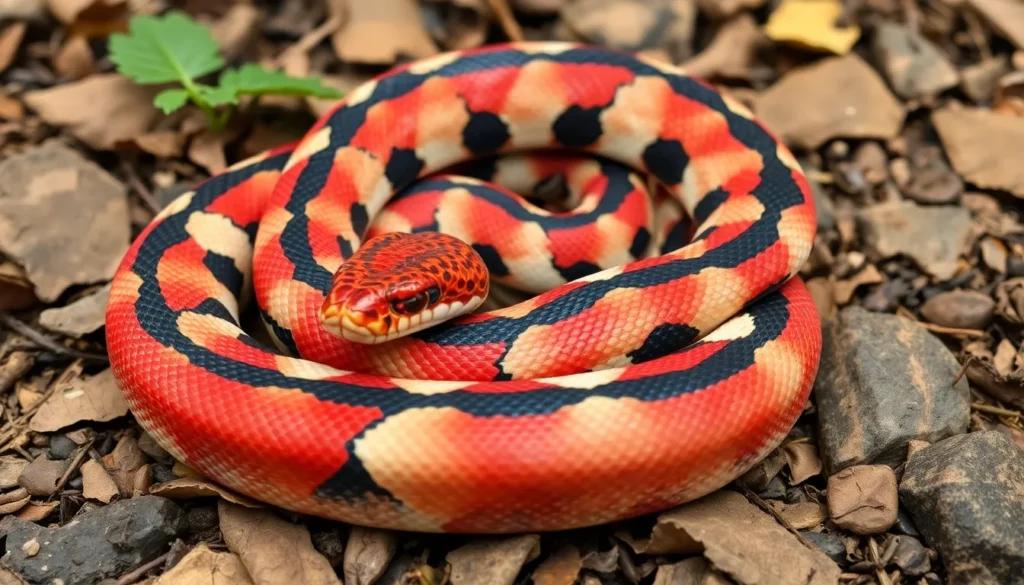
- They are known for their striking coloration. Milk snakes exhibit bright bands of red, black, white, or yellow, often mimicking venomous coral snakes.
- Their coloration serves as a form of Batesian mimicry. This mimicry helps deter predators by resembling the dangerous coral snake.
- Milk snakes are nonvenomous. Despite their vivid colors, they pose no venomous threat to humans or prey.
- They inhabit a wide range of environments. Milk snakes can be found in forests, fields, rocky hillsides, and agricultural areas.
- Their geographic range extends from southern Canada to northern South America. This wide distribution includes many subspecies with varying patterns.
- Milk snakes are primarily nocturnal or crepuscular. They are most active during the night or at dawn and dusk, avoiding midday heat.
- Their diet mainly consists of small mammals, birds, reptiles, and amphibians. They are constrictors, subduing prey by coiling and suffocating.
- Milk snakes can consume other snakes, including venomous species. Their immunity to certain venoms allows them to prey on rattlesnakes and other snakes.
- They reproduce by laying eggs. Females typically lay between 4 to 12 eggs per clutch in sheltered locations.
- Milk snake hatchlings emerge fully independent. Newborn snakes are self-sufficient and must find food and shelter on their own.
- They have smooth, shiny scales. This scale texture aids in their movement and contributes to their glossy appearance.
- Milk snakes can grow to lengths of 14 to 72 inches (35 to 180 cm). Size varies significantly among subspecies.
- They are generally shy and avoid human contact. When threatened, they may vibrate their tails or release musk as a defense.
- Milk snakes are important in controlling rodent populations. By preying on mice and rats, they help maintain ecological balance.
- Some milk snake subspecies have distinct regional color variations. These regional differences assist in identification and classification.
- Milk snakes shed their skin regularly. This process allows growth and helps remove parasites.
- They use their tongues to sense their environment. Like many snakes, milk snakes flick their tongues to collect chemical cues from the air.
- Milk snakes are often kept as pets due to their manageable size and striking appearance. However, this should only be done responsibly with attention to their needs.
- They are preyed upon by birds of prey, larger snakes, and mammals. Their mimicry and defensive behaviors help reduce predation risks.
- Milk snakes are not currently considered threatened or endangered. However, habitat destruction and human activity can impact local populations.
Habitat and Behavior
Milk snakes inhabit diverse environments ranging from woodlands and grasslands to rocky slopes and farmland. They are adaptable and can thrive in a variety of climates across their broad geographic range. Their behavior is largely secretive; they tend to avoid daytime activity to escape heat and predators, becoming most active at night or during twilight. As constrictors, milk snakes hunt primarily by ambush, using their keen sense of smell and heat detection to locate prey. Their diet is varied, including rodents, birds, amphibians, and other reptiles, which they kill by constriction. Milk snakes often seek shelter under logs, rocks, or in abandoned burrows to stay safe and regulate body temperature.
Why This Animal Matters
Milk snakes play a vital role in their ecosystems by controlling populations of rodents and other small animals, which helps prevent crop damage and the spread of disease. Their mimicry of venomous coral snakes is a classic example of evolutionary adaptation that has been studied extensively in biology. Additionally, milk snakes contribute to biodiversity and act as indicators of healthy environments. While they are not currently endangered, their presence can signify balanced ecosystems. Their cultural significance also extends to folklore and educational use, helping raise awareness about reptiles and the importance of wildlife conservation.
Common Misconceptions
Misconception: Milk snakes are venomous and dangerous to humans.
Correction: Milk snakes are nonvenomous and harmless to humans. They rely on mimicry for protection, not venom.
Misconception: Milk snakes drink milk from cows, giving them their name.
Correction: This is a myth. Milk snakes do not drink milk; the name likely originated from farmers observing these snakes near barns where rodents were present.
FAQ
Are milk snakes venomous?
No, milk snakes are nonvenomous. They rely on their bright coloration to mimic venomous coral snakes as a defense mechanism.
Why are they called milk snakes?
The name 'milk snake' comes from an old myth that these snakes drink milk from cows. In reality, they do not drink milk but are often found near barns where they hunt rodents.
Can milk snakes be kept as pets?
Yes, milk snakes are commonly kept as pets due to their manageable size and striking appearance. However, proper care and understanding of their needs are essential for their well-being.





Leave a Reply