
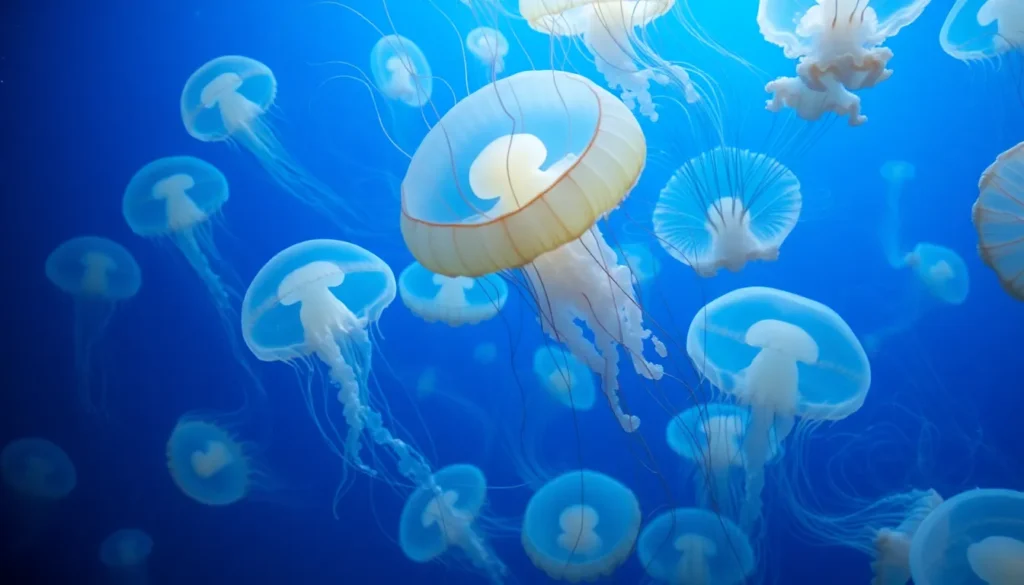
Short Answer
21 Facts About Jellyfish
- Ancient Origins
Jellyfish have existed for over 500 million years, making them one of the oldest living creatures on Earth, predating dinosaurs. - Not True Fish
Despite their name, jellyfish are not fish; they are invertebrates belonging to the phylum Cnidaria. - Body Composition
A jellyfish’s body is composed of about 95% water, giving it a translucent, gelatinous appearance. - Simple Anatomy
They lack a brain, heart, and bones, instead relying on a decentralized nerve net to sense their environment. - Varied Sizes
Jellyfish species range in size from a few millimeters to over 2 meters in diameter, with tentacles extending much longer. - Stinging Cells
They use specialized cells called cnidocytes to deliver stings that can capture prey or defend against predators. - Bioluminescence
Many jellyfish species can produce light through bioluminescence, which may help in attracting prey or deterring predators. - Life Cycle
The typical jellyfish life cycle includes both a polyp stage attached to surfaces and a free-swimming medusa stage. - Reproduction
Jellyfish reproduce both sexually and asexually, depending on the species and life stage. - Diet
They primarily feed on small fish, plankton, and other tiny marine animals by trapping them with their tentacles. - Movement
Jellyfish move by pulsating their bell-shaped bodies, propelling themselves through the water. - Distribution
They inhabit oceans worldwide, from surface waters to deep sea environments. - Jellyfish Blooms
Under certain conditions, jellyfish populations can explode, forming large swarms known as blooms that impact fisheries and tourism. - Ecological Role
They are both predators and prey, playing a crucial part in marine food webs and nutrient cycles. - Immortal Jellyfish
The species Turritopsis dohrnii can revert from its adult form to an immature polyp stage, potentially enabling it to bypass death. - Jellyfish Venom
While many jellyfish stings cause mild irritation, some species have venom capable of causing serious harm or even death to humans. - Jellyfish and Climate Change
Changes in ocean temperature and acidity may contribute to more frequent jellyfish blooms worldwide. - Jellyfish as Food
In some cultures, certain jellyfish species are harvested and eaten as a delicacy. - Jellyfish in Research
Green fluorescent protein (GFP), originally derived from jellyfish, is widely used in molecular biology and medical research. - Jellyfish and Human Impact
Pollution and overfishing can disrupt marine ecosystems, sometimes leading to jellyfish population increases. - Jellyfish Diversity
There are thousands of known jellyfish species, with new ones still being discovered.
Habitat and Behavior
Jellyfish are found in oceans across the globe, from warm tropical waters to cold polar seas. They inhabit various marine environments including surface waters, midwater zones, and deep seas. Jellyfish are mostly drifters, allowing ocean currents to carry them, although they can propel themselves by rhythmically contracting their bell-shaped bodies. Their behavior varies by species; some form large groups or blooms, while others live solitary lives. They feed mainly on plankton, small fish, and other small organisms, capturing prey with their tentacles equipped with stinging cells. Jellyfish reproduce through complex life cycles that include both stationary polyp and free-swimming medusa stages. Environmental factors such as water temperature, salinity, and food availability strongly influence their population dynamics.
Why This Animal Matters
Jellyfish play essential roles in marine ecosystems as both predators and prey, helping to maintain the balance of ocean food webs. They consume large quantities of plankton and small fish, influencing populations of these organisms. Some fish and sea turtles rely on jellyfish as a food source. Additionally, jellyfish blooms can serve as indicators of ocean health, often reflecting changes caused by human activities such as overfishing and pollution. Culturally, jellyfish have fascinated humans for centuries and appear in art, mythology, and cuisine in various regions. Scientifically, jellyfish have contributed to important research tools like the green fluorescent protein, which has revolutionized cellular biology. Conservation of jellyfish and their habitats is important due to their sensitivity to environmental changes and their role in marine biodiversity.
Common Misconceptions
Misconception: Jellyfish are harmless because they do not have brains.
Correction: Although jellyfish lack brains, many have potent venom delivered via their stinging cells that can cause pain or serious injury to humans.
Misconception: All jellyfish are dangerous and deadly.
Correction: Most jellyfish stings are mild and not life-threatening. Only a few species, like the box jellyfish, have venom capable of causing fatal reactions.
Misconception: Jellyfish are simple animals with no ecological importance.
Correction: Jellyfish are important components of marine ecosystems, influencing food webs and nutrient cycling, and serve as indicators of environmental changes.
FAQ
Are jellyfish dangerous to humans?
Most jellyfish stings cause mild irritation, but some species have venom that can be dangerous or even fatal. It is important to recognize and avoid contact with harmful species such as the box jellyfish.
How do jellyfish move without muscles or bones?
Jellyfish move by contracting their bell-shaped bodies rhythmically, pushing water behind them to propel forward. This movement is powered by simple muscle-like cells within their bell margin.
Why do jellyfish sometimes form large blooms?
Jellyfish blooms occur when environmental conditions such as water temperature, salinity, and food availability become favorable. Human activities like overfishing and pollution can also contribute to bloom formation by altering ecosystem balance.


Leave a Reply