
Short Answer
21 Facts About Hippopotamuses
- Large Size: Hippopotamuses are among the largest land mammals, with males weighing up to 3,200 kg (7,000 lbs).
- Semi-Aquatic Lifestyle: They spend much of their time in water to keep cool and protect their sensitive skin from the sun.
- Herbivorous Diet: Despite their large size, hippos primarily eat grass and occasionally aquatic plants, consuming up to 40 kg (88 lbs) of vegetation per night.
- Unique Skin Secretion: Hippos secrete a natural reddish oily substance often called “blood sweat” which acts as a sunscreen and has antimicrobial properties.
- Highly Territorial in Water: Male hippos maintain and defend territories in rivers and lakes, while on land their behavior is less territorial.
- Social Animals: They typically live in groups called pods, which can include 10 to 30 individuals.
- Communication: Hippos communicate through grunts, bellows, and wheezes. They can also produce sounds underwater.
- Close Relatives: The hippopotamus is most closely related to cetaceans (whales and dolphins), sharing a common ancestor about 55 million years ago.
- Breathing Adaptations: Hippos have nostrils located on top of their heads allowing them to breathe while mostly submerged.
- Fast on Land: Despite their bulk, hippos can run up to 30 km/h (19 mph) over short distances on land.
- Reproduction: Female hippos give birth to usually one calf after an 8-month gestation, often in water.
- Longevity: They can live around 40 to 50 years in the wild.
- Teeth and Tusks: Hippos have large canine tusks that grow continuously and are used for fighting.
- Impact on Ecosystem: Their grazing influences vegetation patterns and their movements help create pathways for other animals.
- Dangerous Animals: Despite their herbivorous diet, hippos are considered one of the most dangerous animals in Africa due to their aggressive nature.
- Night Grazers: Hippos typically feed at night, spending daytime resting in water.
- Water Temperature Regulation: Immersion in water helps regulate their body temperature and prevents dehydration.
- Distribution: Native to sub-Saharan Africa, hippos inhabit rivers, lakes, and mangrove swamps.
- Conservation Status: Classified as vulnerable due to habitat loss and illegal hunting for meat and ivory from their teeth.
- Ancient Species: Hippopotamuses have existed in various forms for millions of years, with fossil records dating back around 15 million years.
- Role in Culture: They appear in ancient Egyptian art and mythology and remain culturally significant in parts of Africa.
Habitat and Behavior
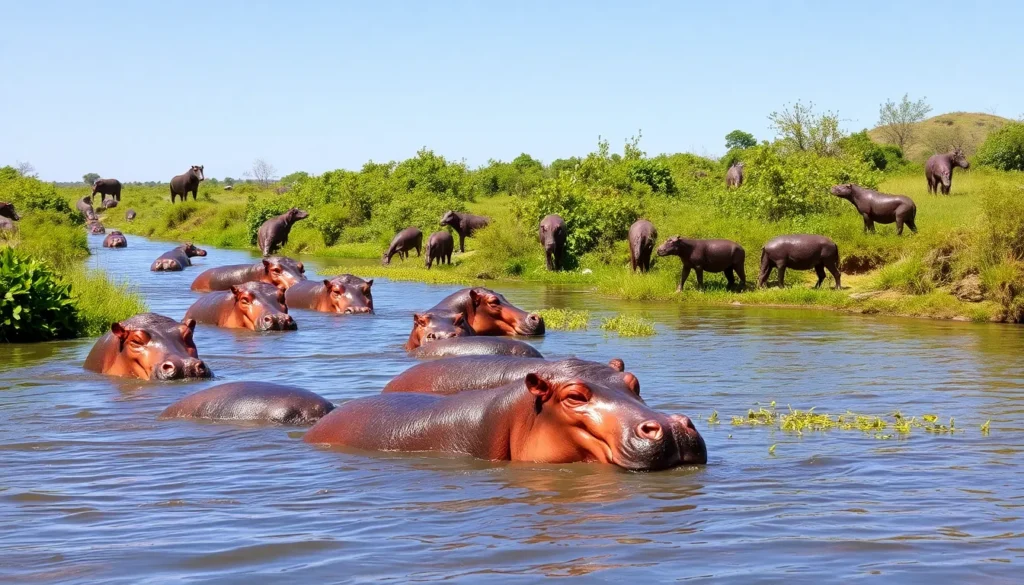
Hippopotamuses inhabit rivers, lakes, and wetlands across much of sub-Saharan Africa. They are highly adapted to a semi-aquatic lifestyle, spending most daylight hours submerged to keep cool and avoid sunburn. At night, they emerge from the water to graze on grasses, traveling up to several kilometers from water sources. Socially, they live in groups called pods dominated by territorial males, with females and their young. While they appear slow and docile, hippos can be highly aggressive, especially when defending territory or offspring. Their behaviors include vocalizations both above and below water, territorial displays, and complex social interactions within pods. Hippos are important ecological engineers, as their grazing influences vegetation and their movements create channels used by other species.
Why This Animal Matters
Hippopotamuses play a critical ecological role by shaping their habitat through grazing which affects plant communities and nutrient cycling. Their dung provides important nutrients to aquatic ecosystems, supporting fish and other wildlife. Culturally, hippos have been featured in art, folklore, and mythology for millennia, symbolizing strength and sometimes chaos. Conservation-wise, hippos face threats from human encroachment, habitat degradation, and poaching for meat and ivory-like teeth. Protecting hippos helps preserve biodiversity and the health of freshwater ecosystems. Their presence also supports ecotourism, which can benefit local economies when managed sustainably.
Common Misconceptions
Misconception: Hippos are slow and clumsy.
Correction: Despite their bulk, hippos can run surprisingly fast on land (up to 30 km/h) and are agile in water.
Misconception: Hippos are related to pigs.
Correction: Although they appear similar, hippos are more closely related to whales and dolphins than to pigs.
Misconception: Hippos are gentle giants.
Correction: Hippos are known to be highly aggressive and are responsible for many human fatalities in Africa each year.
Misconception: Hippos sweat blood.
Correction: The reddish secretion is not sweat or blood but a natural oily substance that protects their skin from sunburn and infection.
Misconception: Hippos only live in water.
Correction: Hippos spend much time in water but feed on land during the night and rest on land occasionally.
FAQ
Are hippos dangerous to humans?
Yes, hippos are considered one of the most dangerous animals in Africa due to their aggressive nature and territorial behavior, causing many human fatalities annually.
Why do hippos spend so much time in water?
Hippos spend most of the day submerged in water to keep their large bodies cool and to protect their sensitive skin from sunburn and dehydration.
What do hippos eat?
Hippos are herbivores and primarily feed on grasses, consuming large quantities at night, occasionally supplementing their diet with aquatic plants.

Leave a Reply