
Short Answer
21 Facts About Dolphin Echolocation
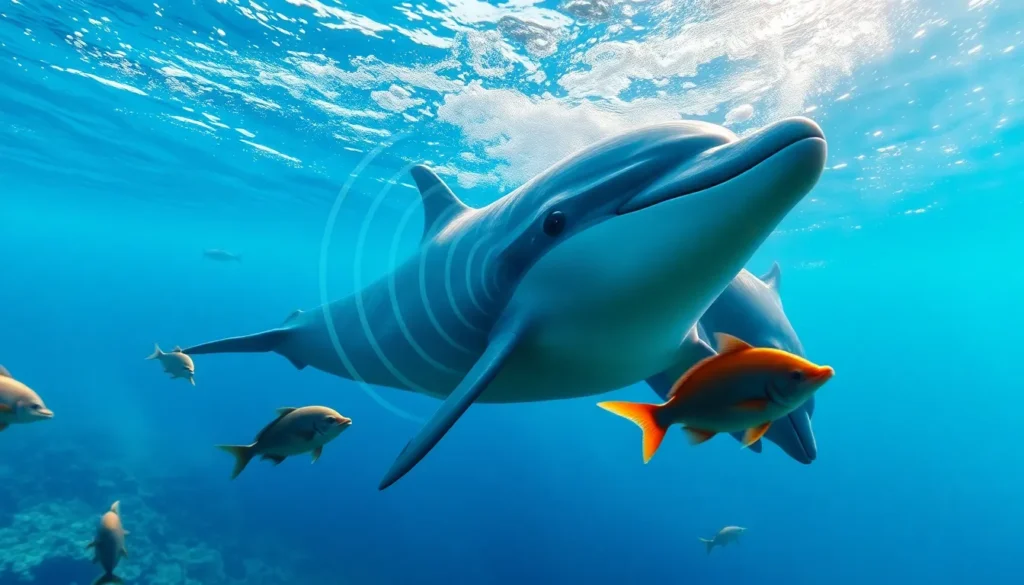
- Dolphins produce echolocation clicks: Dolphins emit a series of rapid, high-frequency clicks that travel through the water to detect objects and prey.
- Sound production location: Echolocation sounds are produced in the nasal sacs located just below the blowhole of the dolphin.
- Reception through the lower jaw: Dolphins receive the returning echoes primarily through their lower jaw, which transmits sound vibrations to the middle ear.
- Use of the melon: The melon, a fatty organ in the dolphin’s forehead, focuses and modulates echolocation clicks into directional beams.
- Frequency range: Dolphin echolocation clicks can range from 40 kHz to over 150 kHz, well beyond the range of human hearing.
- Navigation tool: Echolocation helps dolphins navigate murky waters or dark environments where vision is limited.
- Prey detection: Dolphins use echolocation to detect the size, shape, distance, speed, and even internal structure of prey.
- Speed of sound underwater: Sound travels approximately 1,500 meters per second in water, allowing dolphins to receive echoes quickly for real-time analysis.
- Signal processing: Dolphins’ brains are highly specialized to process echolocation signals rapidly and interpret detailed information from echoes.
- Range of echolocation: Echolocation can detect objects up to 100 meters away, depending on water conditions and object size.
- Use in social interactions: Echolocation clicks can also serve communicative purposes within dolphin pods.
- Individual signature whistles: While distinct from echolocation clicks, dolphins use signature whistles to identify individuals, demonstrating complex acoustic communication.
- Adaptation for hunting strategies: Some dolphins use echolocation to herd fish or locate hidden prey inside sediment or crevices.
- Environmental sensitivity: Echolocation performance can be affected by factors such as water temperature, salinity, and noise pollution.
- Comparison to bats: Like bats, dolphins evolved echolocation independently as an adaptation to their respective environments (water vs air).
- Learning echolocation: Young dolphins develop echolocation skills over time through practice and social learning.
- Research applications: Scientists use knowledge of dolphin echolocation to improve sonar technology and underwater navigation systems.
- Conservation concerns: Human-generated underwater noise can interfere with echolocation, impacting dolphin behavior and survival.
- Complexity of echolocation clicks: Dolphins can vary click patterns, pulse intervals, and intensity to adapt to different situations.
- Echolocation and brain size: Dolphins have large brains relative to body size, facilitating advanced echolocation processing and cognition.
- Unique adaptations: The anatomical features involved in echolocation, such as the melon and specialized jaw fats, are unique to toothed whales, including dolphins.
Habitat and Behavior
Dolphins inhabit diverse marine environments including coastal areas, open oceans, and some freshwater systems. They are highly social animals, living in groups called pods that can range from a few individuals to several hundred. Dolphins rely on echolocation extensively for survival, using it to navigate murky or dark waters where vision is limited, to locate prey such as fish and squid, and to communicate within their pods. Echolocation is especially valuable during hunting in challenging conditions, such as at night or in turbid waters. Their behavioral repertoire includes cooperative hunting, social play, and complex communication, all of which benefit from their sophisticated acoustic abilities.
Why This Animal Matters
Dolphins play an important ecological role as mid-level predators, helping to maintain the balance of marine ecosystems by regulating prey populations. Their reliance on echolocation makes them sensitive indicators of ocean health, particularly regarding noise pollution and habitat degradation. Culturally, dolphins have fascinated humans for centuries, symbolizing intelligence and freedom in many societies. Scientifically, studying dolphin echolocation has contributed significantly to fields such as bioacoustics, neuroscience, and sonar technology development. Conservation efforts focus on protecting dolphins from threats including habitat loss, pollution, and the impact of human-made noise that can disrupt their echolocation and communication.
Common Misconceptions
Misconception: Dolphins use echolocation as a form of hearing.
Correction: Echolocation is an active sonar system where dolphins produce sounds and listen to echoes, distinct from passive hearing which only involves perceiving external sounds.
Misconception: Echolocation allows dolphins to “see” like humans see with their eyes.
Correction: Echolocation provides spatial and structural information about objects but it is not vision; it relies on interpreting sound reflections rather than light.
Misconception: All dolphin species echolocate equally well.
Correction: While most toothed dolphins use echolocation, the efficiency and characteristics can vary among species, and baleen whales do not echolocate.
Misconception: Dolphins’ echolocation clicks are audible to humans.
Correction: Most echolocation clicks are ultrasonic and beyond human hearing range, which typically maxes out around 20 kHz.
Misconception: Dolphins rely solely on echolocation for hunting.
Correction: Dolphins use a combination of echolocation, vision, and cooperative strategies when hunting, not echolocation alone.
FAQ
How do dolphins produce echolocation sounds?
Dolphins produce echolocation clicks using specialized nasal sacs located near their blowhole. These sacs generate rapid bursts of sound that are then focused and directed by the melon in the dolphin's forehead.
Can humans hear dolphin echolocation clicks?
Most dolphin echolocation clicks are ultrasonic, meaning they occur at frequencies above the range of human hearing (generally above 20 kHz), so humans cannot typically hear them without special equipment.
Why do dolphins use echolocation?
Dolphins use echolocation primarily to navigate in murky or dark waters, locate and identify prey, avoid obstacles, and communicate with other dolphins, especially in environments where vision is limited.






Leave a Reply