
Short Answer
21 Facts About Damselflies
- Damselflies belong to the order Odonata. They are closely related to dragonflies, sharing the same order but different suborders.
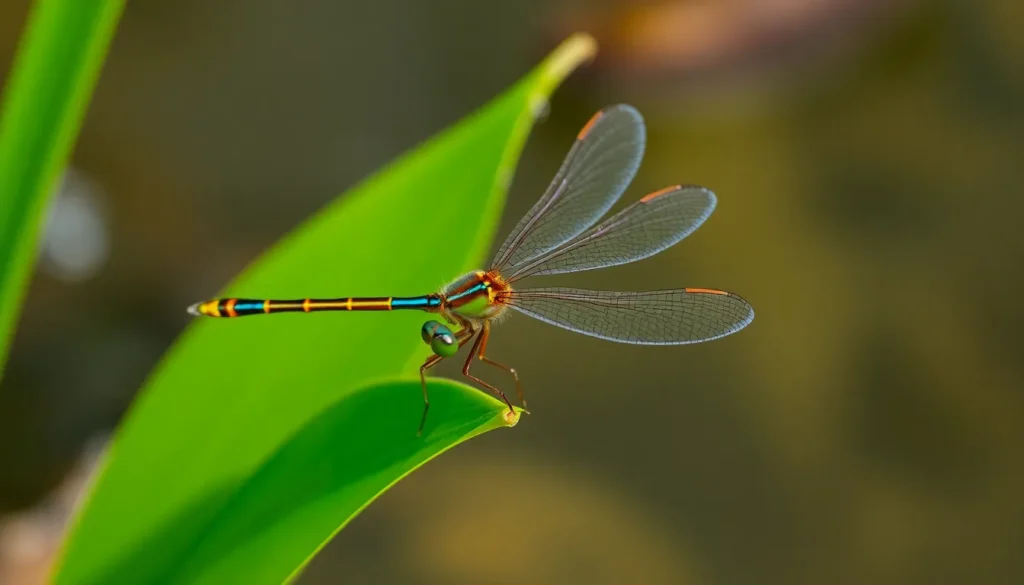
- They have slender bodies and delicate wings. Unlike dragonflies, their wings are usually held together above the body when at rest.
- Damselflies are generally smaller than dragonflies. Their slim build makes them appear more fragile.
- Their eyes are separated on the sides of their heads. This contrasts with dragonflies, whose eyes often touch or nearly touch.
- Damselflies exhibit a wide range of bright colors. These colors can include blues, greens, reds, and metallic hues, often used in mating displays.
- They are carnivorous insects. Both larvae and adults feed on smaller insects, helping control pest populations.
- Damselfly larvae are aquatic. They live in freshwater habitats and use gills for underwater respiration.
- Their life cycle includes a complete metamorphosis with an aquatic nymph stage. The larvae molt several times before emerging as winged adults.
- Damselflies are skilled fliers but generally slower than dragonflies. They can hover and even fly backward with great precision.
- Some damselfly species exhibit elaborate courtship behaviors. Males often display their colors and perform flight displays to attract females.
- They play an important role in freshwater ecosystems. As both predators and prey, they contribute to the balance of aquatic food webs.
- Damselflies have been studied as bioindicators. Their presence and diversity can indicate the health of freshwater environments.
- There are over 3,000 known species of damselflies worldwide. They inhabit various regions, from tropical to temperate zones.
- They are generally diurnal. Most damselflies are active during daylight hours, especially in warm weather.
- Damselfly wings are transparent with a network of veins. This structure provides both flexibility and strength for flight.
- They have compound eyes that provide a wide field of vision. This helps them detect prey and avoid predators effectively.
- Some species participate in tandem or wheel formation during mating. This unique behavior helps transfer sperm efficiently between partners.
- Damselfly larvae are ambush predators. They lie in wait and use their extendable jaws to capture prey underwater.
- Adults use their legs to form a basket for catching prey during flight. This adaptation increases hunting success.
- Damselflies are sensitive to water pollution. Their populations often decline in degraded habitats, making conservation important.
- They have inspired cultural symbolism. In some cultures, damselflies represent purity, agility, or transformation.
Habitat and Behavior
Damselflies primarily inhabit environments near freshwater bodies such as ponds, lakes, streams, and wetlands. Their aquatic larvae require clean water with abundant vegetation for protection and hunting. Adults are often seen perched on plants near water or flying low over the surface. Damselflies are territorial, with males defending prime oviposition sites to attract females. Their feeding behavior involves hunting smaller insects in flight, using their excellent vision and agile flying skills. They rely on their aquatic larval stage to grow and develop before emerging as adults. Seasonal and climatic factors influence their life cycle timing, with many species active in warmer months.
Why This Animal Matters
Damselflies serve as important components of freshwater ecosystems. They help regulate insect populations, including pests such as mosquitoes, through predation. Their larvae contribute to nutrient cycling in aquatic habitats. Because of their sensitivity to pollution and habitat disturbance, damselflies are useful bioindicators for environmental monitoring. Conserving damselfly habitats supports broader biodiversity and ecosystem health. Additionally, damselflies hold cultural significance in various societies, symbolizing qualities like transformation and grace. Understanding and protecting damselflies contribute to preserving freshwater habitats and maintaining ecological balance.
Common Misconceptions
Misconception: Damselflies are just small dragonflies.
Correction: While damselflies and dragonflies belong to the same order (Odonata), they are distinct suborders with notable differences in body shape, wing position, and eye placement.
Misconception: Damselflies sting or bite humans.
Correction: Damselflies do not sting and rarely bite humans; they are harmless and primarily focused on catching small insect prey.
Misconception: Damselflies live only near stagnant water.
Correction: Damselflies inhabit a range of freshwater environments, including flowing streams and rivers, provided the water quality supports their larvae.
FAQ
How can you tell a damselfly from a dragonfly?
Damselflies typically have slimmer bodies, their eyes are separated on either side of the head, and they hold their wings together over their body when resting, unlike dragonflies which have bulkier bodies, eyes that often touch, and wings held open horizontally.
Do damselflies bite or sting humans?
Damselflies do not sting and rarely bite humans. They are harmless to people and primarily feed on smaller insects.
What type of habitat do damselfly larvae require?
Damselfly larvae live in clean freshwater habitats such as ponds, streams, and wetlands, where they use aquatic vegetation for cover and hunting.




Leave a Reply