
Short Answer
21 Facts About Cheetahs
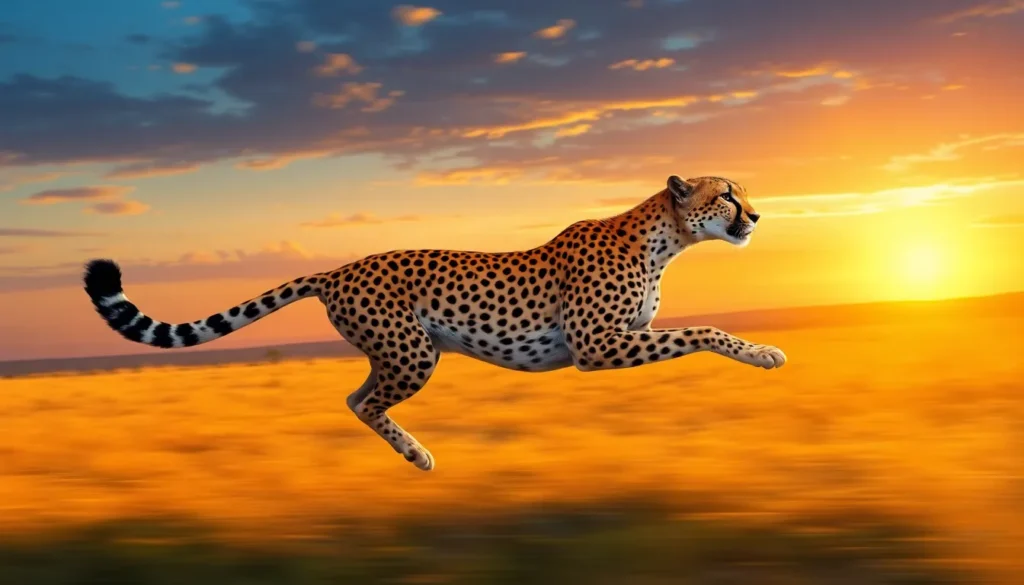
- Fastest Land Animal: Cheetahs are the fastest land animals, capable of speeds up to 70 miles per hour (112 kilometers per hour) in short bursts covering distances up to 1,500 feet.
- Unique Body Structure: Their lightweight frame, long legs, and flexible spine allow extreme acceleration and agility during hunts.
- Non-Retractable Claws: Unlike other big cats, cheetahs have semi-retractable claws that provide extra grip while running.
- Tear Markings: Black tear-like streaks run from the inner corners of their eyes down to the sides of their mouths, possibly reducing glare from the sun and aiding focus on prey.
- Specialized Respiratory System: Their enlarged nasal passages and lungs enable rapid oxygen intake during high-speed chases.
- Short Hunting Duration: Cheetahs typically chase prey for less than a minute to avoid overheating and exhaustion.
- Distinctive Coat Pattern: Their tan fur is covered with solid black spots, which are unique to each individual, aiding identification.
- Limited Climbing Ability: Unlike leopards, cheetahs are poor climbers and rely more on speed than ambush tactics.
- Social Structure: Female cheetahs tend to be solitary, while males may form small groups called coalitions, often of brothers.
- Short Lifespan in Wild: Wild cheetahs live around 10 to 12 years, though they can live longer in captivity.
- Reproductive Challenges: Cheetahs have low genetic diversity, which contributes to challenges in breeding and survival rates of cubs.
- Vocalizations: Unlike other big cats, cheetahs cannot roar but communicate using chirps, purrs, growls, and hisses.
- Daytime Hunters: They usually hunt during the day to avoid competition with nocturnal predators like lions and hyenas.
- Prey Preferences: Their diet mainly includes small to medium-sized ungulates such as gazelles, impalas, and springboks.
- Conservation Status: Classified as vulnerable by the IUCN, cheetahs face threats from habitat loss, human-wildlife conflict, and poaching.
- Range Distribution: Historically widespread, cheetahs are now mainly found in sub-Saharan Africa with a small population in Iran.
- Adapted Tail: Their long tail acts as a rudder to help balance and steer during high-speed chases.
- High Cub Mortality: Over half of cheetah cubs die before reaching 3 months due to predation and environmental dangers.
- Speed Trade-offs: Their adaptations for speed come at the cost of strength and climbing ability compared to other big cats.
- Historical Significance: Cheetahs have been tamed and used for hunting by humans in ancient times, notably in Egypt and India.
- Scientific Name: The cheetah’s scientific name is Acinonyx jubatus, meaning “non-moving claws” in Greek, reflecting their semi-retractable claws.
Habitat and Behavior
Cheetahs primarily inhabit savannas, grasslands, and open plains where their speed is most effective for hunting. They prefer areas with some cover such as tall grasses or bushes to stalk prey. Their diurnal behavior, hunting mostly during the day, reduces competition with nocturnal predators like lions and leopards. Cheetahs rely heavily on their eyesight to spot prey at a distance. Socially, females tend to live solitary lives except when raising cubs, while males often form coalitions, usually with siblings, which helps in defending territories and hunting. Their hunting strategy involves stalking prey to get close, then a rapid chase to catch it. After a successful hunt, cheetahs eat quickly to avoid losing their kill to stronger predators. They are generally shy and avoid confrontations, which can affect their survival in areas with high predator densities.
Why This Animal Matters
Cheetahs play a critical ecological role as predators that help maintain the balance of herbivore populations in their habitats. Their presence can influence the behavior and distribution of prey species, contributing to ecosystem health. Culturally, cheetahs have fascinated humans for millennia, symbolizing speed and grace in various societies. From a conservation perspective, cheetahs are indicators of ecosystem stability and face challenges from habitat fragmentation, human conflict, and genetic bottlenecks. Protecting cheetahs also involves preserving large tracts of habitat that benefit many other species, making them a flagship species for conservation efforts across Africa and parts of Asia.
Common Misconceptions
Misconception: Cheetahs can roar like other big cats.
Correction: Cheetahs cannot roar; they produce different vocalizations such as chirps, purrs, and growls instead.
Misconception: Cheetahs are strong climbers.
Correction: Unlike leopards, cheetahs have limited climbing ability and rely more on speed than ambush tactics.
Misconception: Cheetahs maintain their top speed for long distances.
Correction: Cheetahs can only sustain their maximum speed for short bursts, typically less than a minute, due to rapid overheating.
Misconception: Cheetahs are solitary animals only.
Correction: While females are mostly solitary, males often live in coalitions, usually consisting of brothers.
Misconception: Cheetahs are a type of leopard.
Correction: Although both are spotted big cats, cheetahs belong to a separate genus (Acinonyx) and differ significantly in anatomy and behavior.
FAQ
How fast can a cheetah run?
Cheetahs can reach speeds of up to 70 miles per hour (112 kilometers per hour) in short bursts, typically lasting less than a minute.
Why can't cheetahs roar like other big cats?
Cheetahs lack the specialized vocal fold structure that enables roaring. Instead, they make sounds like chirps, purrs, and growls.
Are cheetahs endangered?
Cheetahs are classified as vulnerable due to habitat loss, reduced prey, human-wildlife conflict, and low genetic diversity, which make their populations susceptible to decline.


Leave a Reply