
Short Answer
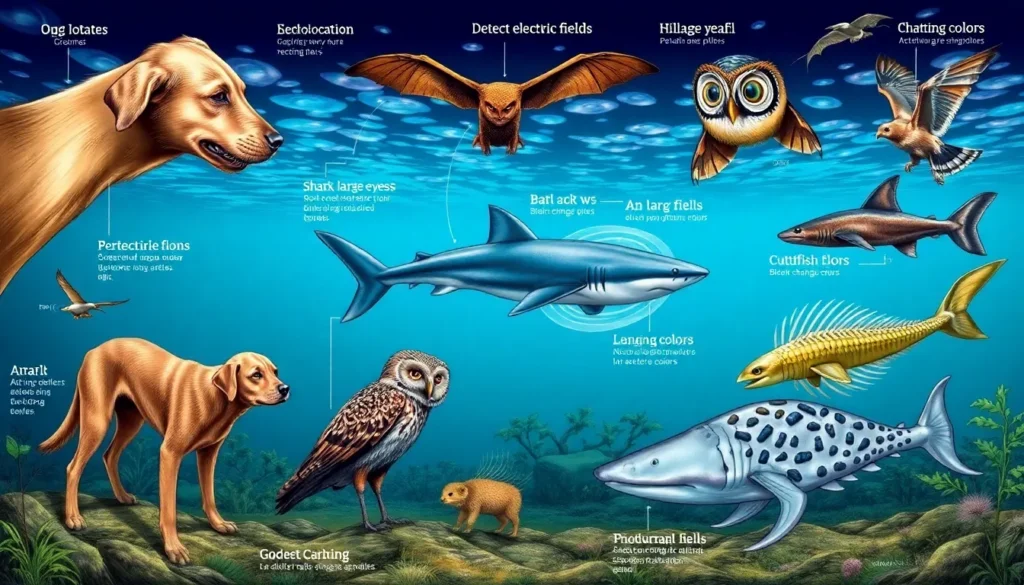
21 Facts About Animal Senses
- Dogs have an extraordinary sense of smell.
Dogs possess up to 300 million olfactory receptors in their noses, compared to about 5 million in humans, making their sense of smell exceptionally sensitive and useful for tracking and detecting scents. - Some birds can see ultraviolet light.
Many bird species, such as pigeons and kestrels, can detect ultraviolet wavelengths, which helps them in navigation, foraging, and identifying mates. - Elephants communicate using infrasound.
Elephants produce low-frequency sounds below the threshold of human hearing, allowing them to communicate over long distances through ground vibrations and air. - Sharks detect electrical fields.
Sharks have specialized organs called ampullae of Lorenzini that sense the electric fields produced by other animals, aiding in hunting and navigation. - Owls have exceptional night vision.
Their large eyes and high density of rod cells allow owls to see well in low light conditions, facilitating nocturnal hunting. - Bats use echolocation to navigate.
By emitting high-frequency sounds and interpreting the returning echoes, bats can detect obstacles and prey in complete darkness. - Cat whiskers detect air movement.
Whiskers, or vibrissae, are highly sensitive tactile hairs that help cats sense nearby objects and changes in air currents, especially in the dark. - Cuttlefish can change skin color for camouflage and communication.
They have specialized skin cells called chromatophores that allow rapid color and pattern changes. - Dogs can hear sounds at higher frequencies than humans.
Dogs can hear frequencies up to around 65,000 Hz, while humans hear up to about 20,000 Hz. - Honeybees perceive polarized light.
Bees use polarized light patterns in the sky to navigate, especially when the sun is obscured. - Rattlesnakes sense infrared radiation.
Pit vipers have specialized pit organs that detect heat emitted by warm-blooded prey, allowing hunting in total darkness. - Fish can detect vibrations using their lateral line system.
This sensory organ detects water movements and pressure changes, aiding in schooling and predator avoidance. - Frogs have a third eyelid called a nictitating membrane.
This translucent membrane protects the eye and keeps it moist while maintaining visibility underwater or on land. - Some spiders can detect prey through web vibrations.
Spiders sense minute vibrations on their webs, helping them locate trapped insects. - Dolphins use sophisticated sonar abilities.
They emit clicks and listen to returning echoes to locate objects and communicate underwater. - Butterflies can taste with their feet.
They have taste sensors on their feet that help them detect suitable plants for laying eggs. - Snakes lack external ears but sense vibrations through their jawbones.
This adaptation allows them to detect ground vibrations and nearby movements. - Some fish have electroreception.
Species like the electric eel generate and sense electric fields for navigation, communication, and predation. - Praying mantises have stereoscopic vision.
They can perceive depth and distance accurately, aiding in precision hunting. - Crows demonstrate problem-solving abilities linked to sensory processing.
Their advanced cognitive skills involve integrating sensory information to solve complex tasks. - Star-nosed moles use their star-shaped noses for touch.
Their nasal appendages contain thousands of tactile receptors, making them one of the fastest tactile sensors in the animal kingdom.
Habitat and Behavior
Animal senses have evolved to fit their diverse habitats and lifestyles. For example, nocturnal animals such as owls and bats have adapted their senses for low-light or dark environments, using enhanced vision or echolocation to hunt and navigate. Aquatic species like sharks and dolphins have developed unique senses such as electroreception or sonar to overcome the challenges of underwater perception. Terrestrial animals often rely on smell, hearing, and tactile senses to find food, avoid predators, and communicate. Sensory adaptations are closely linked to survival strategies, mating behaviors, and ecological niches.
Why This Animal Matters
Understanding animal senses sheds light on the diversity and complexity of life on Earth. These sensory adaptations contribute to the balance of ecosystems by enabling animals to fulfill roles such as predators, prey, pollinators, and communicators. Moreover, studying animal senses can inspire biomimetic technologies in fields like robotics and sensory devices. Conservation efforts benefit from this knowledge by recognizing how environmental changes may impact sensory-dependent behaviors and survival. Additionally, animal senses hold cultural significance in many societies, influencing folklore, art, and human-animal relationships.
Common Misconceptions
Misconception: Animal senses are just more powerful versions of human senses.
Correction: Many animal senses operate fundamentally differently from human senses, detecting stimuli humans cannot perceive, such as ultraviolet light, infrasound, or electric fields.
Misconception: All animals rely primarily on sight.
Correction: While vision is important for many species, others depend more heavily on smell, hearing, touch, or specialized senses adapted to their environments.
FAQ
How do animals use senses differently than humans?
Animals often possess senses that detect stimuli humans cannot perceive, such as ultraviolet light, electrical fields, or infrasound. These adaptations allow them to navigate, communicate, and hunt in ways uniquely suited to their environments.
Which animal has the most sensitive sense of smell?
Dogs are among the animals with the most sensitive sense of smell, having up to 300 million olfactory receptors, allowing them to detect scents at incredibly low concentrations.
What is echolocation and which animals use it?
Echolocation is a sensory mechanism where animals emit sound waves and listen for echoes to locate objects and navigate. Bats and dolphins are well-known users of echolocation.




Leave a Reply