
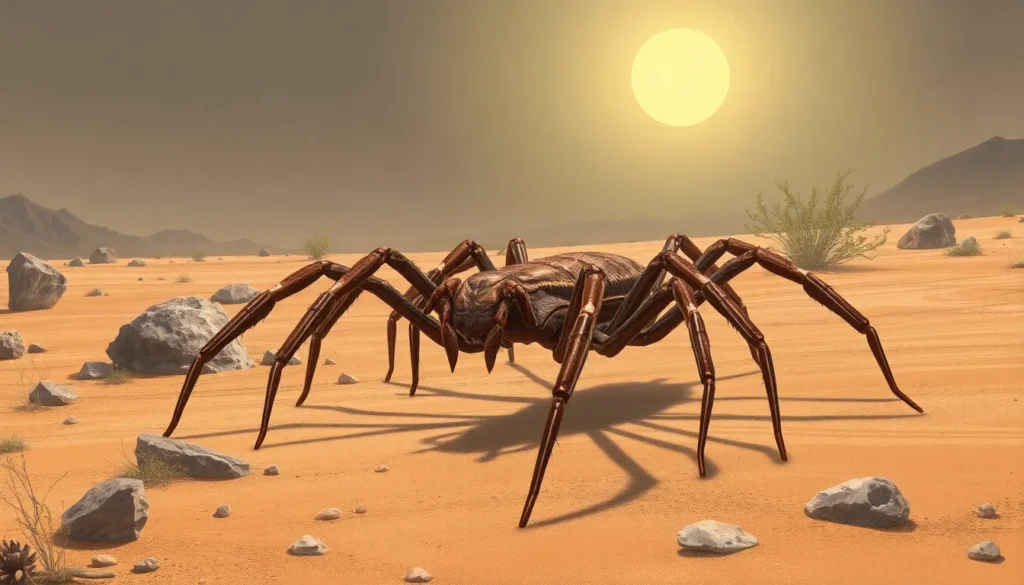
Short Answer
21 Facts About Camel Spiders (Solifuges)
- Not True Spiders: Despite resembling spiders, camel spiders belong to the order Solifugae, distinct from true spiders (order Araneae).
- Large Chelicerae: They have powerful, scissor-like jaws called chelicerae that can be as long as their body, used for capturing and dismembering prey.
- Size Variation: Most camel spiders range from 1 to 6 centimeters in length, but some species can grow larger.
- Fast Runners: They are known for their speed, capable of sprinting up to 16 kilometers per hour (10 mph).
- Mostly Nocturnal: Camel spiders primarily hunt at night, avoiding daytime heat in desert environments.
- Habitat Range: They inhabit arid regions such as deserts and scrublands across North Africa, the Middle East, and parts of Central and South America.
- Diet: They are carnivorous predators feeding on insects, small rodents, lizards, and other arthropods.
- No Venom: Unlike many arachnids, camel spiders do not possess venom glands and kill prey by physical force.
- Sensory Adaptations: They have highly sensitive sensory organs on their pedipalps to detect vibrations and chemical cues.
- Reproduction: Mating involves complex courtship behaviors where males may offer gifts or perform displays to females.
- Egg Laying: Females lay dozens of eggs in burrows, which hatch after several weeks depending on temperature.
- Molting: Camel spiders molt multiple times before reaching adulthood, shedding their exoskeleton to grow.
- Solitary Lifestyle: They are generally solitary except during mating season.
- Defensive Behavior: When threatened, they may raise their front legs and open their chelicerae to appear larger.
- Temperature Sensitivity: They avoid extreme heat by being active during cooler periods and sheltering underground during the day.
- Misleading Nicknames: The common name “camel spider” is thought to originate from myths that they prey on camels, which is unfounded.
- Historical Interest: Camel spiders gained notoriety during military conflicts in desert regions due to exaggerated tales of their size and danger.
- Not Harmful to Humans: While their bite can be painful mechanically, they are not dangerous or venomous to humans.
- Ecological Role: As predators, they help control populations of insects and small animals in desert ecosystems.
- Diverse Species: There are over 1,000 described species of solifuges worldwide, showing a wide variety in size and behavior.
- Ancient Lineage: Fossil records suggest solifuges have existed for at least 100 million years, making them an ancient arachnid lineage.
Habitat and Behavior
Camel spiders are primarily found in arid and semi-arid regions such as deserts, scrublands, and rocky areas. Their distribution spans continents including Africa, the Middle East, and parts of Central and South America. Adapted to hot and dry environments, they seek shelter during the heat of the day by burrowing underground or hiding beneath rocks and debris. They are mainly nocturnal hunters, using their speed and strong chelicerae to capture a variety of prey including insects, small reptiles, and rodents.
These arachnids rely on sensory organs in their pedipalps to navigate and locate prey in the dark. Camel spiders are solitary creatures, coming together only to mate. They exhibit complex courtship behaviors and lay eggs in protected burrows. Their molting process allows growth through successive stages until maturity. Defensive postures and rapid movement help them avoid predators.
Why This Animal Matters
Camel spiders play an important ecological role as predators in desert ecosystems, helping to regulate populations of insects and small vertebrates. This predation contributes to the balance of food webs and ecosystem health. Although they are not venomous or harmful to humans, camel spiders have cultural significance in regions where they live, often featured in folklore and sometimes misunderstood due to myths and exaggerations.
From a scientific perspective, their evolutionary history offers insights into arachnid diversification and adaptation to extreme environments. Understanding their biology and behavior can aid conservation efforts for desert habitats increasingly threatened by climate change and human activity.
Common Misconceptions
Misconception: Camel spiders are venomous and deadly to humans.
Correction: Camel spiders do not have venom glands. Their bite can be painful due to their strong jaws but is not medically dangerous.
Misconception: Camel spiders can run at speeds over 30 miles per hour.
Correction: While very fast for their size, camel spiders reach speeds up to about 10 mph, far less than some myths suggest.
Misconception: Camel spiders prey on camels.
Correction: There is no evidence that camel spiders attack or feed on camels. The name likely arises from their desert habitat and folklore.
Misconception: They are giant spiders.
Correction: Camel spiders are a separate order of arachnids and not true spiders, although they share a similar appearance.
Misconception: Camel spiders chase humans aggressively.
Correction: While they may run quickly when disturbed, camel spiders do not actively chase humans as predators.
FAQ
Are camel spiders dangerous to humans?
Camel spiders are not venomous and do not pose a significant threat to humans. Their bite can cause mechanical injury due to their strong jaws, but it is generally not medically serious.
Where do camel spiders live?
Camel spiders inhabit arid and semi-arid regions including deserts and scrublands in North Africa, the Middle East, and parts of Central and South America.
Do camel spiders really chase people?
Camel spiders are fast and may run quickly when disturbed, but they do not actively chase humans as predators. Reports of aggressive chasing are often exaggerated or misinterpreted.



Leave a Reply