
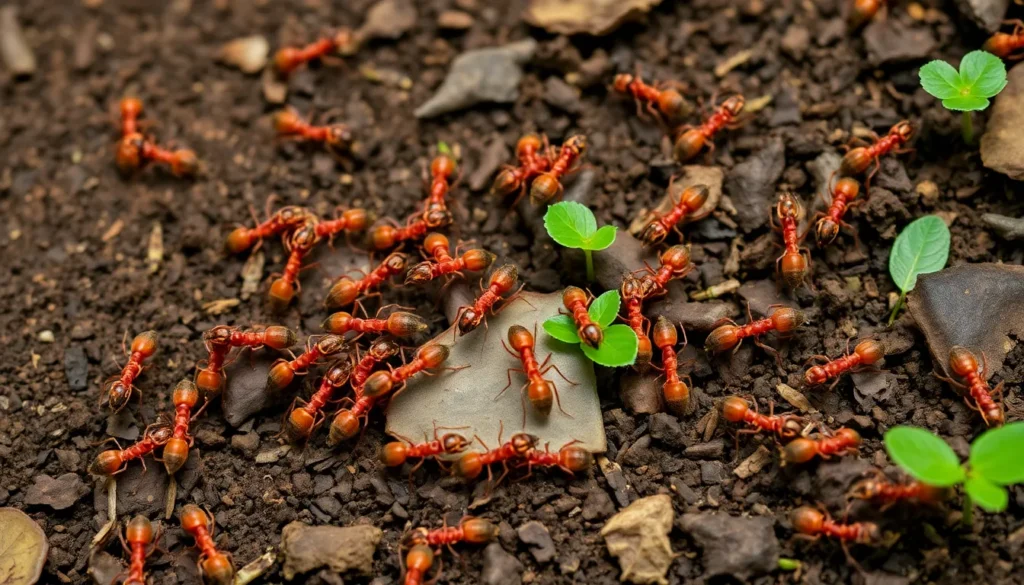
Short Answer
21 Facts About Ants
- Ants Have Existed for Over 100 Million Years. Fossil evidence shows that ants have been present since the Cretaceous period, coexisting with dinosaurs and evolving alongside flowering plants.
- There Are Over 12,000 Known Species of Ants. Scientists have identified thousands of ant species worldwide, each adapted to different environments and lifestyles.
- Ants Are Social Insects Living in Colonies. Most ants live in highly organized colonies or nests, which can range from a few dozen individuals to millions.
- Ant Colonies Have a Caste System. Colonies typically include queens, males, and worker ants, each with specialized roles such as reproduction, defense, or foraging.
- Ants Communicate Using Chemicals Called Pheromones. They release pheromones to signal danger, mark trails to food, or identify colony members.
- Some Ants Can Carry Objects Much Heavier Than Themselves. Ants are capable of lifting and carrying weights 10 to 50 times their own body weight.
- Ants Use Their Strong Mandibles for Various Tasks. Their jaws help them cut, carry, defend, and build nests.
- Leafcutter Ants Are Known for Their Farming Behavior. They cut leaves not to eat but to cultivate fungus, which serves as their primary food source.
- Army Ants Are Known for Their Aggressive Foraging Columns. These ants travel in large groups, hunting and overwhelming prey through sheer numbers.
- Some Ant Species Practice Slave-Making. Certain ants raid other colonies to capture and enslave their worker ants.
- Ants Can Form Living Bridges. Some species link their bodies to create bridges to cross gaps.
- Ants Have Two Stomachs. One stores food for themselves, and the other stores food to share with others in the colony.
- Queen Ants Can Live for Many Years. While worker ants may live months to a few years, queens can survive up to 30 years under ideal conditions.
- Ants Play a Role in Soil Aeration. Their tunneling activities improve soil structure and nutrient cycling.
- Some Ants Have Developed Symbiotic Relationships. Certain species protect aphids in exchange for honeydew, a sugary secretion produced by the aphids.
- Ants Are Found on Every Continent Except Antarctica. Their adaptability allows them to thrive in diverse climates from deserts to rainforests.
- Ants Exhibit Collective Decision-Making. Through decentralized communication, colonies can make complex decisions without a central leader.
- Fire Ants Are Known for Their Painful Sting. Their venom can cause burning sensations and allergic reactions in humans.
- Some Ants Use Tools. Certain species use debris, sand grains, or plant matter to assist in foraging or defense.
- Ant Colonies Can Be Massive. Some supercolonies span hundreds of kilometers, with interconnected nests and millions of ants.
- Ants Have Been Studied for Biomimicry Applications. Their efficient foraging and networking behaviors inspire algorithms and robotics research.
Habitat and Behavior
Ants inhabit virtually every terrestrial environment on Earth except Antarctica. They thrive in forests, grasslands, deserts, and urban areas. Their nests vary widely, from underground tunnels to arboreal nests in trees or inside wood. Ants are primarily diurnal but some species are nocturnal. Their social structure is highly organized, with division of labor among workers, soldiers, and reproductive individuals. Foraging behavior depends on the species and environment, with some ants hunting individually while others coordinate group raids. Ants communicate primarily through chemical signals but also use tactile and sometimes acoustic signals. Their ability to adapt to different ecological niches contributes to their widespread distribution and evolutionary success.
Why This Animal Matters
Ants play essential roles in ecosystems, including soil aeration, nutrient recycling, seed dispersal, and predation on other insects, which can help control pest populations. Their interactions with plants and other animals influence biodiversity and ecosystem functioning. Culturally, ants have been subjects of folklore, symbolism, and scientific study, representing industriousness and cooperation. Some species have economic importance, both positive and negative; for instance, leafcutter ants impact agriculture by defoliation, while other ants contribute to natural pest control. Conservation of ant diversity is important as they serve as bioindicators of environmental health and changes in habitat quality.
Common Misconceptions
Misconception: Ants sting all the time and are always aggressive.
Correction: While some species like fire ants do have painful stings and can be aggressive, many ants do not sting and primarily use bites or chemical sprays for defense.
Misconception: All ants are pests and harmful to humans.
Correction: Most ant species are harmless and beneficial, contributing to ecosystem health. Only a few are considered pests due to their nesting habits or stings.
Misconception: Ants are solitary insects.
Correction: Ants are social insects that live in colonies with complex social structures, cooperating extensively within their groups.
FAQ
How do ants communicate with each other?
Ants primarily communicate using pheromones, which are chemical signals that convey messages such as food location, danger, or colony identity. They also use tactile signals and sometimes sounds.
Why are ants important for the environment?
Ants contribute to soil aeration, nutrient cycling, seed dispersal, and natural pest control. Their activities help maintain healthy ecosystems and biodiversity.
Do all ants have a queen?
Most ant colonies have one or more queens responsible for reproduction. However, some species may have multiple queens or reproduce through other mechanisms, but a social structure with reproductive individuals is typical.


Leave a Reply