
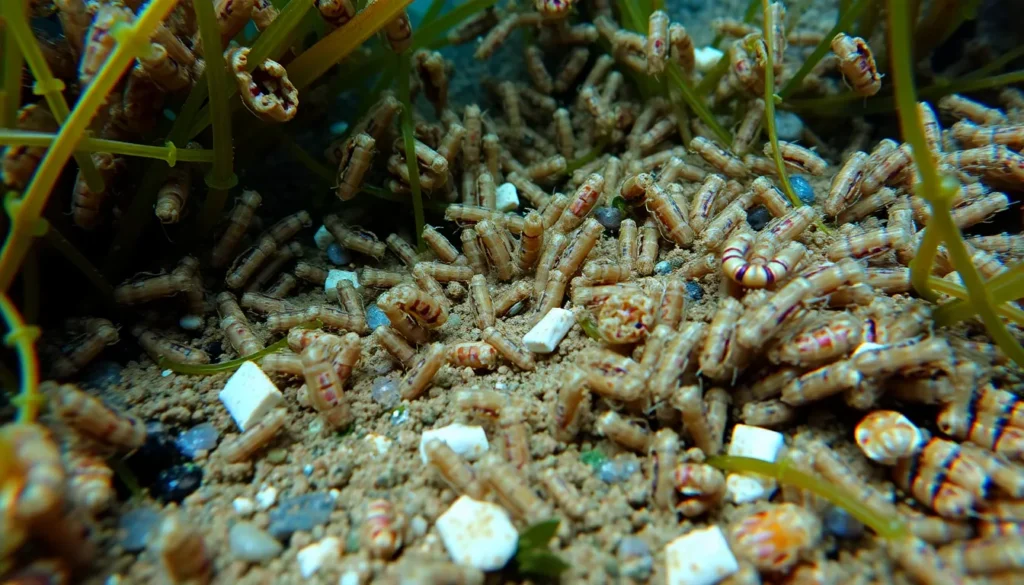
Short Answer
21 Facts About Amphipods
- Amphipods are small crustaceans. They belong to the order Amphipoda and typically range from 1 to 340 millimeters in length.
- Diverse group with many species. There are over 9,900 known species of amphipods worldwide, inhabiting various aquatic environments.
- Body structure is laterally compressed. Unlike many crustaceans, amphipods have bodies that are flattened from side to side rather than top to bottom.
- They lack a carapace. Unlike some other crustaceans, amphipods do not have a hard protective shell covering their thorax.
- Amphipods have distinct appendages. Their thoracic limbs are specialized for different functions, including swimming, feeding, and burrowing.
- Many species are scavengers. They feed on detritus, dead plants, and animals, contributing to nutrient recycling.
- Some amphipods are herbivores or predators. Dietary habits vary widely depending on species and habitat.
- They inhabit marine, freshwater, and terrestrial environments. Amphipods are found from ocean depths to freshwater streams and even moist terrestrial habitats.
- Amphipods are important prey items. They serve as food for fish, birds, and other aquatic animals.
- Some amphipods exhibit bioluminescence. A few deep-sea species can produce light through chemical reactions.
- Many amphipods exhibit sexual dimorphism. Males and females often differ in size and morphology.
- They reproduce sexually with direct development. Amphipods typically lay eggs that hatch into miniature adults without a larval stage.
- Amphipods can be indicators of environmental health. Their presence and diversity often reflect water quality and habitat conditions.
- Some species build tubes or burrows. These structures provide shelter and protection from predators.
- Amphipods have a global distribution. They are found in all oceans and many freshwater systems worldwide.
- They play a role in sediment mixing. Through their burrowing and feeding activities, amphipods contribute to sediment turnover.
- Amphipods can tolerate a range of environmental conditions. Some species survive in extreme habitats, such as deep-sea vents or highly polluted waters.
- Their fossil record dates back to the Jurassic. Amphipods have existed for at least 150 million years based on fossil evidence.
- Some amphipods are invasive species. They can be transported by ships and disrupt local ecosystems.
- Amphipods are studied in scientific research. They are used in toxicology and ecology studies due to their sensitivity to pollutants.
- They exhibit a variety of locomotion methods. Amphipods can swim, crawl, or jump depending on the species and environment.
Habitat and Behavior
Amphipods inhabit a wide range of environments, primarily aquatic, including marine, freshwater, and some moist terrestrial habitats. In marine environments, they can be found from shallow coastal waters to the deep sea, often living among algae, sediments, or under rocks. Freshwater amphipods are common in streams, rivers, and lakes. Terrestrial species typically live in moist leaf litter or soil near water. Behaviorally, amphipods are generally nocturnal and exhibit diverse feeding strategies such as scavenging, grazing, and predation. Many species burrow into sediment or construct tubes for protection. Locomotion varies with species, including swimming with their pleopods, crawling, or leaping using powerful legs. Amphipods often display social behaviors, such as forming swarms or aggregations, especially during reproduction.
Why This Animal Matters
Amphipods play a critical ecological role in aquatic ecosystems by recycling organic matter through their scavenging and detritivorous feeding habits. They serve as a key food source for many fish, birds, and invertebrates, thereby supporting higher trophic levels. Amphipods contribute to sediment mixing and nutrient cycling through their burrowing activities. Their sensitivity to pollution and habitat changes makes them valuable bioindicators for environmental monitoring. Additionally, amphipods have significance in scientific research, particularly in studies related to ecotoxicology and environmental stress. Some species have cultural importance in indigenous diets or as bait in fishing, although this is less common compared to other crustaceans. Conservation concerns arise mainly for endemic or habitat-restricted species vulnerable to pollution, habitat loss, and invasive competitors.
Common Misconceptions
Misconception: Amphipods are a type of shrimp.
Correction: Although amphipods and shrimp are both crustaceans, amphipods belong to a separate order (Amphipoda) and have distinct body structures, behaviors, and ecological roles.
Misconception: Amphipods are harmful pests.
Correction: Amphipods are generally beneficial in ecosystems, aiding in decomposition and serving as prey. While some invasive species may disrupt local habitats, most amphipods do not cause harm.
Misconception: All amphipods live underwater.
Correction: While most amphipods are aquatic, some species have adapted to live in moist terrestrial environments such as leaf litter and soil near water.
FAQ
What do amphipods eat?
Amphipods have varied diets depending on species, including scavenging dead organic matter, grazing on algae, and preying on smaller organisms.
Are amphipods harmful to humans?
No, amphipods are not harmful to humans and generally pose no threat; they are important components of aquatic ecosystems.
How do amphipods reproduce?
Amphipods reproduce sexually, with females carrying fertilized eggs until they hatch into miniature adults, bypassing a larval stage.





Leave a Reply