
Short Answer
21 Facts About Chameleon Tongue Projection
- Chameleons have an extraordinary tongue length.
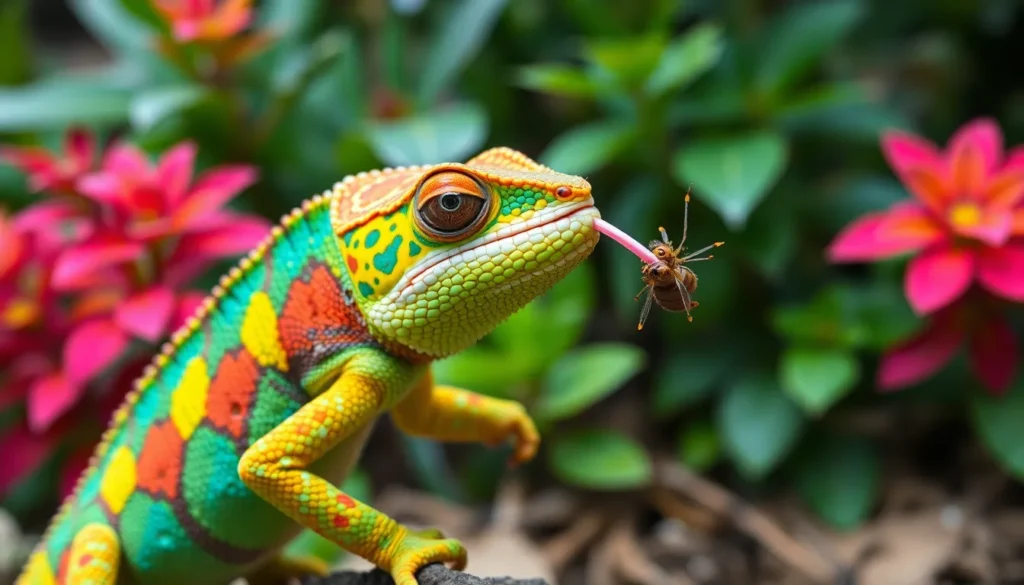
Chameleon tongues can extend up to twice the length of their body, allowing them to capture prey from a significant distance. - The tongue can project at incredible speeds.
A chameleon’s tongue can reach speeds of up to 13 miles per hour (21 km/h), making it one of the fastest appendages in the animal kingdom. - It uses a unique mechanism for projection.
The chameleon’s tongue is powered by a special muscle system that allows for rapid extension and retraction. - The tongue is sticky.
At the tip of the tongue, there is a sticky pad that helps secure the prey once it makes contact. - Chameleons have a prehensile tongue.
This means that their tongue can grasp and hold onto objects, which aids in capturing prey. - The tongue can be shot out and retracted quickly.
Chameleons can shoot their tongues out in a matter of milliseconds and retract them just as quickly. - Chameleons are ambush predators.
They rely on their exceptional tongue projection to catch insects and other small prey while remaining motionless. - Different species have different tongue lengths.
The size of the tongue varies among chameleon species, adapted to their specific hunting needs. - Chameleons can gauge distance accurately.
They possess keen eyesight that allows them to judge the distance to their prey before launching their tongue. - The tongue is made of elastic tissue.
This elasticity enables the tongue to stretch and contract efficiently, facilitating rapid movement. - Chameleons can target multiple prey items.
They can aim their tongue at several insects in a single launch, increasing their chances of a successful catch. - Habitat affects tongue function.
Chameleons in dense forests may have evolved shorter tongues compared to those in open environments to suit their hunting strategies. - The color of the tongue can change.
Some chameleons exhibit color changes in their tongues, potentially as a means of communication or camouflage. - Fast tongue projection is energy-efficient.
The rapid projection of their tongue requires less energy than other forms of hunting, making it an efficient predatory strategy. - Chameleons use their tongues for feeding and cleaning.
Beyond predation, chameleons may also use their tongues to clean their eyes and other body parts. - Some species use their tongues for social interactions.
In certain contexts, tongue movements can be part of displays during mating rituals or territorial disputes. - The tongue can be injured.
Despite its robustness, a chameleon’s tongue can sustain injuries if it strikes hard surfaces or larger prey. - Captive chameleons may exhibit tongue issues.
In captivity, improper diet or habitat can lead to tongue problems, affecting their ability to feed. - Chameleons are not the only reptiles with long tongues.
Other reptiles, such as some species of skinks, also possess long tongues, but their projection mechanisms differ significantly. - Research continues on chameleon tongue mechanics.
Scientists study chameleon tongue projection for insights into biomechanics and potential applications in robotics. - Chameleons face threats to their habitat.
Deforestation and habitat loss endanger many chameleon species, highlighting the need for conservation efforts.
Habitat and Behavior
Chameleons are predominantly found in tropical and subtropical regions, particularly in Madagascar, Africa, and parts of Asia. They inhabit various environments, including rainforests, savannas, and deserts. Chameleons are known for their distinctive behavior of changing color, which aids in communication and camouflage. They are primarily arboreal, spending much of their time in trees or shrubs, where they can effectively hunt insects and avoid predators. Their unique hunting strategy, involving slow movements and rapid tongue projection, allows them to be efficient ambush predators.
Why This Animal Matters
Chameleons play a vital role in their ecosystems as insectivores, helping to control insect populations. Their unique adaptations make them a subject of interest in the study of evolution and biomechanics. Additionally, chameleons hold cultural significance in various societies, often symbolizing transformation and adaptability. Conservation efforts are crucial for many chameleon species, as habitat destruction poses significant threats to their survival.
Common Misconceptions
FAQ
How do chameleons use their tongues?
Chameleons use their tongues to catch prey quickly and efficiently, extending them to great lengths in milliseconds.
Can chameleons change color at will?
Chameleons can change color, but this is primarily for communication and not solely for camouflage.
What threats do chameleons face?
Chameleons face threats from habitat destruction, climate change, and the pet trade, leading to declining populations.



Leave a Reply