
Short Answer
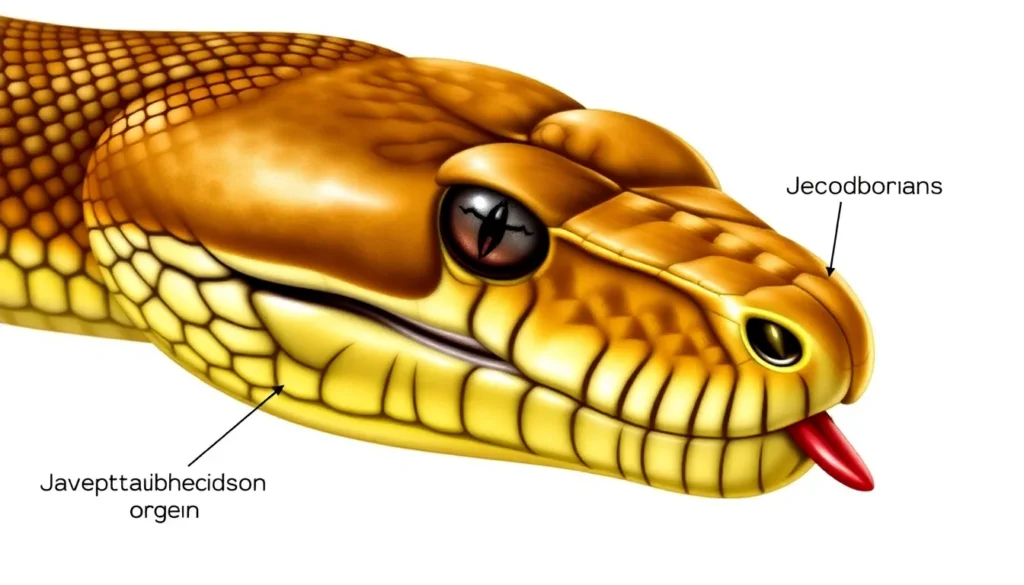
21 Facts About Snake Jacobson’s Organ
- Jacobson’s Organ is also known as the vomeronasal organ.
This organ is present in many reptiles, including snakes, and is primarily used to detect pheromones, which are chemical signals used for communication. - It aids in prey detection.
Jacobson’s organ enhances a snake’s ability to locate prey by sensing chemical cues left behind, making hunting more effective. - Found in the roof of the mouth.
The organ is positioned in the nasal cavity and opens into the mouth, allowing snakes to sample chemical molecules effectively. - Not all snakes have a fully developed Jacobson’s organ.
While most snakes possess this organ, some species may have a reduced or non-functional version. - It plays a role in social interactions.
Snakes use Jacobson’s organ to detect pheromones released by other snakes, which can indicate territory, mating readiness, or alarm signals. - Jacobson’s organ is more developed in some species.
Certain snake species, such as the garter snake, have a more pronounced Jacobson’s organ, enhancing their ability to detect chemical signals. - It works in conjunction with the tongue.
Snakes use their forked tongues to collect scent particles from the air and deliver them to Jacobson’s organ for analysis. - It is a vestige of a more complex system.
In ancestral reptiles, Jacobson’s organ was part of a more complex olfactory system, indicating its evolutionary significance. - Functional in various environments.
The organ helps snakes adapt to diverse habitats by improving their sensory perception, critical for survival in different ecological niches. - Jacobson’s organ can detect a wide range of chemicals.
It is particularly sensitive to pheromones, but can also detect other environmental chemicals, aiding in navigation and foraging. - It influences mating behavior.
Chemical cues detected by Jacobson’s organ can trigger mating behaviors, such as courtship displays or aggression towards rivals. - It is linked to the sense of taste.
While primarily a chemosensory organ, Jacobson’s organ contributes to the snake’s overall perception of taste and flavor. - Snakes can distinguish between similar chemicals.
The sensitivity of Jacobson’s organ allows snakes to differentiate between various pheromones, which can be crucial for social interactions. - It is often overlooked in studies.
Despite its importance, Jacobson’s organ is less studied than other sensory systems, limiting understanding of its full ecological role. - It is present in other reptiles.
Apart from snakes, Jacobson’s organ is also found in lizards, some amphibians, and even some mammals, indicating its evolutionary significance. - It can influence predator-prey dynamics.
The efficiency of prey detection via Jacobson’s organ can impact predator-prey relationships in ecosystems. - Research continues on its functions.
Scientists are exploring the specific mechanisms and evolutionary advantages provided by Jacobson’s organ in snakes. - Jacobson’s organ is often mistaken for other sensory organs.
This can lead to misunderstandings about how snakes perceive their environment. - It has implications for snake conservation.
Understanding Jacobson’s organ’s role can aid in conservation efforts by highlighting the importance of chemical communication in snake populations. - It reflects evolutionary adaptations.
The existence and function of Jacobson’s organ illustrate how snakes have adapted to their environments over millions of years. - Future studies may reveal more about its complexities.
As research advances, there may be new insights into the workings and significance of Jacobson’s organ.
Habitat and Behavior
Snakes are found in a variety of habitats, including forests, deserts, and aquatic environments. Their behavior often includes solitary hunting, with many species relying on camouflage and chemical cues to navigate and locate prey. The Jacobson’s organ plays a crucial role in their survival, allowing them to detect and respond to environmental changes and threats effectively.
Why This Animal Matters
Jacobson’s organ is essential for snakes, impacting their ecological roles as predators and prey. It facilitates interspecies communication and mating behaviors, thus influencing the genetic diversity within populations. Understanding this organ is vital for conservation efforts, as it underlines the complex interactions within ecosystems and the importance of maintaining healthy snake populations.
Common Misconceptions
FAQ
What is Jacobson's organ?
Jacobson's organ, or vomeronasal organ, is a chemosensory structure in snakes that detects pheromones and chemical cues.
How does Jacobson's organ work?
It works by receiving chemical signals collected by the snake's tongue, which are then analyzed to inform the snake's behaviors.
Do all snakes have Jacobson's organ?
Most snakes have it, but some species may have a reduced or non-functional version.




Leave a Reply