
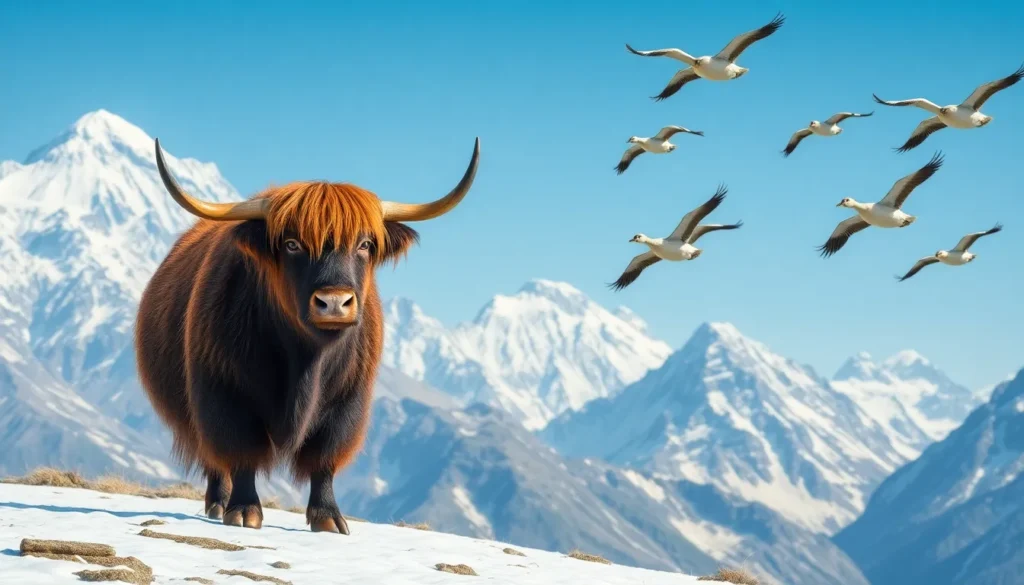
Short Answer
21 Facts About High Altitude Animals
- Yaks have dense, woolly coats: Their thick fur insulates them against the freezing temperatures of the Tibetan Plateau and other high mountain regions.
- Bar-headed geese migrate over the Himalayas: They fly at altitudes of up to 7,000 meters (23,000 feet), higher than any other migratory bird.
- Yaks have larger lungs and hearts: This adaptation helps them efficiently process oxygen in thin air.
- Bar-headed geese possess specialized hemoglobin: Their hemoglobin has a higher affinity for oxygen, allowing them to absorb more oxygen at high altitudes.
- Yaks are essential to Tibetan culture: They serve as pack animals, sources of milk, meat, and fuel from their dung.
- Bar-headed geese can sustain flight in low-oxygen environments: Their muscle cells utilize oxygen very effectively during flight.
- Yaks have wide, tough hooves: These enable stable movement on rocky, steep terrain.
- Bar-headed geese use tailwinds for migration: They strategically time their flights to take advantage of favorable wind currents.
- Yaks have adapted digestive systems: Their rumens allow them to digest coarse, fibrous high-altitude vegetation.
- Bar-headed geese exhibit increased capillary density: This improves oxygen delivery to tissues during flight.
- Yaks have lower metabolic rates: This helps conserve energy in harsh environments with limited food.
- Bar-headed geese have reinforced flight muscles: Their pectoral muscles contain more mitochondria for sustained energy output.
- Yaks can withstand extreme cold and wind: Their body fat and fur provide critical insulation.
- Bar-headed geese nesting occurs at high elevations: They breed on lakes and wetlands above 3,000 meters.
- Yaks show seasonal migration within high altitudes: They may move to lower elevations during winter for better forage.
- Bar-headed geese have been recorded flying nonstop for up to 1,200 kilometers: This endurance is rare among birds.
- Yaks communicate with low-frequency sounds: These travel long distances across mountainous terrain.
- Bar-headed geese have a unique respiratory system: They can maintain steady breathing rates despite thin air pressure.
- Yaks are social animals: They live in herds that provide protection and social interaction.
- Bar-headed geese populations are currently stable: Conservation efforts and habitat protection contribute to their status.
- Both yaks and bar-headed geese have evolved over thousands of years: Their specialized adaptations are results of long-term natural selection in high altitude ecosystems.
Habitat and Behavior
Yaks (Bos grunniens) are native to the Himalayan region, Tibetan Plateau, and surrounding high-altitude areas, typically found between 3,000 and 5,500 meters elevation. They inhabit cold, arid environments with sparse vegetation, relying on tough grasses and shrubs for food. Yaks are well-adapted to steep, rocky terrain and harsh winter conditions. They live in herds, often led by a dominant male, and display seasonal movements to access better forage. They are domesticated in many regions but also exist in wild populations.
Bar-headed geese (Anser indicus) breed in Central Asia at elevations ranging from 3,000 to 5,500 meters, particularly around high-altitude lakes and wetlands. They undertake one of the highest known migratory flights, crossing the Himalayas to winter in the Indian subcontinent. Their behavior includes synchronized flocking during long-distance flights, and they time their migration to coincide with favorable weather patterns. They feed on grasses, seeds, and aquatic plants.
Why This Animal Matters
Yaks are vital to the livelihoods of many Himalayan and Central Asian communities, providing meat, milk, fiber, and transportation. Ecologically, they influence vegetation patterns and soil dynamics through grazing and trampling. Their presence supports predator species and scavengers in these fragile ecosystems.
Bar-headed geese are important indicators of wetland health in high-altitude regions. Their migratory patterns connect ecosystems across vast geographical ranges, contributing to nutrient cycling and seed dispersal. The species also holds cultural significance in many local traditions and is a subject of scientific interest regarding altitude physiology.
Common Misconceptions
Misconception: Yaks are simply wild cattle.
Correction: While related to cattle, yaks have distinct adaptations and behaviors suited to high altitudes, and many yaks are domesticated, unlike typical wild cattle.
Misconception: Bar-headed geese migrate at low altitudes to avoid thin air.
Correction: Bar-headed geese routinely fly at extremely high altitudes, often above 6,000 meters, adapting physiologically to low oxygen levels rather than avoiding them.
FAQ
How do yaks survive in low oxygen environments?
Yaks have larger lungs and hearts that allow more efficient oxygen uptake and circulation. They also have a higher concentration of red blood cells, which helps transport oxygen more effectively in thin air.
Why can bar-headed geese fly at such high altitudes?
Bar-headed geese possess specialized hemoglobin molecules with a higher affinity for oxygen, increased capillary density, and enhanced muscle mitochondria, all of which enable them to sustain flight in low-oxygen conditions at extreme altitudes.
Are yaks domesticated animals?
Yes, many yaks are domesticated and are essential to local human populations for transportation, milk, meat, and wool. Wild yaks also exist but are less common and are generally found in remote areas of the Tibetan Plateau.






Leave a Reply