
Short Answer
21 Facts About Bowerbird Architecture
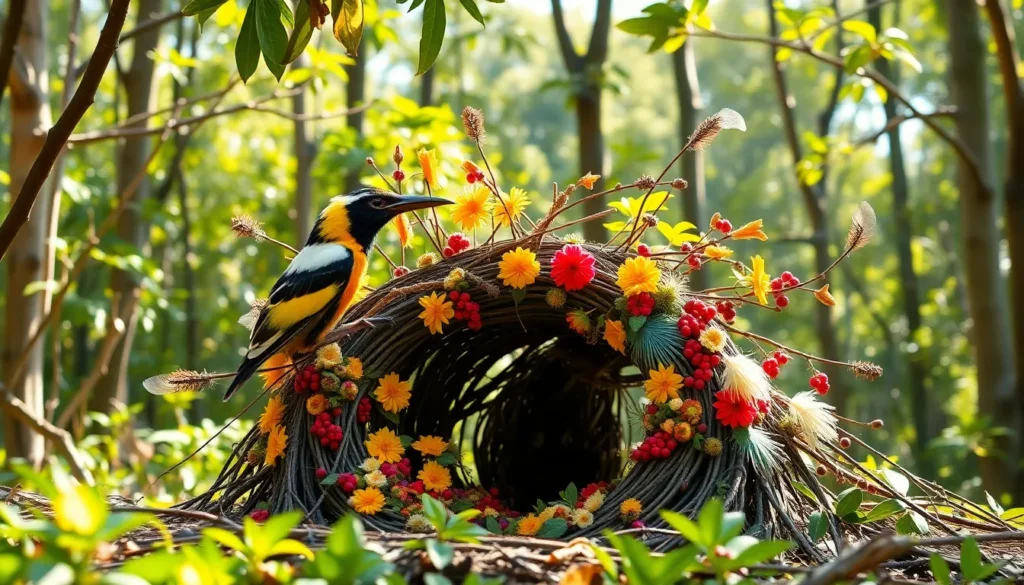
- Unique Structures: Male bowerbirds build elaborate structures called bowers, which are not nests but display arenas used to attract females.
- Variety in Bower Types: Different bowerbird species construct distinct types of bowers, including maypole bowers, avenue bowers, and mat bowers.
- Use of Decorations: Bowerbirds collect and arrange colorful objects such as flowers, feathers, berries, and even human-made items to decorate their bowers.
- Color Preferences: Each species and individual male often shows preference for particular colors, which can influence female choice.
- Construction Complexity: Bowers can be extremely complex, with some species building symmetrical and well-structured avenues that demonstrate architectural skill.
- Behavioral Displays: Males perform elaborate courtship dances and vocalizations around their bowers to complement their architectural displays.
- Learning and Innovation: Young males learn bower building by observing others and sometimes innovate new decoration or construction techniques.
- Territoriality: Bowerbirds defend their bowers aggressively against rivals, ensuring the integrity of their display site.
- Maintenance: Males regularly repair and rearrange their bowers to keep them attractive and functional throughout the breeding season.
- Strategic Placement: Bowls are often built in locations that maximize visibility and accessibility to females.
- Significance of Symmetry: Symmetry and neatness in bower construction are thought to signal the male’s fitness to potential mates.
- Use of Illusions: Some species create optical illusions by arranging decorations in ways that exaggerate the apparent size or quality of the bower.
- Cognitive Abilities: Bowerbirds demonstrate advanced problem-solving skills related to bower construction and decoration.
- Species-Specific Designs: The design and decoration style of bowers vary significantly between species, aiding species recognition.
- Non-Nesting Function: Unlike nests, bowers are not used for raising young—they are solely for mating displays.
- Female Choice: Females visit multiple bowers and select mates based on the quality and appeal of the bower and the male’s performance.
- Impact on Evolution: Bowerbird architecture is a classic example of sexual selection driving the evolution of complex animal behavior.
- Use of Man-Made Objects: Some bowerbirds incorporate human-made items like bottle caps, plastic pieces, and glass into their decorations.
- Geographical Distribution: Bowerbirds are native to Australia and New Guinea, where their architectural behaviors have evolved over millions of years.
- Research Significance: Scientists study bowerbird architecture to understand animal cognition, mating strategies, and evolutionary biology.
- Conservation Status: Habitat loss threatens some bowerbird species, making the preservation of their natural environments crucial for maintaining their unique behaviors.
Habitat and Behavior
Bowerbirds inhabit forests, woodlands, and rainforest edges primarily in Australia and New Guinea. They are known for their solitary and territorial males who fiercely guard their bowers. Male bowerbirds invest considerable time and energy into constructing and decorating their bowers, which serve as a visual and behavioral display to attract females during the breeding season. Females visit several bowers to assess the males based on the architecture, decoration, and courtship displays before selecting a mate. Outside the breeding season, bowerbirds lead more typical bird behaviors such as feeding on fruits and insects and maintaining social hierarchies within their populations.
Why This Animal Matters
Bowerbirds play an important ecological role as seed dispersers due to their frugivorous diet, aiding in forest regeneration. Their architectural behavior provides valuable insights into sexual selection and animal cognition, illustrating how complex behaviors can evolve through mate choice. Culturally, bowerbirds have fascinated naturalists and ornithologists for centuries, contributing to the understanding of animal artistry and intelligence. Conservation of bowerbird habitats is essential not only for preserving biodiversity but also for maintaining the natural laboratories that allow the study of evolutionary biology and behavioral ecology.
Common Misconceptions
Misconception: Bowers are nests where bowerbirds raise their chicks.
Correction: Bowers are not nests but mating display structures; females build separate nests for laying eggs and raising chicks.

Misconception: Bowerbirds build bowers purely for shelter.
Correction: Bowls serve exclusively for courtship and mate attraction, not for shelter or protection.
Misconception: All bowerbirds build the same type of bower.
Correction: Bower construction varies widely among species, with different styles and decoration preferences.
Misconception: The decorations have no significance beyond aesthetics.
Correction: Decorations often signal the male’s fitness and can influence female mate choice.
FAQ
What is the main purpose of bowerbird architecture?
The main purpose of bowerbird architecture is to serve as a mating display to attract females. Male bowerbirds build and decorate bowers to demonstrate their fitness and entice females to choose them as mates.
Do bowerbirds use their bowers as nests?
No, bowerbirds do not use their bowers as nests. The bowers are solely structures for courtship displays, while females build separate nests elsewhere for laying eggs and raising chicks.
Why do bowerbirds decorate their bowers with colorful objects?
Bowerbirds decorate their bowers with colorful objects to enhance the attractiveness of their display. These decorations signal the male's health, resourcefulness, and suitability as a mate, influencing female choice.





Leave a Reply