
Short Answer
21 Facts About Anglerfish Mating
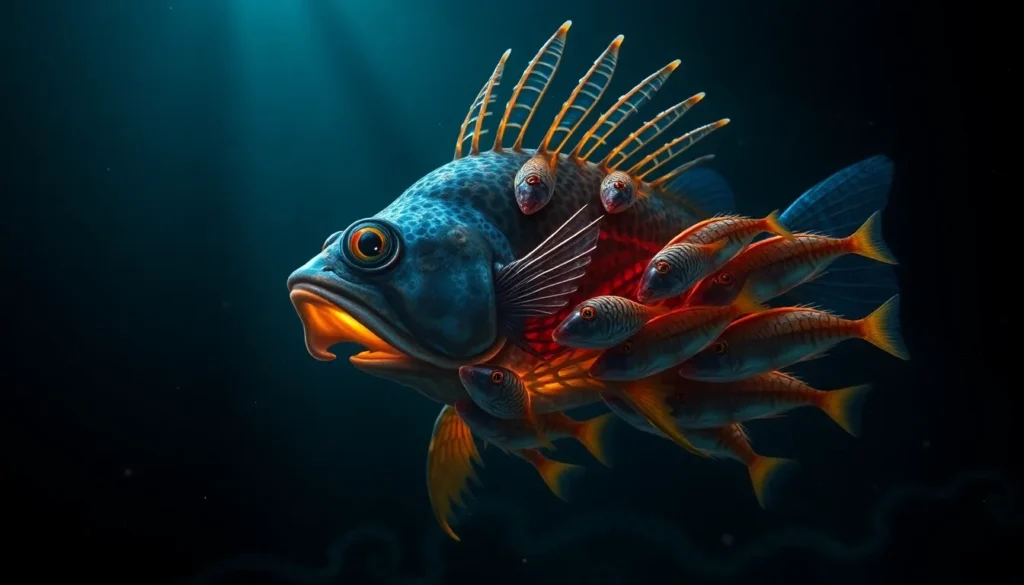
- Extreme Sexual Dimorphism: Female anglerfish are significantly larger than males, sometimes up to 60 times heavier, which is unusual among fish species.
- Parasitic Males: In many anglerfish species, males permanently attach to females by biting into their skin and fusing with them, relying on the female’s body for nutrients.
- Permanent Fusion: Once attached, the male’s tissues merge with the female’s circulatory system, effectively becoming a parasitic appendage.
- Multiple Males Possible: A single female can carry multiple males simultaneously, each attached and fused to her body.
- Function of Fusion: The fusion ensures the male is always available to fertilize the female’s eggs when she is ready to spawn.
- Male Independence Lost: After fusion, the male loses many independent functions, including feeding and swimming, surviving solely on nutrients from the female.
- Reproductive Advantage: This mating strategy is believed to be an adaptation to the deep-sea environment where finding a mate is challenging due to low population density.
- Bioluminescent Lure: Female anglerfish possess a bioluminescent lure that attracts prey and possibly mates in the dark ocean depths.
- Male Size: Males are much smaller, often just a few centimeters long, and are specialized for locating females rather than hunting.
- Olfactory Adaptations: Males have highly developed olfactory organs to detect pheromones released by females from a distance.
- Varied Attachment Sites: Males may attach to different locations on the female’s body, depending on the species.
- Species Variability: Not all anglerfish exhibit the same degree of sexual parasitism; some species have free-living males that do not fuse with females.
- Evolutionary Mystery: The precise evolutionary pathway of this parasitic mating strategy is still an area of scientific research.
- Longevity of Attachment: Attached males can remain fused for years, providing continuous reproductive potential.
- Reproductive Cycles: Female anglerfish can carry fertilized eggs to maturity after males have attached and inseminated them.
- Genetic Exchange: The fusion allows direct genetic exchange as sperm is delivered continuously through the male’s body to the female’s reproductive organs.
- Rare Observation: Actual mating and fusion events are rarely observed due to the inaccessibility of deep-sea habitats.
- Adaptation to Scarcity: The parasitic male strategy is an evolutionary response to the difficulty of encountering mates in the vast, dark ocean depths.
- Impact on Male Physiology: Males lose many organs including their digestive system after fusion, becoming essentially reproductive organs.
- Female Autonomy: Despite carrying males, females maintain full control over feeding and movement.
- Scientific Interest: Anglerfish mating is a model system for studying sexual dimorphism, reproductive strategies, and deep-sea adaptations.
Habitat and Behavior
Anglerfish are deep-sea fish primarily found at depths ranging from 200 to over 2000 meters in oceans worldwide. They thrive in dark, cold environments where sunlight does not penetrate. Their behavior is adapted to this extreme environment, utilizing bioluminescent lures to attract prey and potential mates. The females are largely solitary and sedentary, while males are adapted to seek out females by sensing chemical signals in the water. The unique mating strategy, involving male parasitism, ensures reproductive success despite the sparse population density and vastness of their habitat.
Why This Animal Matters
Anglerfish play an important role in the deep-sea ecosystem as predators, helping to maintain the balance of deep-sea food webs. Their unusual mating strategy provides valuable insight into evolutionary biology, sexual selection, and adaptation to extreme environments. The species has cultural significance due to its striking appearance and mysterious lifestyle, often featured in documentaries and scientific literature. Conservation relevance is tied to their deep-sea habitat, which is increasingly threatened by human activities such as deep-sea fishing and resource extraction, highlighting the need for further study and protection of these unique creatures.
Common Misconceptions
Misconception: All anglerfish males are free-living and independent.
Correction: While some species have free-living males, many deep-sea anglerfish species have males that permanently attach to females and become parasitic.

Misconception: The female anglerfish kills the male when they fuse.
Correction: The fusion is a mutual biological process where the male becomes dependent on the female for nutrients, but it is a reproductive adaptation rather than an act of harm.
Misconception: The glowing lure is used to attract mates only.
Correction: The bioluminescent lure primarily attracts prey, though it may also aid in attracting mates in the pitch-black deep sea.
Misconception: Anglerfish live in shallow waters.
Correction: Anglerfish are deep-sea dwellers, typically found at great depths where sunlight does not reach.
FAQ
Why do male anglerfish attach to females?
Male anglerfish attach to females to ensure they have a constant supply of sperm for fertilization, which is critical in the deep sea where encounters between individuals are rare.
Do all anglerfish males become parasitic?
No, parasitic attachment occurs mainly in deep-sea anglerfish species; some species have free-living males that do not fuse with females.
How does the fusion between male and female anglerfish work?
The male bites into the female’s skin and their tissues fuse, connecting their circulatory systems so the male receives nutrients and can provide sperm when needed.


Leave a Reply