
Short Answer
21 Facts About Locusts
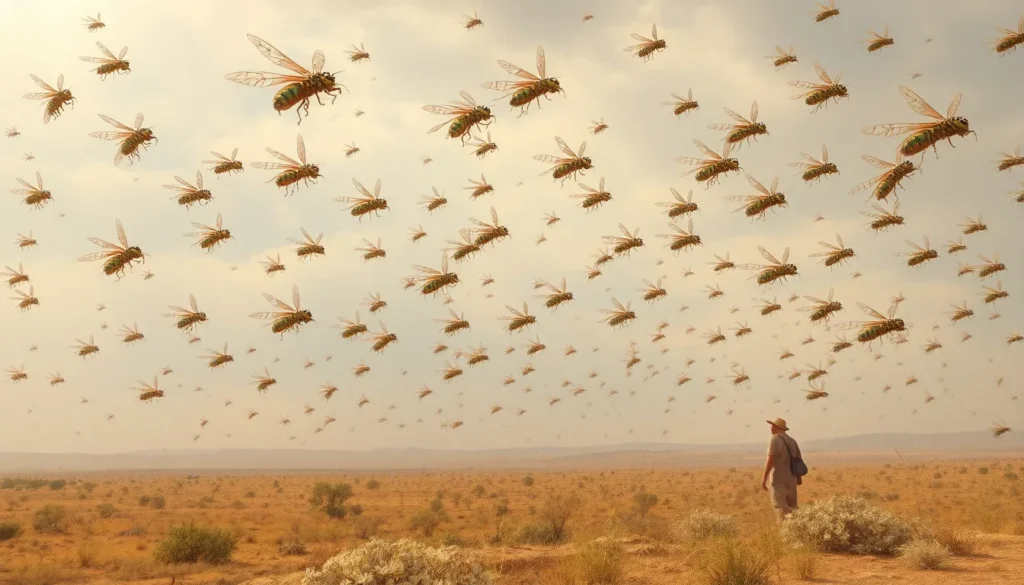
- Locusts are a type of grasshopper. They belong to the family Acrididae and differ mainly in their ability to form swarms under certain conditions.
- Locusts exhibit phase polyphenism. They can change between solitary and gregarious phases, which affects their behavior, color, and physiology.
- Swarms can cover vast distances. Some locust swarms travel hundreds to thousands of kilometers in search of food.
- Locust outbreaks are triggered by environmental factors. Rainfall and vegetation growth can create conditions favorable for swarming.
- They have a significant impact on agriculture. Locust swarms can destroy crops, leading to food insecurity in affected regions.
- Locusts can consume their own weight in food daily. This high consumption rate contributes to their destructive potential.
- Locusts have been recorded as pests since ancient times. Historical texts from various cultures mention locust plagues.
- There are several species of locusts. The desert locust (Schistocerca gregaria) is among the most infamous.
- Locust swarming behavior is a form of collective movement. This coordination helps them find new feeding grounds efficiently.
- Locusts use their hind legs to jump long distances. This physical adaptation aids in escaping predators and moving swiftly.
- They have chewing mouthparts. These are adapted to consume a wide variety of plant material.
- Locusts undergo incomplete metamorphosis. Their life cycle includes egg, nymph, and adult stages without a pupal stage.
- Swarming locusts produce distinct sounds. They create noise by rubbing their hind legs against their wings, a behavior known as stridulation.
- Locusts can travel over oceans. Some swarms have been observed crossing the Red Sea and other bodies of water.
- Control measures include pesticides and biological agents. Efforts to manage locust outbreaks involve monitoring and targeted treatments.
- Climate change may influence locust behavior. Shifts in rainfall and temperature patterns could affect their breeding and migration.
- Locusts are a food source in some cultures. They are harvested and consumed as a protein-rich snack in parts of Africa and Asia.
- Locusts can affect ecosystems both positively and negatively. While destructive to crops, they also serve as prey for various animals.
- Locusts have inspired cultural expressions. They appear in literature, art, and religious texts symbolizing famine or divine punishment.
- Modern technology aids in locust monitoring. Satellite imagery and drones help track swarm movements for early warning.
- The study of locusts is important for food security. Understanding their biology and behavior aids in developing better management strategies.
Habitat and Behavior
Locusts primarily inhabit arid and semi-arid regions, including deserts, grasslands, and savannas. They thrive in areas where vegetation periodically flourishes following rains, providing ample food to support their rapid population growth. In their solitary phase, locusts are relatively harmless and tend to avoid each other. However, when environmental conditions trigger crowding, locusts enter the gregarious phase, leading to dramatic changes in coloration, behavior, and physiology. During this phase, they form large, dense swarms capable of long-distance flight and coordinated movement. These swarms can devastate crops and natural vegetation, traveling day and night to find new feeding grounds. Locusts are adept jumpers, using powerful hind legs, and possess wings that allow sustained flight. Their life cycle progresses through incomplete metamorphosis stages: egg, nymph (hopper), and adult. Communication among locusts includes visual signals and sound production through stridulation. They rely on environmental cues such as humidity and temperature to regulate their breeding and swarming activities.
Why This Animal Matters
Locusts play a complex ecological role. On one hand, they contribute to nutrient cycling by consuming vegetation and serving as prey for birds, reptiles, and mammals. Their swarming behavior, although destructive to agriculture, is a natural response to environmental variability that has evolved over millions of years. Culturally, locusts have influenced human societies for centuries, often symbolizing hardship and resilience. Economically, locust outbreaks pose serious challenges to food security, particularly in regions dependent on subsistence farming. Controlling locust populations is critical to minimizing crop losses and protecting livelihoods. Scientific research on locusts informs pest control strategies and enhances understanding of collective animal behavior. Their sensitivity to climate and habitat changes also makes them a subject of interest in studies on environmental impacts and adaptation.
Common Misconceptions
Misconception: Locusts and grasshoppers are completely different insects.
Correction: Locusts are a type of grasshopper distinguished mainly by their ability to form swarms and undergo phase changes, but they share many biological traits with other grasshoppers.
Misconception: All locusts are always dangerous pests.
Correction: Locusts are only destructive when they enter the gregarious swarming phase; solitary locusts do not pose significant threats to crops.
Misconception: Locust swarms can destroy entire countries’ food supplies overnight.
Correction: While locust swarms can cause extensive crop damage, complete destruction of national food supplies is rare due to control measures and the localized nature of outbreaks.
Misconception: Locusts only appear in deserts.
Correction: Although associated with arid regions, locusts can inhabit various environments including grasslands and savannas where conditions support their life cycle.
Misconception: Locusts are a modern pest problem caused by human activity.
Correction: Locust outbreaks have been documented since ancient times and are part of natural ecological cycles, although human activities can influence their frequency and impact.
FAQ
What triggers locust swarming behavior?
Locust swarming is triggered by environmental factors such as increased rainfall and vegetation growth, which cause locust populations to become dense and shift from the solitary to the gregarious phase.
Are locusts harmful to humans?
Locusts do not pose direct harm to humans as they do not bite or sting, but their swarms can cause significant agricultural damage leading to food shortages.
How are locust outbreaks controlled?
Control measures include monitoring populations, applying pesticides, introducing biological control agents, and using modern technology like satellite imagery and drones to detect and manage swarms early.



Leave a Reply