
Short Answer
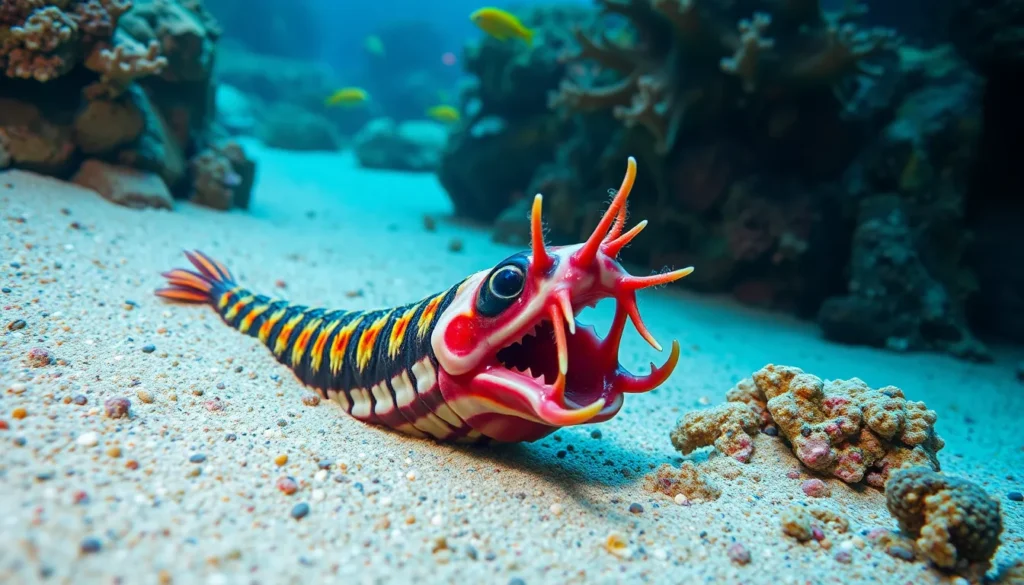
21 Facts About Bobbit Worms
- Scientific Classification: Bobbit worms belong to the genus Eunice within the family Eunicidae, which includes many large predatory polychaete worms.
- Ambush Predators: Bobbit worms are ambush predators that lie buried in sediment with only their jaws exposed, waiting to capture prey.
- Powerful Jaws: Their jaws are highly specialized and can snap shut at incredible speeds, allowing them to catch swift-moving fish and invertebrates.
- Size: Some bobbit worms can grow up to 3 meters (10 feet) in length, making them one of the largest polychaetes.
- Segmented Bodies: Like other polychaetes, bobbit worms have segmented bodies covered in bristles called chaetae that aid in movement and anchoring.
- Coloration: Their coloration varies but often includes shades of brown, red, or purple, providing camouflage within the ocean floor.
- Habitat: They predominantly inhabit tropical and subtropical marine environments, often buried in sandy or muddy substrates on the ocean floor.
- Nocturnal Activity: Bobbit worms tend to be more active at night, which is when they hunt more frequently.
- Diet: Their diet mainly consists of fish and other smaller marine animals, which they capture using their sharp jaws.
- Regeneration: Bobbit worms can regenerate lost body parts, a common trait among many polychaete worms.
- Reproduction: They reproduce sexually, releasing eggs and sperm into the water column for external fertilization.
- Larval Stage: Their larvae are planktonic, drifting in the ocean currents before settling on the seabed to mature.
- Movement: While primarily sedentary ambush predators, they can move through sediment using their muscular bodies and bristles.
- Camouflage: Their ability to blend into the ocean floor helps them avoid predators and surprise prey.
- Feeding Mechanism: They use their extendable jaws to snatch prey quickly, often pulling it beneath the sediment to consume.
- Defense: Their powerful jaws can also serve as a defense mechanism against potential threats.
- Scientific Interest: Bobbit worms are studied for their unique hunting strategies and biomechanical jaw structure.
- Misidentification: They are sometimes mistaken for mythical creatures due to their size and striking appearance.
- Interaction With Humans: Although generally not dangerous, their sharp jaws can cause injury if handled carelessly.
- Environmental Indicators: Presence of bobbit worms can indicate healthy benthic ecosystems with adequate prey availability.
- Longevity: Exact lifespan is not well documented but is believed to span several years under natural conditions.
Habitat and Behavior
Bobbit worms inhabit tropical and subtropical ocean floors, primarily in sandy or muddy substrates where they can bury themselves. They create burrows that conceal most of their bodies, leaving only their powerful jaws exposed to sense vibrations and movements in the water. This positioning enables them to ambush prey efficiently. They are mostly nocturnal hunters, emerging or becoming more active during the night to capture fish and other small marine creatures. Their movement is generally limited to adjusting their position within the sediment, but they can rapidly extend their jaws to seize prey. Bobbit worms’ behavior is characterized by stealth, patience, and sudden, rapid strikes.
Why This Animal Matters
Bobbit worms play an important ecological role as mid-level predators in benthic marine ecosystems. By controlling populations of smaller fish and invertebrates, they contribute to maintaining ecological balance. Their predation influences prey behavior and community structure on the seafloor. Additionally, their presence serves as an indicator of healthy marine habitats, which are essential for biodiversity. While not widely known culturally, bobbit worms have fascinated scientists and marine enthusiasts due to their unusual hunting methods and impressive physical adaptations. Understanding their biology may provide insights into evolutionary specialization and predator-prey dynamics in marine environments.
Common Misconceptions
Misconception: Bobbit worms are aggressive towards humans and pose a significant danger.
Correction: While bobbit worms have powerful jaws, they generally avoid humans and will only bite if provoked or handled improperly. They are not considered a major threat to humans.
Misconception: Bobbit worms are mythical or prehistoric monsters.
Correction: Bobbit worms are real marine animals, scientifically classified polychaete worms. Although their size and appearance may seem unusual, they are part of modern marine biodiversity.
Misconception: Bobbit worms live only in deep ocean trenches.
Correction: They are mostly found in shallow to moderate depths in tropical and subtropical seas, not exclusively deep ocean trenches.
FAQ
Are bobbit worms dangerous to humans?
Bobbit worms have powerful jaws capable of inflicting injury, but they generally avoid humans and attacks are rare, usually occurring only if the worm is handled or disturbed.
How do bobbit worms catch their prey?
Bobbit worms lie buried in sediment with jaws exposed, detecting vibrations and quickly snapping their jaws to seize passing fish or invertebrates.
Where are bobbit worms commonly found?
They are typically found in tropical and subtropical marine environments, buried in sandy or muddy ocean floors at shallow to moderate depths.



Leave a Reply