
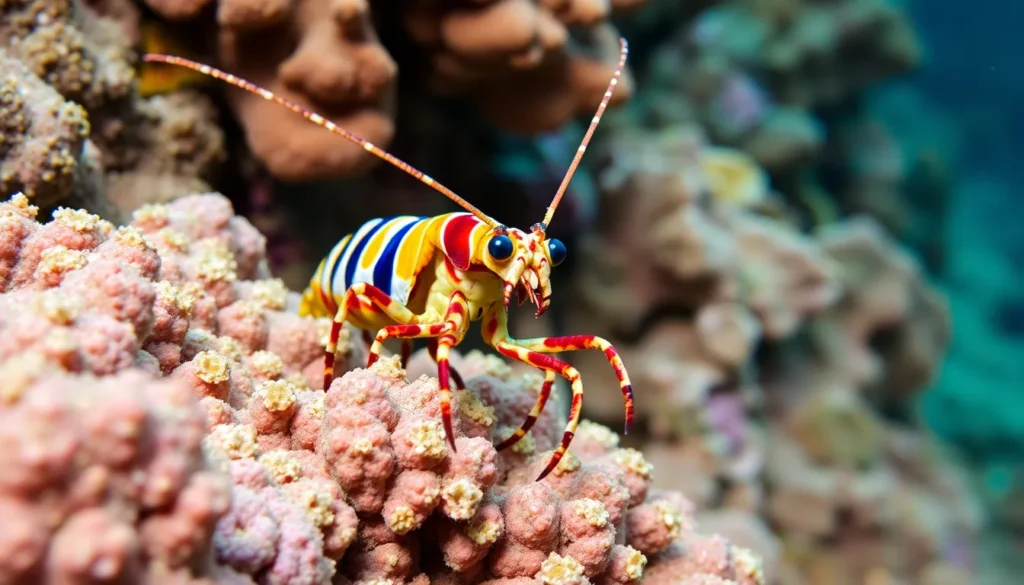
Short Answer
21 Facts About Mantis Shrimp
- Exceptional vision: Mantis shrimp have some of the most complex eyes in the animal kingdom, capable of seeing polarized light and detecting ten times more color than humans.
- Two main types: They are generally classified into two groups based on their hunting appendages: smashers, which have club-like claws, and spearers, which have sharp, spear-like claws.
- Powerful strike: Their claw strike can accelerate as fast as a bullet from a gun, generating forces strong enough to break glass or crack shells of prey.
- Speed of strike: The mantis shrimp’s strike can reach speeds of 23 meters per second (about 50 miles per hour) in just a few milliseconds.
- Cavitation bubbles: Their rapid strike creates cavitation bubbles that collapse with a force that can stun or kill prey even if the claw misses.
- Longevity: Some mantis shrimp species can live up to 20 years in the wild, which is relatively long for marine crustaceans.
- Complex communication: Mantis shrimp use visual signals, including changes in body coloration and polarized light reflection, to communicate with one another.
- Colorful exoskeletons: Many species display vibrant colors ranging from bright reds to greens and blues, often used for signaling and camouflage.
- Territorial behavior: Mantis shrimp are known to be highly territorial, often defending burrows aggressively against intruders.
- Burrow dwellers: Most mantis shrimp live in burrows on the ocean floor, which they excavate and maintain themselves.
- Diet: They primarily feed on hard-shelled prey such as mollusks, crabs, and snails, using their powerful claws to break the shells.
- Complex eyes: Each eye moves independently and contains trinocular vision, allowing mantis shrimp to calculate depth precisely.
- Reproductive behavior: Females lay eggs within their burrows, which they guard until hatching, sometimes exhibiting parental care.
- Global distribution: Mantis shrimp species are found in tropical and subtropical waters worldwide, especially in coral reef environments.
- Scientific interest: Their unique visual system and strike mechanics are subjects of ongoing research in fields like biology, physics, and robotics.
- Muscle and spring mechanism: Their striking appendage is powered by a latch and spring system that stores energy for a rapid release.
- Predator avoidance: Their speed and powerful strike help them avoid predators by quickly incapacitating threats or escaping.
- Molting: Like other crustaceans, mantis shrimp molt their exoskeleton to grow, during which they are vulnerable to predation.
- Size range: They vary in size, with some species growing up to 38 cm (15 inches) in length, though most are smaller.
- Not true shrimp: Despite their name, mantis shrimp are not true shrimp but belong to the order Stomatopoda, a distinct group of crustaceans.
- Ecological role: As predators, mantis shrimp help control populations of various invertebrates, contributing to reef ecosystem balance.
Habitat and Behavior
Mantis shrimp inhabit shallow tropical and subtropical marine waters, often residing in coral reefs, rocky substrates, and sandy or muddy ocean floors. They excavate and maintain burrows, which serve as both shelter and a base from which to hunt. These crustaceans exhibit solitary and territorial behavior, defending their burrows against intruders and potential predators. Their hunting strategy depends on their claw type: smashers use their club-like appendages to bludgeon prey, while spearers impale soft-bodied prey with their sharp claws. Mantis shrimp are diurnal hunters, relying on their advanced vision to detect prey and communicate. Their ability to deliver rapid and powerful strikes aids in capturing prey and deterring predators. Molting is an essential process for growth but temporarily increases vulnerability to threats.
Why This Animal Matters
Mantis shrimp play a critical role in marine ecosystems as effective predators that regulate populations of mollusks, crabs, and other invertebrates. This predation helps maintain ecological balance within coral reef communities. Their extraordinary vision systems have inspired scientific research in optics and materials science, providing insights into color perception and polarization. Additionally, the mechanics of their rapid striking appendages have influenced biomimetic engineering and robotics. Understanding mantis shrimp biology contributes to marine biodiversity knowledge and highlights the complexity of oceanic life. Although not currently endangered, mantis shrimp are affected by habitat degradation, making their conservation important for sustaining healthy reef ecosystems.
Common Misconceptions
Misconception: Mantis shrimp are harmless small shrimp.
Correction: Despite their name, mantis shrimp are large, powerful crustaceans capable of delivering extremely fast and strong strikes that can break aquarium glass and injure humans.
Misconception: Mantis shrimp have normal vision similar to other marine animals.
Correction: Mantis shrimp possess one of the most complex visual systems known, capable of detecting polarized light and a wider color spectrum than humans, allowing unique perception of their environment.
Misconception: Mantis shrimp are closely related to true shrimp.
Correction: Mantis shrimp belong to the order Stomatopoda and are not true shrimp, which are part of the order Decapoda; their evolutionary lineage and anatomy are distinctly different.
FAQ
How do mantis shrimp see more colors than humans?
Mantis shrimp possess up to 16 types of photoreceptor cells in their eyes, compared to the three types humans have. This allows them to detect ultraviolet light and polarized light, providing a vastly expanded color perception.
Why are mantis shrimp strikes so powerful?
Their striking appendages operate using a latch and spring mechanism that stores energy and releases it extremely rapidly, enabling them to strike with speeds comparable to a bullet, generating enough force to break shells or aquarium glass.
Are mantis shrimp dangerous to humans?
While mantis shrimp are not aggressive towards humans, their powerful strikes can cause painful injuries if handled improperly. They are capable of breaking aquarium glass and should be treated with caution.



Leave a Reply