
Short Answer
21 Facts About Sea Urchins
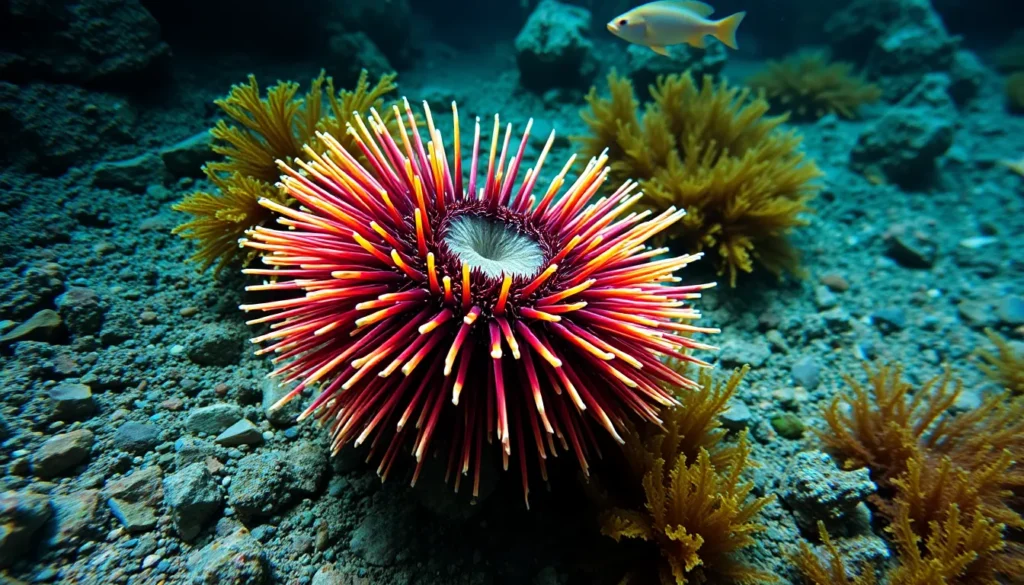
- Sea urchins have spiny exteriors. Their hard shells, called tests, are covered with movable spines that protect them from predators and aid in locomotion.
- They belong to the class Echinoidea. Sea urchins are echinoderms, related to starfish and sand dollars.
- Sea urchins use tube feet for movement. These small, flexible appendages extend through the test and help them move and cling to surfaces.
- Their mouth is located on the underside. Sea urchins have a specialized jaw apparatus called Aristotle’s lantern, used for scraping algae and other food.
- Sea urchins come in various colors. They can be purple, red, green, black, or even multicolored depending on the species.
- They inhabit a wide range of marine environments. From shallow tidal pools to deep ocean floors, sea urchins adapt to various habitats.
- Sea urchins play a key role in controlling algal growth. By grazing on algae, they help maintain balance in coral reef and kelp forest ecosystems.
- Some species can live for several decades. Longevity varies, with some sea urchins living over 30 years in the wild.
- They have no brain but possess a decentralized nerve system. This allows them to respond to environmental stimuli without a central nervous system.
- Sea urchins reproduce by releasing eggs and sperm into the water. Fertilization occurs externally, and larvae undergo several developmental stages before settling.
- They are prey for various marine animals. Predators include sea otters, fish, and certain species of crabs and starfish.
- Sea urchin spines can sometimes be venomous. While not all species are venomous, some have spines that can cause painful wounds.
- They have been used as model organisms in developmental biology. Their embryos are transparent and develop outside the mother, making them useful for scientific studies.
- Sea urchins contribute to bioerosion. By grazing on coral and rock surfaces, they help shape marine habitats, although excessive grazing can damage reefs.
- Some sea urchins exhibit social behavior. Certain species aggregate in groups, which may offer protection or assist in feeding.
- Their gonads are considered a delicacy. Known as uni in Japanese cuisine, sea urchin roe is harvested and consumed worldwide.
- Sea urchins can regenerate lost spines. This regeneration helps them recover from injuries sustained in their environment.
- Climate change impacts sea urchin populations. Ocean acidification affects their calcium carbonate shells, potentially altering survival rates.
- Some species have adapted to deep-sea environments. These sea urchins live at depths exceeding 5,000 meters, demonstrating wide ecological adaptability.
- Sea urchins possess pedicellariae. These tiny pincer-like structures on their surface help remove debris and deter parasites.
- Their fossil record dates back hundreds of millions of years. Sea urchins have existed since the Ordovician period, showing evolutionary resilience.
Habitat and Behavior
Sea urchins inhabit marine environments worldwide, from intertidal zones to deep ocean floors. They prefer rocky substrates where they can cling with their tube feet and find food. Many sea urchins are nocturnal, grazing on algae or detritus under the cover of darkness to avoid predators. Their spines provide protection, but they also use pedicellariae to keep their bodies free from parasites and debris. Sea urchins move slowly and rely on their Aristotle’s lantern to scrape food from surfaces. Some species form dense populations, influencing the structure of benthic communities and the availability of resources.
Why This Animal Matters
Sea urchins are important ecological players in marine ecosystems. By grazing on algae, they prevent algal overgrowth that can smother coral reefs and kelp forests, promoting biodiversity and habitat health. Their bioerosion activities contribute to the natural reshaping of underwater landscapes. Sea urchins also serve as a food source for numerous predators, maintaining a balance in the food web. Economically, they are harvested for their edible gonads, supporting fisheries in various regions. However, changes in sea urchin populations can signal shifts in ocean health, making them indicators for environmental monitoring and conservation efforts.
Common Misconceptions
Misconception: Sea urchins are plants or stationary organisms.
Correction: Sea urchins are animals capable of movement, albeit slowly, using their tube feet and spines.
Misconception: All sea urchin spines are poisonous.
Correction: While some species have venomous spines, many sea urchins possess spines that are simply sharp but non-venomous.
Misconception: Sea urchins have brains.
Correction: Sea urchins lack a centralized brain; instead, they have a decentralized nerve ring that coordinates their movements and responses.
Misconception: Sea urchins are harmful to coral reefs.
Correction: Although overpopulation can lead to excessive grazing and reef damage, sea urchins generally help maintain reef health by controlling algae growth.
Misconception: Sea urchins only live in shallow waters.
Correction: Sea urchins inhabit a broad range of depths, from shallow tidal pools to deep-sea environments.
FAQ
Are sea urchins dangerous to humans?
Most sea urchins are not dangerous, but some species have sharp or venomous spines that can cause painful wounds. It is advisable to avoid direct contact.
How do sea urchins eat without a mouth?
Sea urchins have a mouth located on their underside equipped with Aristotle's lantern, a complex jaw apparatus that scrapes algae and other food from surfaces.
Can sea urchins regenerate lost parts?
Yes, sea urchins can regenerate lost spines and, to some extent, damaged tissue, helping them recover from injuries.


Leave a Reply