
Short Answer
21 Facts About Pipefish
- Pipefish belong to the family Syngnathidae. This family includes seahorses and sea dragons, characterized by their elongated bodies and tubular snouts.
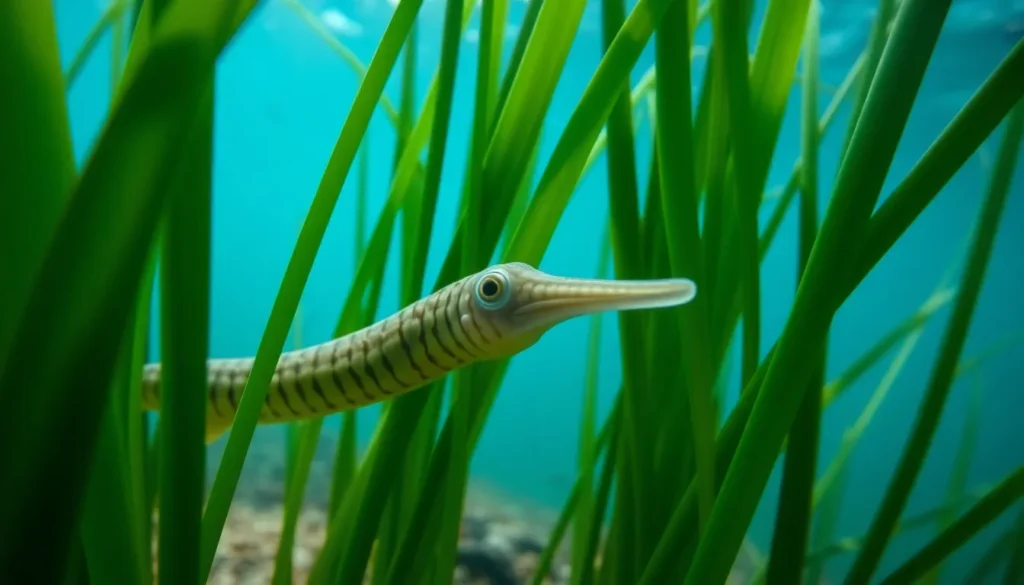
- They have long, slender bodies covered in bony rings. This rigid armor provides protection and distinguishes them from other fish.
- Pipefish possess a tubular snout used for suction feeding. They feed primarily on small crustaceans and plankton by sucking prey into their mouths.
- Most pipefish species exhibit male pregnancy. Males carry fertilized eggs in a brood pouch or attached to their bodies until hatching.
- Pipefish are generally poor swimmers. Their elongated bodies and small fins limit swimming speed, so they rely on camouflage to avoid predators.
- They exhibit a wide variety of colors and patterns. These adaptations help them blend into seaweed, coral, or seagrass habitats.
- Pipefish are found in shallow coastal waters worldwide. They inhabit environments such as seagrass beds, coral reefs, and estuaries.
- Some species can grow up to 40 centimeters in length. However, most pipefish are smaller, usually ranging between 10 and 30 centimeters.
- Their diet mainly consists of small crustaceans and planktonic organisms. They use their suction feeding technique to capture prey efficiently.
- Pipefish have fused jaws, forming a beak-like structure. This unique morphology aids in their specialized feeding method.
- They often swim upright, resembling sea grasses. This behavior enhances their camouflage against predators.
- Some pipefish species display sexual dimorphism. Males and females may differ in size, coloration, or brood pouch structure.
- Pipefish can be indicators of healthy marine ecosystems. Their presence often signals intact seagrass or coral habitats.
- They have a relatively low reproductive rate compared to other fish. This makes them sensitive to environmental changes and habitat degradation.
- Pipefish are preyed upon by larger fish, birds, and invertebrates. Their camouflage is a primary defense mechanism.
- They communicate through subtle body movements and color changes. This is particularly important during mating and brood care.
- Some species participate in cleaning symbiosis. They remove parasites from other fish, benefiting both parties.
- Pipefish have evolved independently in various marine habitats. Their diversity reflects adaptation to different environmental niches.
- They are sometimes kept in specialized marine aquariums. However, their care requires specific knowledge due to their dietary and environmental needs.
- Pipefish have a fossil record dating back to the Eocene epoch. This indicates their long evolutionary history over millions of years.
- Conservation efforts focus on protecting their habitats. Seagrass bed preservation is crucial for sustaining pipefish populations.
Habitat and Behavior
Pipefish inhabit a wide range of coastal environments globally, including seagrass meadows, coral reefs, estuaries, and sometimes brackish waters. These habitats provide ample shelter and feeding opportunities. Their elongated bodies and coloration enable them to blend seamlessly with aquatic vegetation or coral structures, which is essential given their relatively slow swimming speeds. Behavioral adaptations such as swimming in an upright position and mimicking the swaying of seagrass assist in camouflage. Pipefish feed predominantly on small crustaceans and plankton, using rapid suction feeding facilitated by their tubular snouts. Reproductively, male pipefish play a unique role by carrying fertilized eggs in specialized brood pouches or attached to their ventral surfaces until the offspring hatch. This male pregnancy is a distinctive trait within the Syngnathidae family. Pipefish tend to be solitary or form loose aggregations and rely on subtle visual cues for communication, especially during mating and parental care.
Why This Animal Matters
Ecologically, pipefish contribute to the balance of marine food webs by controlling populations of small invertebrates and serving as prey for larger predators. Their reliance on healthy seagrass beds and coral reefs makes them important bioindicators for the condition of these ecosystems. Culturally, pipefish have intrigued divers and marine biologists due to their unique reproductive strategies and morphological adaptations. From a conservation perspective, pipefish populations are vulnerable to habitat destruction, pollution, and climate change effects that degrade coastal environments. Protecting pipefish habitats aids broader marine conservation goals, supporting biodiversity and ecosystem resilience.
Common Misconceptions
Misconception: Pipefish are just smaller or less interesting versions of seahorses.
Correction: Although closely related, pipefish have distinct body shapes, behaviors, and ecological roles that differ significantly from seahorses, such as their elongated bodies and different swimming postures.
Misconception: Only female pipefish carry the offspring.
Correction: Male pipefish are responsible for carrying fertilized eggs during incubation, a rare reproductive trait in the animal kingdom known as male pregnancy.
Misconception: Pipefish are fast swimmers.
Correction: Pipefish are generally slow and rely on camouflage rather than speed to evade predators.
FAQ
What distinguishes pipefish from seahorses?
Pipefish have elongated, straight bodies and swim horizontally, whereas seahorses have curled tails and swim upright. Both belong to the same family but differ significantly in morphology and behavior.
How do male pipefish carry their offspring?
Male pipefish carry fertilized eggs either in a specialized brood pouch or attached externally along the ventral surface until the young hatch, providing protection and oxygenation.
What habitats do pipefish prefer?
Pipefish typically inhabit shallow coastal waters such as seagrass beds, coral reefs, and estuaries where they can camouflage effectively and find abundant prey.




Leave a Reply