
Short Answer
21 Facts About Seahorses
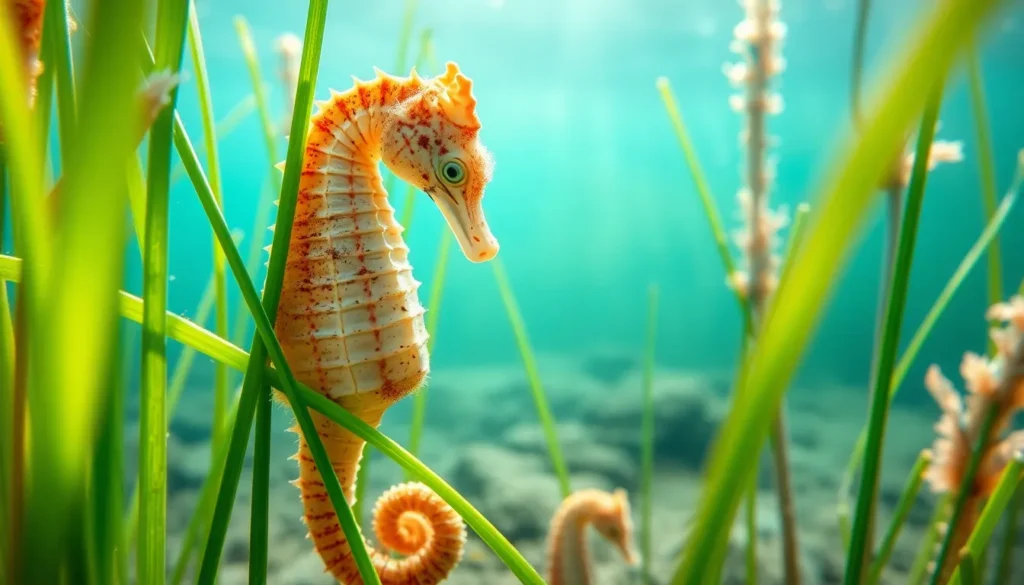
- Seahorses belong to the genus Hippocampus. The name Hippocampus comes from the Ancient Greek words for “horse” (hippos) and “sea monster” (kampos), reflecting their horse-like head.
- They have a prehensile tail. Unlike most fish, seahorses use their tails to grasp onto seagrasses and corals to anchor themselves in place.
- Seahorses swim upright. This vertical posture is rare among fish and contributes to their distinctive appearance.
- They lack scales. Instead, seahorses have a thin skin stretched over bony plates arranged in rings, providing a protective armor.
- Seahorses have a long snout. This snout functions like a straw, allowing them to suck in small prey such as plankton and tiny crustaceans.
- They are poor swimmers. Seahorses rely on the dorsal fin on their back, which rapidly oscillates, to propel them, while pectoral fins assist with steering.
- Seahorses have excellent camouflage abilities. They can change color to blend into their surroundings, helping avoid predators.
- Male seahorses are the ones that carry the eggs. Females deposit eggs into the male’s brood pouch where he fertilizes and incubates them.
- Pregnancy duration varies among species. Depending on the species and environmental conditions, gestation can last from 10 days to six weeks.
- Newborn seahorses are miniature versions of adults. They are independent immediately after birth and receive no parental care.
- Seahorses are monogamous. Many species form pair bonds that last through a breeding season or even for life.
- They use a unique mating dance. Partners often engage in synchronized swimming and color changes before mating.
- Seahorses have eyes that move independently. This allows them to scan for food and predators simultaneously.
- There are about 46 known species of seahorses worldwide. They vary in size, color, and habitat preference.
- Seahorses inhabit shallow tropical and temperate waters. They are commonly found in seagrass beds, coral reefs, and mangroves.
- Seahorses are carnivorous. Their diet consists mainly of small crustaceans like mysid shrimp and other tiny planktonic animals.
- They have a very limited swimming range. Seahorses typically stay close to their anchor points and are not strong migrators.
- Seahorses lack stomachs. Their digestion is rapid, requiring them to eat almost constantly to meet energy needs.
- They are sensitive to water quality changes. Pollution and habitat degradation significantly impact seahorse populations.
- Seahorses are listed on CITES Appendix II. This status regulates international trade to prevent overexploitation.
- They play a role in traditional medicine and aquarium trade. This has contributed to population pressures in some regions.
Habitat and Behavior
Seahorses are found in coastal waters worldwide, primarily in shallow areas such as seagrass beds, coral reefs, and mangrove forests. They prefer habitats that provide ample places to hold onto with their prehensile tails, ensuring stability in currents. Seahorses are solitary or found in small groups and rely on camouflage to avoid predators. Their slow swimming and upright posture make them vulnerable, so they remain close to their anchoring points. Their feeding behavior involves stealthily approaching prey and sucking it into their snouts. Reproductively, seahorses are notable for male pregnancy, where the male incubates fertilized eggs in a brood pouch until birth. They have relatively short lifespans, typically 1 to 5 years depending on species and environmental conditions.
Why This Animal Matters
Seahorses contribute to the health of coastal ecosystems by controlling populations of small crustaceans and other planktonic organisms. Their reliance on healthy seagrass beds and reefs makes them indicators of environmental quality. Culturally, seahorses have been symbols of strength and patience in various traditions and are popular in marine-related art and folklore. Conservation-wise, seahorses face threats from habitat destruction, pollution, and overharvesting for traditional medicine and the aquarium trade. Protecting seahorses helps preserve biodiversity and maintain balanced marine ecosystems.
Common Misconceptions
Misconception: Seahorses are fish that swim fast and travel long distances.
Correction: Seahorses are poor swimmers that move slowly and generally remain close to their habitat.
Misconception: Female seahorses carry and give birth to the young.
Correction: Male seahorses carry the fertilized eggs in a specialized brood pouch and give birth to live young.
Misconception: Seahorses have scales like other fish.
Correction: Seahorses have bony plates beneath their skin instead of scales.
Misconception: Seahorses can survive in any marine environment.
Correction: Seahorses require specific habitats such as seagrass beds and coral reefs, and are sensitive to environmental changes.
FAQ
Why do male seahorses carry the babies?
Male seahorses have a brood pouch where females deposit eggs. The male fertilizes and incubates the eggs in this pouch until the young are born, a unique reproductive adaptation among fish.
How do seahorses eat if they swim slowly?
Seahorses use their long snouts to suck in small prey like plankton and tiny crustaceans. They rely on stealth and camouflage rather than speed to catch food.
Are seahorses endangered?
While not all seahorse species are endangered, many face threats from habitat loss, pollution, and overharvesting. They are protected under CITES Appendix II to regulate international trade and prevent overexploitation.

Leave a Reply