
Short Answer
21 Facts About Animal Communication
- Animals use multiple communication modes. Many species employ combinations of vocalizations, body language, chemical signals, and even bioluminescence to convey messages.
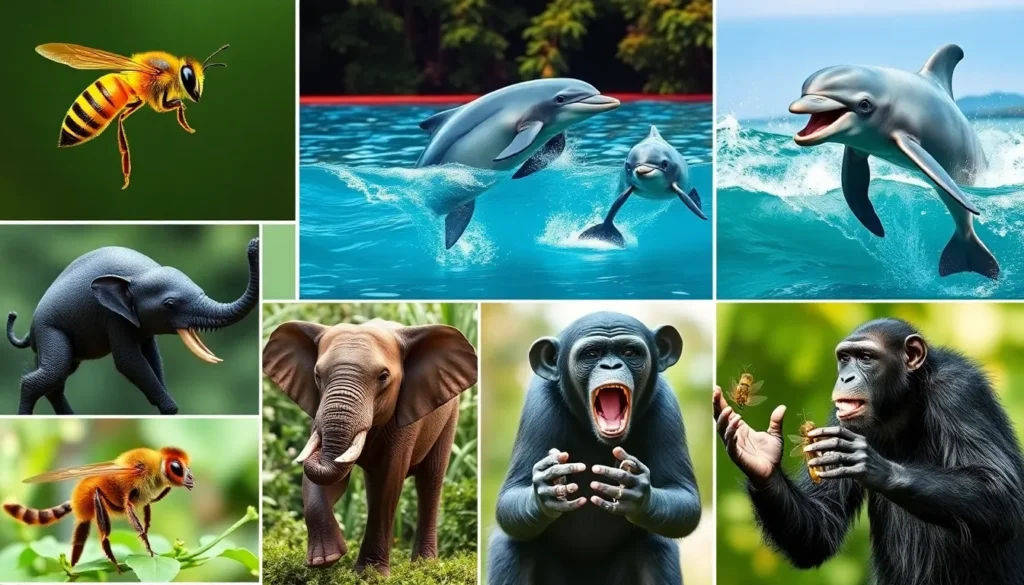
- Honeybees perform a waggle dance. Honeybees communicate the location of food sources to hive mates through a specific dance pattern that indicates distance and direction.
- Dolphins use signature whistles. Each dolphin has a unique whistle that functions like a name, allowing individual identification within social groups.
- Elephants communicate with infrasound. They produce low-frequency sounds below human hearing range that can travel several kilometers to coordinate group movements.
- Some animals communicate chemically. Ants, for example, use pheromones to mark trails, signal danger, or identify colony members.
- Birds have complex songs. Many bird species use intricate songs not only for mating but also to establish territories and communicate social status.
- Apes use gestures and facial expressions. Great apes such as chimpanzees and gorillas rely on a range of visual signals to express emotions and intentions.
- Whales produce songs. Certain whale species, like humpbacks, create long, structured songs that may serve purposes in mating or social cohesion.
- Fireflies use light signals. These insects communicate through specific patterns of bioluminescent flashes to attract mates.
- Octopuses change color. They rapidly alter skin color and texture to communicate mood, camouflage, or warnings to others.
- Prairie dogs have alarm calls. Their vocalizations can specify predator type, size, and speed, demonstrating a sophisticated communication system.
- Some frogs use vocal sacs. Male frogs inflate vocal sacs to amplify calls that attract females or deter rivals.
- Dogs use body language. Tail wagging, ear position, and posture all convey emotional states and intentions to other dogs and humans.
- Bees can perceive polarized light. This ability helps them navigate and may influence their communication dances.
- Seahorses engage in synchronized dances. These courtship behaviors involve coordinated movements and color changes.
- Many animals have learned communication abilities. Parrots and some primates can mimic human speech or use symbols to communicate with humans.
- Communication can be context-dependent. Signals may change meaning depending on social situation, environment, or individual relationships.
- Animal communication often serves survival. Warning calls, mating signals, and territory defense are critical for species continuation.
- Some animals eavesdrop on others. Certain species listen or watch signals from competitors or predators to gain advantages.
- Communication evolves over time. Animal signaling systems can adapt due to environmental pressures or social complexity.
- Research on animal communication informs human language origins. Studying animal signaling helps scientists understand the evolution of complex communication systems, including human language.
Habitat and Behavior
Animal communication occurs across diverse habitats—from terrestrial environments like forests and grasslands to aquatic settings such as oceans and freshwater systems. Communication methods vary according to ecological context, sensory abilities, and social structures. For example, aquatic mammals like whales and dolphins rely heavily on sound due to limited visibility underwater, while forest-dwelling birds use complex songs suited to dense vegetation. Social animals tend to develop more elaborate communication systems to maintain group cohesion, coordinate activities, and establish hierarchies. These behaviors are essential for finding mates, avoiding predators, and navigating their environments effectively.
Why This Animal Matters
Understanding animal communication is crucial for conservation efforts, as it provides insights into species’ social dynamics and needs. Effective communication often underpins reproductive success and survival, so disruptions—such as noise pollution or habitat fragmentation—can have detrimental effects. Additionally, animal communication studies contribute to broader ecological knowledge, informing how species interact within ecosystems. Culturally, many societies value animals for their communicative behaviors, which inspire art, literature, and scientific curiosity. Furthermore, research in this field aids in developing better human-animal interactions, improving welfare in domesticated and captive species.
Common Misconceptions
Misconception: Animals communicate only through sounds.
Correction: While vocalizations are common, animals also use visual signals, chemical cues, tactile interactions, and other modes to communicate.
Misconception: Animal communication is simple and instinctual.
Correction: Many animals exhibit complex, learned, and context-dependent communication that can involve syntax-like structures and symbolic elements.
Misconception: Only humans have language.
Correction: Although human language is uniquely complex, many animals demonstrate sophisticated communication systems with elements comparable to language features.
Misconception: Animals communicate only for mating or territorial purposes.
Correction: Communication serves multiple functions including social bonding, predator warnings, navigation, and cooperation.
Misconception: Animal signals always have fixed meanings.
Correction: The meaning of signals can vary based on context, individual relationships, and environmental factors.
FAQ
How do animals communicate without vocal sounds?
Many animals use visual signals such as body language and color changes, chemical signals like pheromones, tactile communication through touch, and bioluminescent flashes for communication without vocal sounds.
Why is studying animal communication important?
Studying animal communication helps scientists understand social structures, mating behaviors, survival strategies, and the evolution of communication, including insights relevant to human language development.
Can animals understand human language?
While most animals cannot understand human language fully, some species like parrots and certain primates can learn to recognize and use human words or symbols to communicate basic ideas.


Leave a Reply