
Short Answer
21 Facts About Proboscis Monkeys
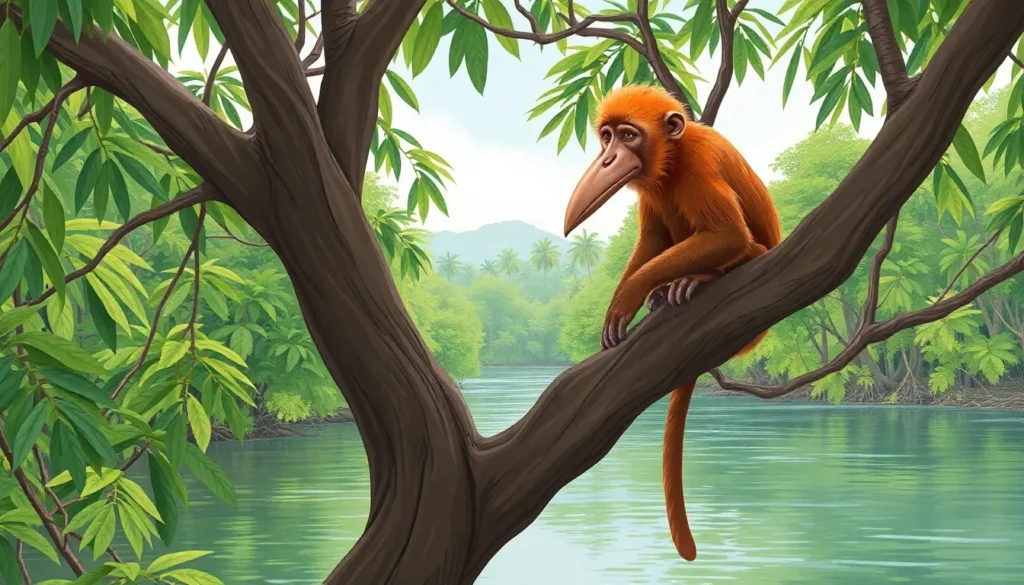
- Distinctive Large Nose: Male proboscis monkeys are known for their large, pendulous noses, which can exceed 10 cm in length and are believed to amplify vocalizations and attract mates.
- Endemic to Borneo: These primates are found exclusively on the island of Borneo in Southeast Asia, inhabiting coastal mangroves, riverine forests, and lowland rainforests.
- Scientific Name: Their scientific name is Nasalis larvatus, which reflects the prominent nasal feature.
- Sexual Dimorphism: Males are significantly larger than females, weighing up to 20 kg compared to females at around 10 kg, and their nose size is a clear sexual dimorphic trait.
- Diet Mainly Folivorous: Proboscis monkeys primarily eat leaves, unripe fruits, and seeds, relying on a specialized stomach to ferment and digest tough plant materials.
- Excellent Swimmers: They are strong swimmers, often crossing rivers and mangrove channels, aided by partially webbed feet and hands.
- Social Structure: They live in groups typically consisting of one dominant male, several females, and their offspring, though all-male bachelor groups also occur.
- Communication: Their vocal repertoire includes honks, grunts, and roars, which help maintain group cohesion and signal alarm.
- Conservation Status: Classified as Endangered by the IUCN due to habitat loss, hunting, and fragmentation of their forest environments.
- Unique Nose Function: The male’s nose is thought to serve as a resonating chamber, enhancing calls to intimidate rivals or attract females.
- Crucial Role in Ecosystems: Their feeding habits help in seed dispersal and maintaining forest health.
- Reproductive Behavior: Females give birth to a single infant after a gestation of about 166 days, with young monkeys developing strong swimming skills early.
- Locomotion: They are arboreal quadrupeds, moving skillfully through trees but also travel on the ground when necessary.
- Predators: Natural predators include crocodiles, clouded leopards, and large snakes.
- Adaptations to Mangroves: Their digestive system is adapted to detoxify the tannins and alkaloids found in mangrove leaves.
- Lifespan: In the wild, proboscis monkeys typically live around 13 to 15 years.
- Threat from Humans: Logging, palm oil plantations, and hunting have drastically reduced their habitat and populations.
- Distinctive Coloration: Their fur is reddish-brown with lighter underparts, aiding camouflage among foliage.
- Group Size Variation: Group sizes vary but typically range from 10 to 30 individuals.
- Scientific Research: They have been subjects of behavioral and ecological studies due to their unique adaptations and conservation status.
- Symbol of Borneo Wildlife: They represent an iconic species of Borneo’s biodiversity and are featured in conservation efforts and ecotourism.
Habitat and Behavior
Proboscis monkeys inhabit the mangrove forests, riverine forests, and lowland rainforests of Borneo, primarily favoring areas close to water sources. Their arboreal nature enables them to navigate the canopy in search of food, but they are also comfortable swimming across rivers and mangrove channels, a rare skill among primates. Socially, they live in one-male groups or all-male bachelor groups, maintaining a complex social hierarchy. Communication through vocalizations and physical displays is vital for group cohesion and territory defense. Their diet consists mainly of leaves, fruits, and seeds, which they digest with the aid of a multi-chambered stomach adapted for fermenting fibrous plant material.
Why This Animal Matters
Proboscis monkeys are important ecological players in their habitats by aiding seed dispersal and contributing to the health of mangrove and riverine ecosystems. Their unique adaptations, such as specialized digestion and swimming ability, provide insight into primate evolution and ecological niches. Culturally, they are emblematic of Borneo’s rich biodiversity and are often highlighted in conservation initiatives. Protecting proboscis monkeys also helps preserve the larger ecosystems they inhabit, which are under threat from deforestation and human encroachment.
Common Misconceptions
Misconception: The large nose of the proboscis monkey is a hindrance to its survival.
Correction: The male’s large nose actually plays a role in amplifying vocal calls and attracting mates, making it an important evolutionary trait rather than a disadvantage.
Misconception: Proboscis monkeys are solitary animals.
Correction: They are social primates that live in groups, which can include one dominant male with females and offspring or all-male bachelor groups.
Misconception: Proboscis monkeys only live in one type of forest.
Correction: While they favor mangrove and riverine forests, they also inhabit lowland rainforests and are adaptable to various forest environments near water.
Misconception: Proboscis monkeys are not good swimmers.
Correction: They are strong swimmers, using partially webbed feet and hands to cross rivers and mangrove channels regularly.
Misconception: Their conservation status is stable.
Correction: Proboscis monkeys are classified as Endangered due to habitat loss, hunting, and fragmentation, requiring ongoing conservation efforts.
FAQ
Why do male proboscis monkeys have large noses?
Male proboscis monkeys have large noses that serve to amplify their vocalizations, which helps in attracting females and intimidating rival males during mating season.
Where are proboscis monkeys found?
Proboscis monkeys are endemic to the island of Borneo, where they inhabit mangrove forests, riverine forests, and lowland rainforests.
What is the conservation status of proboscis monkeys?
They are classified as Endangered by the IUCN due to threats like habitat loss, hunting, and forest fragmentation.


Leave a Reply