
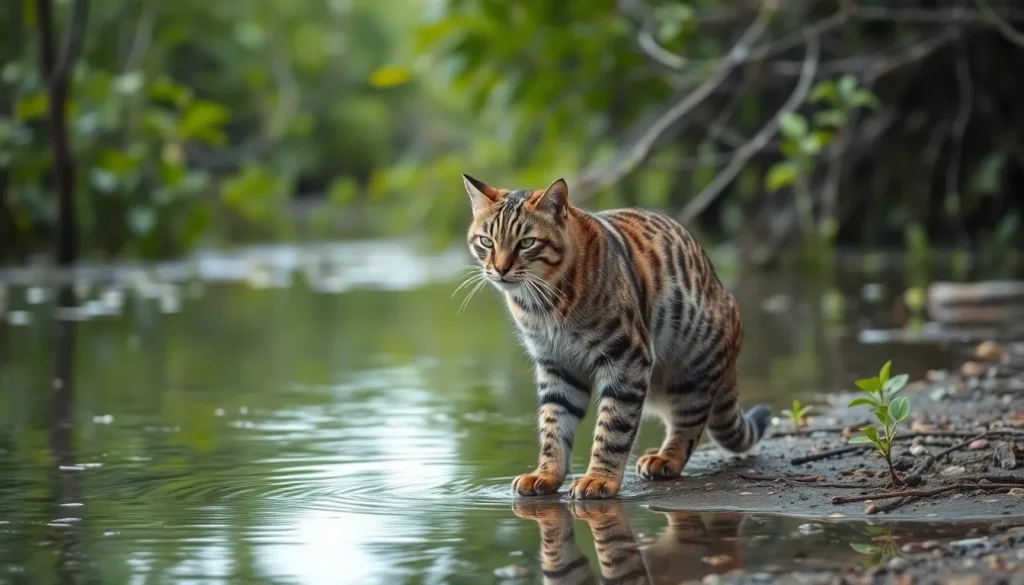
Short Answer
21 Facts About Fishing Cats
- Fishing cats are medium-sized wild cats. They typically weigh between 5 to 16 kilograms (11 to 35 pounds), making them larger than domestic cats but smaller than big cats like leopards.
- They have webbed feet. Their partially webbed toes aid in swimming and catching fish, a unique trait among felids.
- Fishing cats are excellent swimmers. Unlike many other cat species, they are comfortable in water and frequently enter water bodies to hunt.
- Their diet includes a significant amount of fish. They are named for their skill at catching fish, which forms a large part of their diet along with frogs, crustaceans, and small mammals.
- They inhabit wetland areas. Fishing cats are commonly found in mangroves, marshes, and riverine forests across South and Southeast Asia.
- Fishing cats have a distinctive coat pattern. Their fur is marked with dark spots and stripes, providing camouflage in their natural habitat.
- The species is nocturnal and crepuscular. They are most active during the night and at dawn or dusk.
- They are solitary animals. Fishing cats typically live and hunt alone, only coming together for mating.
- Fishing cats communicate through vocalizations, scent marking, and visual cues. They use growls, meows, and purrs to communicate with conspecifics.
- The gestation period for fishing cats is around 63 to 70 days. Females usually give birth to litters of two to four kittens.
- They have strong, muscular bodies. This physical build supports their ability to swim and capture slippery prey.
- Fishing cats possess sharp retractable claws. These claws help them grip slippery fish and climb trees.
- Their eyes have vertical slit pupils. This adaptation improves night vision for hunting in low-light conditions.
- They are vulnerable due to habitat loss. Wetland drainage and deforestation threaten their populations.
- Fishing cats are listed as Vulnerable by the IUCN. Their numbers are declining due to human encroachment and poaching.
- They can swim long distances. Fishing cats have been observed swimming across rivers and even in tidal waters.
- These cats are known to use their paws to scoop fish out of water. This hunting technique is unusual among felids.
- Fishing cats have a wide distribution but patchy populations. They range from eastern India and Bangladesh to Thailand, Malaysia, and Indonesia.
- Their presence indicates healthy wetland ecosystems. Because they rely on aquatic prey, fishing cats serve as indicators of environmental quality.
- They are rarely seen due to their elusive nature. Their secretive habits and dense habitats make direct observation difficult.
- Conservation efforts include habitat protection and research. Various organizations work to study and safeguard fishing cats and their habitats.
Habitat and Behavior
Fishing cats are typically found in wetland environments such as mangrove swamps, marshes, and along rivers and streams. Their distribution covers parts of South and Southeast Asia, including countries like India, Nepal, Sri Lanka, Bangladesh, Thailand, Malaysia, and Indonesia. These cats have adapted to a semi-aquatic lifestyle, showing remarkable proficiency in swimming and fishing, unlike most other felids. They are primarily nocturnal and crepuscular, hunting mostly at night or during twilight hours. Solitary by nature, fishing cats mark their territories with scent markings and communicate through vocalizations and body language. Their diet is diverse but dominated by aquatic prey like fish, frogs, and crustaceans, supplemented by small mammals and birds. The ability to swim and hunt in water gives fishing cats a unique ecological niche among wild cats.
Why This Animal Matters
Fishing cats play an important ecological role as predators in wetland ecosystems, helping to maintain balanced populations of fish and amphibians. Their presence is an indicator of healthy aquatic habitats, which are increasingly threatened by human activities such as urbanization, agriculture, and pollution. Additionally, fishing cats have cultural significance in some local communities, often featuring in folklore and traditional stories. Conservation of fishing cats also supports the preservation of wetland biodiversity as a whole. Due to their vulnerability from habitat destruction and fragmentation, fishing cats are a focus of conservation initiatives aimed at protecting wetlands and promoting coexistence between humans and wildlife.
Common Misconceptions
Misconception: Fishing cats mainly eat fish and nothing else.
Correction: While fish form a large part of their diet, fishing cats also consume frogs, crustaceans, small mammals, and birds, making their diet varied and opportunistic.
Misconception: Fishing cats are domesticated or easily kept as pets.
Correction: Fishing cats are wild animals with specialized habitat needs and behaviors; they are not domesticated and require conservation in their natural environments.
Misconception: Fishing cats are identical to other wild cats like leopard cats.
Correction: Although related, fishing cats have distinct adaptations such as webbed feet and a semi-aquatic lifestyle that differentiate them from other small wild cats.
Misconception: Fishing cats are abundant and not at risk.
Correction: Fishing cats are classified as Vulnerable due to habitat loss and fragmentation, with many populations declining across their range.
Misconception: Fishing cats avoid water like most cats.
Correction: Fishing cats are strong swimmers and often enter water to hunt, showing a unique affinity for aquatic environments among felids.
FAQ
What makes fishing cats unique among wild cats?
Fishing cats are unique because they have adaptations such as partially webbed feet and a strong affinity for water, enabling them to hunt aquatic prey like fish, which is uncommon among wild cats.
Where are fishing cats typically found?
Fishing cats are found mainly in wetland habitats across South and Southeast Asia, including countries like India, Bangladesh, Thailand, and Indonesia.
Are fishing cats endangered?
Fishing cats are classified as Vulnerable due to habitat loss, wetland degradation, and fragmentation, making conservation efforts critical for their survival.



Leave a Reply