
Short Answer
21 Facts About Tapirs
- Tapirs belong to the family Tapiridae. They are part of the order Perissodactyla, which also includes horses and rhinoceroses.
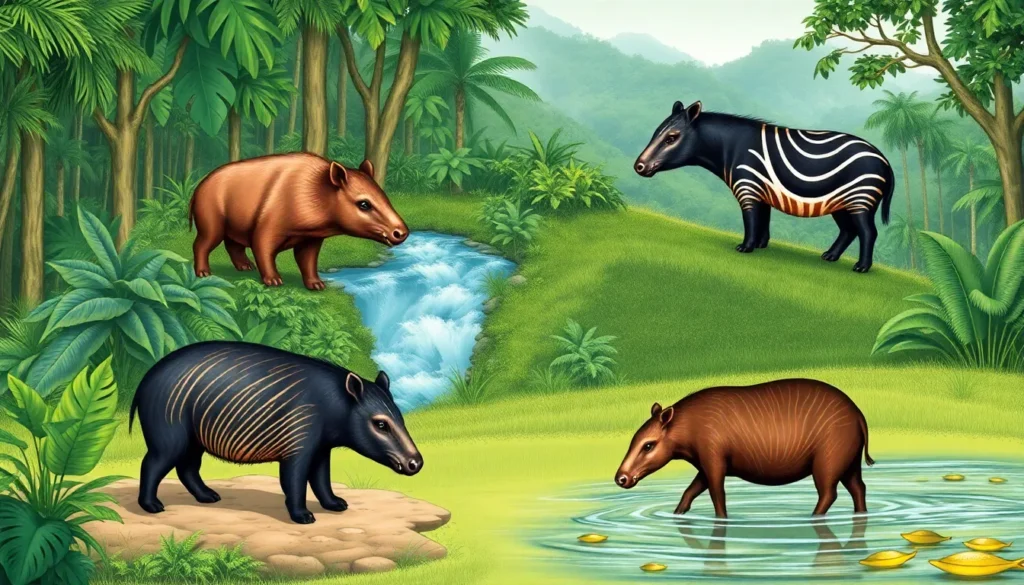
- There are four recognized species of tapirs. These are the Brazilian tapir, Malayan tapir, Baird’s tapir, and the mountain tapir.
- Tapirs have a distinctive prehensile snout. Their flexible upper lip and nose help them grasp leaves and fruit.
- They are primarily nocturnal. Tapirs are most active at night, which helps them avoid predators.
- Tapirs are excellent swimmers. They often enter water to cool down, evade predators, or find food.
- The Malayan tapir is the largest species. It can weigh up to 540 kg (1,190 lbs) and is notable for its black and white coloration.
- Tapirs have a relatively slow reproductive rate. Females typically give birth to a single calf after a gestation period of about 13 months.
- Young tapirs have striped and spotted coats. This camouflage helps protect them from predators in dense forest environments.
- Tapirs are herbivores. They primarily feed on leaves, twigs, fruits, and aquatic plants.
- The mountain tapir is adapted to colder, higher-altitude habitats. It has a thicker coat compared to other species.
- Baird’s tapir is the largest land mammal in Central America. It can grow up to 2 meters (6.6 feet) in length.
- Tapirs have poor eyesight but a strong sense of smell. Their sense of smell compensates for limited vision in dense forests.
- They play an important role as seed dispersers. By consuming fruits and excreting seeds elsewhere, tapirs help maintain forest biodiversity.
- Tapirs have existed for over 20 million years. Fossil records show their ancestors date back to the early Miocene epoch.
- They communicate through high-pitched whistles. This vocalization helps them maintain contact, especially between mothers and calves.
- Tapirs have a unique dental formula. Their teeth are adapted for grinding tough vegetation.
- All tapir species are considered vulnerable or endangered. Habitat loss and hunting have significantly reduced their populations.
- Tapirs can run surprisingly fast. Despite their bulky bodies, they can reach speeds up to 30 miles per hour (48 km/h) to escape predators.
- Their skin is thick and tough. This helps protect them from bites and scratches in dense underbrush.
- Tapirs have a solitary lifestyle. They generally live alone except during mating season or when a mother is raising her calf.
- Tapirs are sometimes called “living fossils.” Their primitive body plan has changed little over millions of years, providing insight into mammalian evolution.
Habitat and Behavior
Tapirs inhabit a variety of environments, including tropical rainforests, cloud forests, and grasslands, primarily in Central and South America, with one species, the Malayan tapir, native to Southeast Asia. They favor dense vegetation near water sources where they can feed and hide. Tapirs are generally solitary and nocturnal, using their excellent swimming abilities to evade predators and cool off. They rely heavily on their keen sense of smell to locate food and communicate. Their diet consists mainly of leaves, fruits, and aquatic plants, which they forage for both on land and in shallow water. Tapirs mark their territory with urine and communicate using high-pitched whistles.
Why This Animal Matters
Tapirs play a crucial ecological role as seed dispersers, helping to maintain the health and diversity of forest ecosystems. By consuming a wide range of fruits and vegetation, they contribute to plant regeneration and forest dynamics. Their presence indicates healthy, intact habitats. Culturally, tapirs have significance in indigenous folklore and are sometimes considered symbols of forest vitality. From a conservation perspective, tapirs are indicators of habitat quality and are vulnerable to threats such as deforestation, hunting, and habitat fragmentation. Protecting tapirs helps preserve broader biodiversity and ecosystem functions.
Common Misconceptions
Misconception: Tapirs are related to pigs.
Correction: Although tapirs resemble pigs in appearance, they are more closely related to horses and rhinoceroses as members of the order Perissodactyla.
Misconception: All tapirs have the same coloration.
Correction: Tapir species vary in coloration; for example, the Malayan tapir has a distinctive black and white pattern, while the Brazilian tapir is mostly brown.
Misconception: Tapirs are slow and defenseless.
Correction: Tapirs can run quickly and have thick skin that offers protection; they also use water to escape predators effectively.
Misconception: Tapirs are extinct or mythical animals.
Correction: Tapirs are extant mammals with several species currently living, though some are endangered.
FAQ
What do tapirs eat?
Tapirs are herbivores that primarily consume leaves, fruits, twigs, and aquatic plants, foraging mainly at night.
Where do tapirs live?
Tapirs are found in Central and South America, with the Malayan tapir inhabiting parts of Southeast Asia, usually in dense forests near water.
Are tapirs endangered?
Most tapir species are considered vulnerable or endangered due to habitat loss, hunting, and fragmentation, making conservation efforts important.



Leave a Reply