
Short Answer
21 Facts About Eels
- Eels belong to the order Anguilliformes. This order includes about 800 species of elongated fish commonly referred to as eels.
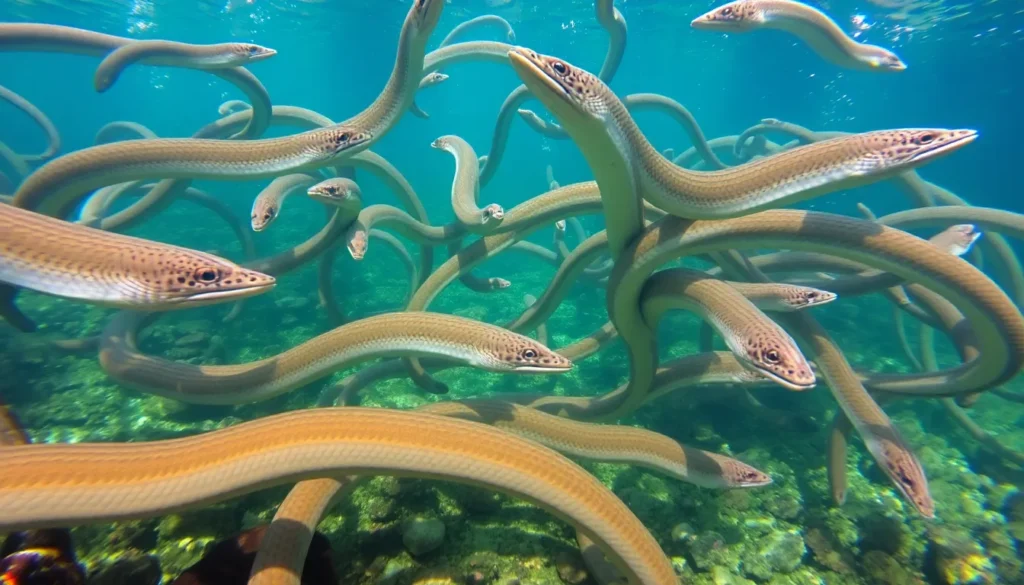
- They have snake-like bodies. Eels possess long, slender, and flexible bodies that enable them to navigate through narrow crevices and burrows.
- Most eels are carnivorous. Their diet typically consists of fish, worms, and crustaceans.
- Many eel species are catadromous. This means they live in freshwater but migrate to the ocean to spawn.
- The European eel has a remarkable migration pattern. It travels thousands of kilometers from European rivers to the Sargasso Sea to reproduce.
- Eels undergo a unique larval stage called leptocephalus. These transparent, leaf-shaped larvae drift with ocean currents before transforming into juvenile eels.
- Eels lack pelvic fins. This anatomical feature distinguishes them from many other fish species.
- The American eel also migrates to the Sargasso Sea. Similar to the European eel, it completes a long-distance spawning migration.
- Electric eels can produce electric shocks. The electric eel, native to South America, can generate up to 600 volts for hunting and self-defense.
- Not all eels are electric. Most eel species cannot produce electricity; the electric eel is a unique member of the knifefish family.
- Some eels can breathe through their skin. This adaptation allows them to survive in oxygen-poor waters for short periods.
- Eels have a high fat content. This makes them an important food source in various cultures.
- Eels are nocturnal hunters. They often hunt at night, using their keen sense of smell to locate prey.
- Eels can navigate using the Earth’s magnetic field. Studies suggest they use geomagnetic cues during migration.
- Eels play a significant ecological role. They help maintain the balance of aquatic ecosystems by controlling populations of smaller fish and invertebrates.
- Some eel species burrow into mud or sand. This behavior provides protection from predators and environmental extremes.
- Eels have a long lifespan. Some species can live up to 20 years or more in the wild.
- Eel populations are declining. Overfishing, habitat loss, and barriers like dams threaten their survival.
- The Japanese eel is culturally significant. It is a traditional delicacy and symbol of stamina in Japan.
- Eels communicate using chemical signals. They release pheromones to attract mates or signal danger.
- The exact spawning locations of some eels remain partially mysterious. Despite extensive research, scientists still seek to fully understand their reproductive behaviors.
Habitat and Behavior
Eels inhabit a variety of aquatic environments, ranging from freshwater rivers and lakes to marine coastal waters and deep oceans. Many species prefer murky, slow-moving, or sheltered waters where they can hide among rocks, vegetation, or sediment. Eels are generally nocturnal, emerging at night to hunt and feed on smaller fish, crustaceans, worms, and other invertebrates. Their elongated bodies allow them to burrow or slip into narrow crevices for protection and ambush hunting. Migration is a notable behavior for catadromous eels, which spend much of their lives in freshwater but undertake extensive oceanic journeys to spawn. These migrations involve complex navigation potentially aided by geomagnetic sensing.
Why This Animal Matters
Eels contribute significantly to aquatic ecosystems by regulating prey populations and serving as prey for larger predators. Their unique life cycles and migratory patterns are important for understanding ecological connectivity between freshwater and marine habitats. Eels also hold cultural and economic importance in many regions, particularly in Europe and Asia, where they are harvested for food and featured in folklore. Conservation of eel populations is critical due to their declining numbers, which reflect broader environmental challenges such as habitat fragmentation, pollution, and climate change.
Common Misconceptions
Misconception: All eels can generate electric shocks.
Correction: Only electric eels (genus Electrophorus) produce significant electric shocks. Most eel species cannot generate electricity.
Misconception: Eels are snakes.
Correction: Eels are fish with elongated bodies, not reptiles. They belong to the order Anguilliformes, distinct from snakes in the class Reptilia.
Misconception: Eels live only in saltwater.
Correction: Many eels live in freshwater environments for most of their lives, migrating to saltwater only to spawn.
FAQ
What is unique about the eel's life cycle?
Many eel species are catadromous, meaning they live in freshwater but migrate to the ocean to spawn. Their larvae drift in ocean currents before returning to freshwater, making their life cycle complex and unique among fish.
Can all eels produce electric shocks?
No, only electric eels, which are part of the knifefish family, can produce significant electric shocks. Most eels cannot generate electricity.
Why are eel populations declining?
Eel populations are declining due to factors such as overfishing, habitat destruction, water pollution, and the construction of dams that block their migratory routes.





Leave a Reply