
Short Answer
21 Facts About Yeti Crabs
- Yeti crabs belong to the family Kiwaidae. They were first discovered in 2005 near hydrothermal vents in the South Pacific Ocean.
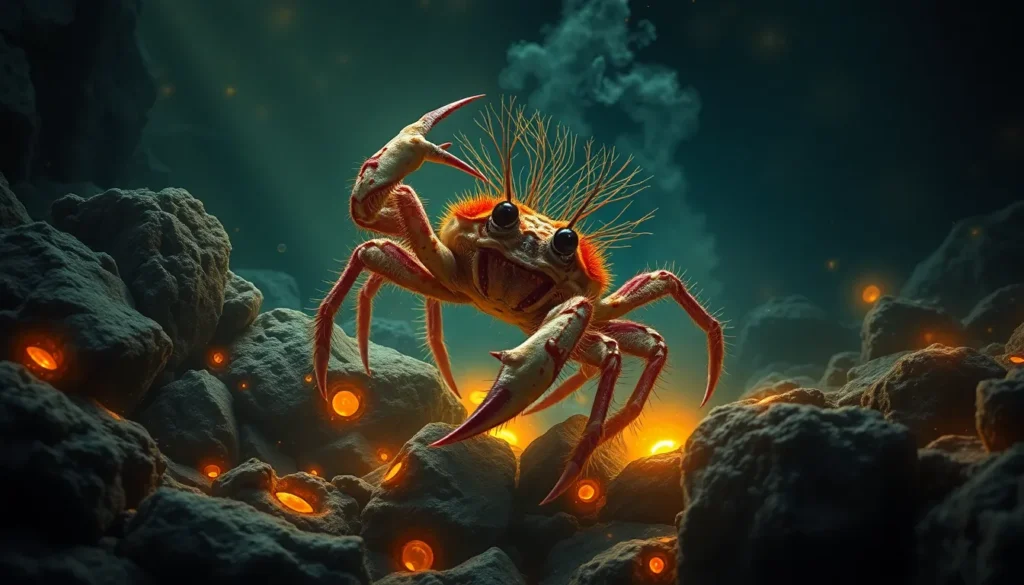
- They are named for their hair-covered pincers. The dense setae covering their claws resemble the fur of the mythical yeti.
- These setae contain bacteria. Yeti crabs cultivate bacteria on their pincers, which they may use as a food source.
- Yeti crabs inhabit extreme deep-sea environments. They are typically found near hydrothermal vents and cold seeps at depths exceeding 2,000 meters.
- They have reduced eyesight. Due to their deep-sea habitat, their eyes are either very small or absent, relying on other senses.
- Yeti crabs use their claws to harvest bacteria. They wave their hairy pincers in vent fluids to farm bacteria for nourishment.
- There are multiple species of yeti crabs. Notably Kiwa hirsuta, Kiwa puravida, and Kiwa tyleri are among the known species.
- Yeti crabs have a pale, almost translucent exoskeleton. This coloration is typical of deep-sea creatures living in darkness.
- They exhibit limited mobility. Their locomotion is adapted to the rugged terrain surrounding vents.
- Their discovery challenged previous assumptions. Before their finding, such unique crustaceans were unknown in hydrothermal vent ecosystems.
- Yeti crabs play a role in vent community ecosystems. Their bacterial farming contributes to nutrient cycling in these isolated environments.
- They possess specialized appendages. Their pincers and legs are adapted for clinging onto rocks in strong vent currents.
- Yeti crabs are part of a diverse vent fauna. They coexist with tube worms, vent shrimp, and other extremophiles.
- They are considered extremophiles. Adapted to survive high pressure, low light, and toxic vent chemicals.
- Their feeding strategy is symbiotic. The bacteria they cultivate may detoxify chemicals and provide nutrition.
- Yeti crabs have a slow reproductive cycle. Like many deep-sea species, reproduction and growth occur at slower rates.
- They are mostly discovered via submersibles. Remote operated vehicles have been essential for studying these deep-sea animals.
- Yeti crabs exhibit sexual dimorphism. Males and females can differ in size and claw morphology.
- Their setae vary in density among species. This variation may relate to differing environmental conditions.
- Yeti crabs contribute to scientific understanding of deep-sea life. Their unique biology helps researchers study adaptation to extreme habitats.
- They remain relatively understudied. Due to their remote habitat, many aspects of their biology and ecology are still unknown.
Habitat and Behavior
Yeti crabs are inhabitants of deep-sea hydrothermal vent systems, primarily located along mid-ocean ridges in the Pacific and Southern Oceans. These environments are characterized by extreme conditions including high pressure, near-freezing temperatures, and chemical-rich vent fluids. They thrive on rocky substrates near vents, where they use their hairy pincers to cultivate colonies of bacteria. This bacterial farming is an essential part of their survival strategy, compensating for the scarcity of other food sources in the deep ocean. Yeti crabs are adapted to cling tightly to rocks to withstand strong currents and vent emissions. Their reduced eyesight suggests reliance on tactile and chemical cues. These crabs exhibit relatively slow movement and reproduction, typical of deep-sea organisms. Interactions with other vent fauna are not well documented but they likely form part of a complex vent community ecosystem.
Why This Animal Matters
Yeti crabs are ecologically significant as members of hydrothermal vent communities, which are hotspots of biodiversity in the deep ocean. Their bacterial farming may contribute to nutrient cycling and offer insights into symbiotic relationships in extreme environments. Furthermore, their unique adaptations provide valuable information for scientists studying evolutionary biology and adaptation to harsh habitats. Understanding yeti crabs can also inform conservation efforts, as deep-sea vent ecosystems are increasingly threatened by human activities such as deep-sea mining. While not yet evaluated for conservation status, protecting these species helps preserve biodiversity and ecosystem function in one of Earth’s least explored frontiers.
Common Misconceptions
Misconception: Yeti crabs are related to the mythical yeti.
Correction: The name ‘yeti crab’ refers only to the crab’s hairy pincers that resemble fur. They have no relation to any mythical creatures.
Misconception: Yeti crabs are found in shallow waters.
Correction: Yeti crabs inhabit deep-sea hydrothermal vents, usually at depths greater than 2,000 meters, far below shallow ocean regions.
Misconception: Yeti crabs are aggressive predators.
Correction: Yeti crabs primarily farm bacteria on their pincers and are not known to exhibit aggressive predatory behavior.
FAQ
What are yeti crabs?
Yeti crabs are deep-sea crustaceans known for their hairy pincers and unique bacterial-farming behavior near hydrothermal vents.
Where do yeti crabs live?
They live on rocky substrates near hydrothermal vents in the deep ocean, typically at depths exceeding 2,000 meters.
Why do yeti crabs have hairy pincers?
Their pincers are covered with dense setae that harbor bacteria, which the crabs farm and likely use as a food source.
Leave a Reply