
Short Answer
21 Facts About Iguanas
- Diverse Species: There are over 45 species of iguanas, belonging to the family Iguanidae, found mainly in Central and South America, as well as the Caribbean.
- Herbivorous Diet: Most iguanas are primarily herbivores, feeding on leaves, flowers, and fruit, although some species may occasionally eat insects or small animals.
- Size Variation: Iguanas vary greatly in size; the Green Iguana can grow up to 6.5 feet (2 meters) in length, including the tail.
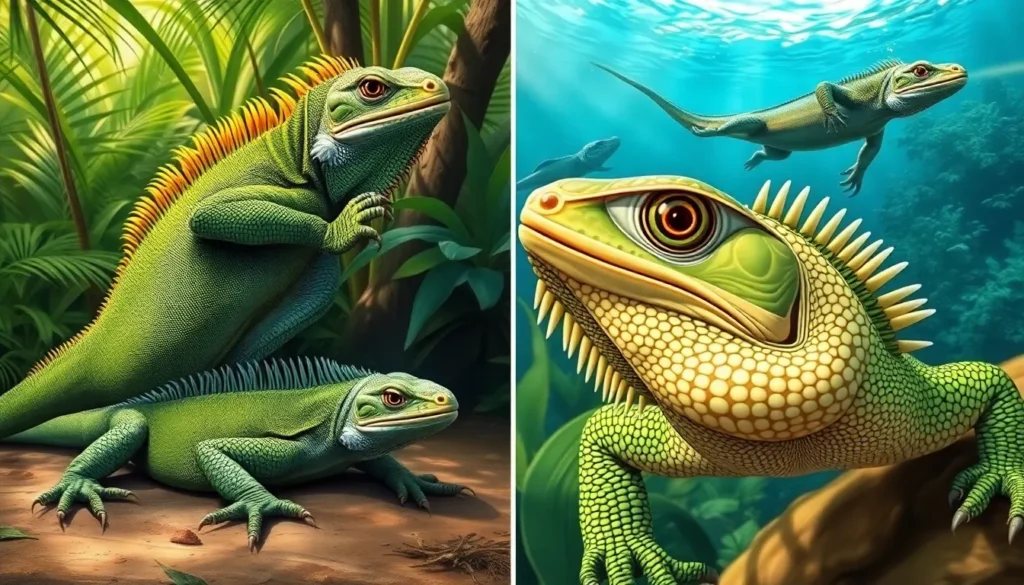
- Distinctive Dewlap: Many iguanas have a large, hanging flap of skin under their chin called a dewlap, used for communication and thermoregulation.
- Third Eye: Iguanas possess a parietal eye on top of their heads, which helps detect changes in light and shadow, aiding in predator detection.
- Tail Autotomy: Some iguanas can drop their tail to escape predators, a process known as autotomy, but unlike some lizards, their tails do not regenerate fully.
- Excellent Climbers: Iguanas are adept climbers and often live in trees, using their sharp claws and strong limbs to navigate branches.
- Temperature Regulation: Being ectothermic, iguanas rely on external heat sources like sunlight to regulate their body temperature.
- Strong Swimmers: Certain iguana species, like the Marine Iguana of the Galápagos Islands, are strong swimmers and forage in the ocean.
- Marine Iguanas: The Marine Iguana is unique among lizards for its ability to dive and feed underwater on algae.
- Reproductive Behavior: Iguanas lay eggs, with clutch sizes varying by species; females often dig nests in sandy or soft soil to deposit eggs.
- Visual Communication: Iguanas use body postures, head bobs, and dewlap extensions to communicate with others, especially during mating or territorial displays.
- Longevity: In captivity, iguanas can live 15 to 20 years or more, though wild lifespans may be shorter due to predation and environmental factors.
- Color Changes: Some species can change color slightly based on mood, temperature, or health, aiding in camouflage or signaling.
- Predators: Natural predators include birds of prey, snakes, and mammals, with young iguanas being especially vulnerable.
- Conservation Status: Some iguana species are threatened or endangered due to habitat loss, hunting, and the pet trade.
- Ecological Role: Iguanas contribute to seed dispersal and vegetation control within their ecosystems.
- Cultural Significance: Iguanas have cultural importance in various indigenous communities and are sometimes featured in folklore and cuisine.
- Pet Trade: Iguanas are popular in the exotic pet trade, but they require specialized care and can be challenging to maintain as pets.
- Adaptations: Iguanas have evolved adaptations like sharp teeth for tearing plant material and powerful limbs for climbing and defense.
- Scientific Study: Iguanas are subjects of research in areas such as ecology, physiology, and evolutionary biology.
Habitat and Behavior
Iguanas primarily inhabit tropical and subtropical environments, including rainforests, deserts, and coastal regions. They are arboreal, spending much of their time in trees, but some species, such as the Marine Iguana, are adapted to coastal and marine habitats. Iguanas are ectothermic reptiles, so they depend on the sun to regulate their body temperature, often basking on rocks or branches. Behaviorally, iguanas are territorial and use visual signals like head bobbing and dewlap extension to communicate dominance or attract mates. They are mostly solitary animals except during breeding seasons. Their diet is mainly herbivorous, feeding on a variety of vegetation, although dietary habits can vary among species. Iguanas have keen vision and rely on sight over other senses. They also have strong claws and tails used for defense against predators.
Why This Animal Matters
Iguanas play a significant role in their ecosystems primarily as herbivores that help control plant growth and promote seed dispersal, contributing to the maintenance of healthy habitats. They are part of the food web, serving as prey for a variety of predators, which helps sustain biodiversity. Furthermore, some species hold cultural and economic importance for local human populations. Conservation efforts are important for protecting iguana species threatened by habitat destruction and over-collection. Studying iguanas also provides insights into evolutionary adaptations and ecological dynamics in tropical environments.
Common Misconceptions
Misconception: Iguanas are aggressive and dangerous pets.
Correction: While iguanas can defend themselves with their tails and claws, they are generally not aggressive if properly socialized and handled carefully. However, they require knowledgeable care and can be defensive if threatened.
Misconception: All iguanas can live in cold climates.
Correction: Iguanas are cold-blooded reptiles adapted to warm climates and cannot survive in cold environments without artificial heat sources.
Misconception: Iguanas are carnivorous.
Correction: Most iguanas are primarily herbivores, feeding on plants rather than meat.
Misconception: Iguanas can regenerate their tails like some lizards.
Correction: Unlike some lizard species, most iguanas cannot fully regenerate their tails once lost.
Misconception: All iguanas are marine animals.
Correction: Only the Marine Iguana species is adapted for life in the ocean; most iguanas are terrestrial or arboreal.
FAQ
What do iguanas eat?
Most iguanas are herbivores that eat leaves, flowers, and fruit, although some species may occasionally consume insects or small animals.
Can iguanas live as pets?
Iguanas can be kept as pets but require specialized care, including a proper diet, temperature regulation, and habitat setup to thrive.
Do iguanas bite?
Iguanas can bite if they feel threatened or provoked, but they generally avoid confrontation when possible.



Leave a Reply