
Short Answer
21 Facts About Ancient Egypt
1. Ancient Egypt was one of the longest-lasting civilizations in history.
Spanning over 3,000 years from around 3100 BCE to 30 BCE, Ancient Egypt maintained a complex and stable society along the Nile River, marked by remarkable cultural and technological achievements.
2. The Nile River was central to Egyptian life.
The annual flooding of the Nile provided fertile soil for agriculture, making it possible for Ancient Egyptians to sustain large populations and develop cities.
3. Pharaohs were considered divine rulers.
Egyptian kings, known as pharaohs, were believed to be gods on earth, mediating between the gods and the people to maintain order and harmony.
4. Hieroglyphics was the writing system used by Ancient Egyptians.
This complex system combined logographic and alphabetic elements and was primarily employed in religious texts, monumental inscriptions, and official records.
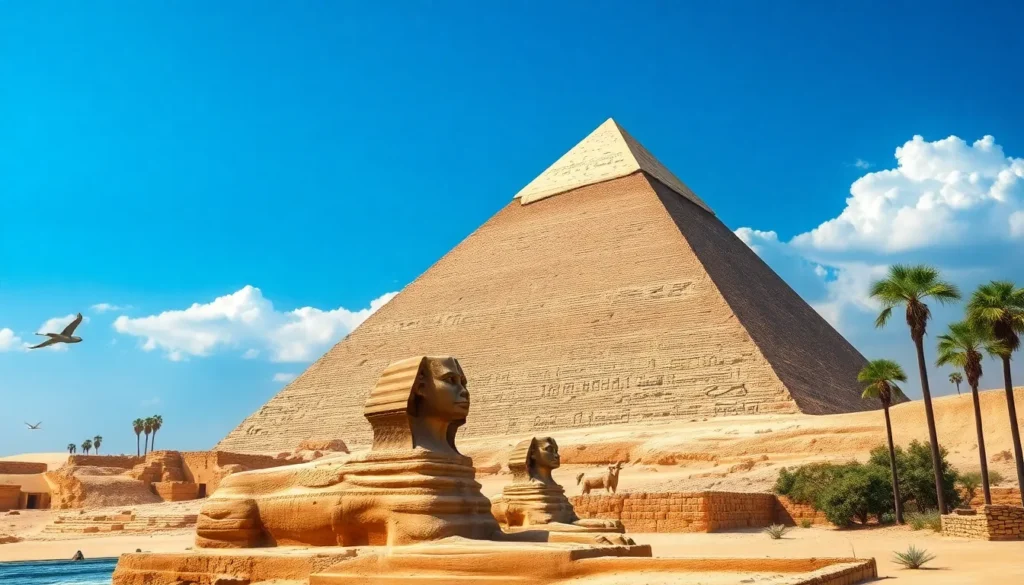
5. The Great Pyramid of Giza is one of the Seven Wonders of the Ancient World.
Built as a tomb for Pharaoh Khufu, it remains an architectural marvel due to its size, precision, and the mystery surrounding its construction techniques.
6. Mummification was practiced to preserve bodies for the afterlife.
Ancient Egyptians believed in an afterlife where the soul would live on, so they developed elaborate embalming methods to prevent decay.
7. Egyptian religion was polytheistic.
They worshipped numerous gods and goddesses, each representing natural and social elements, such as Ra (the sun god) and Isis (goddess of magic and motherhood).
8. Women in Ancient Egypt had notable legal rights.
They could own property, initiate divorce, and engage in business, which was more progressive compared to many other ancient societies.
9. The Rosetta Stone was key to deciphering hieroglyphics.
Discovered in 1799, it contained the same text in Greek, Demotic, and hieroglyphics, enabling scholars to finally understand Egyptian writing.
10. Ancient Egyptians made advances in medicine.
They practiced surgical techniques, developed medical texts, and used various herbal remedies, some of which influenced later medical knowledge.
11. The concept of zero was absent in Egyptian mathematics.
Although skilled in arithmetic and geometry, the Egyptians did not have a symbol or concept for zero as understood in modern mathematics.
12. Egyptian art followed strict conventions.
Figures were often depicted in a composite view combining profile and frontal perspectives to show the most recognizable features clearly.
13. The calendar developed by Egyptians was solar-based.
They created a 365-day calendar divided into 12 months of 30 days, with 5 extra days added, influencing later calendar systems.
14. The Sphinx is a famous monumental sculpture.
Located near the Great Pyramids, the Great Sphinx features a lion’s body and a human head, symbolizing strength and wisdom.
15. Ancient Egypt influenced Greek and Roman cultures.
Through trade, conquest, and cultural exchange, Egyptian ideas, art, and religious beliefs impacted Mediterranean civilizations.
16. Egyptian tombs were richly decorated with texts and images.
These decorations were meant to guide and protect the deceased in the afterlife, often including spells from the Book of the Dead.
17. The use of papyrus was an Egyptian innovation.
Papyrus, made from the papyrus plant, was used as an early form of paper for writing and record-keeping.
18. Ancient Egyptians built an extensive network of temples.
Temples served as religious centers and places for rituals, dedicated to gods and pharaohs, often beautifully decorated and architecturally complex.
19. Slavery existed but was less common than often assumed.
Most laborers were skilled workers, farmers, or conscripted peasants, with slaves primarily used in households or specific industries.
20. The Eye of Horus symbolized protection and health.
This ancient symbol was widely used as an amulet and in artwork to invoke safety and well-being.
21. The decline of Ancient Egypt began with foreign invasions.
Starting with the Assyrian and Persian conquests, followed by Greek and Roman rule, these invasions ended the independence of Ancient Egypt as a civilization.
History / Background
Ancient Egypt emerged around 3100 BCE with the unification of Upper and Lower Egypt under the first pharaoh, traditionally Narmer. Situated along the fertile banks of the Nile River, the civilization developed a rich cultural, religious, and political system. It is characterized by impressive architectural feats such as the pyramids, complex religious beliefs, and advances in writing, medicine, and governance. The civilization endured through various periods of stability and decline until it was ultimately absorbed into the Roman Empire in 30 BCE.
Importance and Impact
Ancient Egypt has had a profound influence on subsequent cultures and the modern understanding of early civilization. Its innovations in architecture, writing, and governance set foundations for later societies. The preservation of its monuments and texts allows contemporary scholars to study the development of human culture, religion, and technology. Additionally, Egypt’s art and symbolism continue to inspire modern aesthetics and popular culture worldwide.
Why It Matters
Studying Ancient Egypt provides valuable insight into how complex societies emerge and sustain themselves over millennia. Understanding their achievements and challenges helps contextualize the development of human knowledge in fields such as medicine, mathematics, and law. Moreover, the civilization’s focus on cultural legacy and the afterlife reflects universal human concerns about mortality and meaning, making it relevant to various disciplines today.
Common Misconceptions
All Egyptians were slaves.
Slavery was limited; most labor was done by peasants, skilled workers, or conscripted citizens.
The pyramids were built by slaves.
Evidence suggests skilled laborers and seasonal workers constructed the pyramids under organized conditions.
Egyptian gods are identical to Greek or Roman gods.
Although some gods share attributes, Egyptian deities are distinct with unique roles and mythologies.
Hieroglyphics were purely symbolic and impossible to understand.
The discovery of the Rosetta Stone enabled scholars to decipher hieroglyphics as a complex writing system.
FAQ
What was the primary purpose of the pyramids?
The pyramids, especially the Great Pyramid of Giza, were constructed as tombs for pharaohs to protect their bodies and possessions for the afterlife.
How did Egyptians use the Nile River?
The Nile's annual flooding deposited fertile soil used for agriculture, supported transportation, and was central to religious life.
What role did religion play in Ancient Egypt?
Religion permeated all aspects of Egyptian life, influencing governance, art, burial practices, and daily rituals, centered on a pantheon of gods and beliefs about the afterlife.




Leave a Reply